PNTV: Bounce by Matthew Syed (#270)
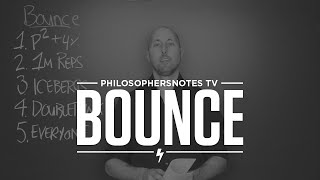
Matthew Syed argues that visible talent is an iceberg. Andre Agassi hit a million practice balls. The real skill is deliberate practice stretched 4% beyond comfort, plus the mental flexibility to switch between doubt and confidence.
Chapters
Hi, this is Brian. Welcome back to Philosopher's Notes TV Today. Another great book, Bounce by Matthew Syed. Bounce Subtitle Mozart, Federer, Picasso, Beckham and the Science of Success. Fantastic book. I just profiled Matthew's other book, Black Box Thinking which is his newest book. I interviewed him last week and I read this book and the other one as I mentioned in that video, in about a 72 hour period of time. He's a fantastic writer, a former Olympic table tennis player. He was the number one rated ping pong player in England for a decade. He's now an award winning sports journalist for the London Times for the Times in London. And this book is awesome. Bunch of big ideas. We're going to cover five of my favorite ones. Now this is in the same genre as Talent is Overrated the Talent Code Mindset Outliers by Gladwell. We have a growing collection. I'll put a link below. Really enjoyed Matthew's perspective. I'm excited to interview him about this book as well. So first big idea P2 plus 4% purposeful practice. He talks a lot about Erickson, whose research revealed the fact that greatness, excellence, world class performance is not a function of inborn talent.
Right?
This whole book is about dispelling the myth of inborn talent as a theory of excellence and replacing it with a practice theory of excellence. You might have an amazing genetic disposition that gives you a shot at doing something extraordinary, or you may not. Either way, deliberate, purposeful practice, as Matthew describes it, is absolutely essential if you want to reach your potential. Period. Purposeful practice. We've talked about it in the context of 4%, right? In the Rise of Superman by Steven Kotler. Getting into flow and pushing yourself in that kind of growth zone. The incremental growth that you want to see via purposeful practice only occurs when you're willing to stretch out of your comfort zone into your stretch zone, but not so far that you go into your snap zone. Right? He said that's 4%. You want to move in between. Here's Boredom, where your skills are really high and the challenge is low. Here. Here's Anxiety, where the challenge is really high and your skills are really low.
Right?
You want to be in flow, where your skills match the challenges by a little bit less. You want to be 4% stretched into that next realm of performance. That's our first big idea. P2 plus 4% second big idea is 1 million reps. He tells the story of Andre Agassi, who in his autobiography, which I'm excited to read called Open, Matthew tells Us. He shares the story of when he was a child and his father said that he believed in the logic of math as it relates to excellent performance. And he told his son, young little Andre, if you hit 2500 balls a day, that's about 17,500 shots, repetitions a week, and that's approaching a million balls that you would hit over the course of a year. And his dad told him, any kid that hits a million balls a year is unbeatable. The logic, the math of expertise, of practice, we need to be willing to put in the reps. Dan Coyle in the Little Book of Talents says repetitions has a bad reputation. The idea of putting in your reps has a bad rep, and it's unfortunate, Dan Coyle says, and Matthew Syed says, and all these other great teachers and writers tell us, because repetition is the only way we're going to cultivate skill. It's the only way we're going to rewire our brains in such a way that we can perform at a high level. And that doesn't matter whether we're talking about tennis or optimal living. I deliberately repeat myself again and again and again for myself and for you, so we can drill this more deeply into our consciousness and actually practice it more and more and more. So remember 1 million balls. Remember a million reps of young Andre Agassi and the unbeatable energy of that. The third big idea is icebergs. And Matthew tells us the fascinating, absolutely fascinating story of Laszlo Polger, who was a Hungarian educational researcher who believed in the theory of practice leading to excellence in an era and in a community that didn't believe that. They believed that you either had it or you didn't. You were born with it or not. And he wanted to disprove that theory and prove that greatness is made world class. Performance excellence is made via practice. So long story a little shorter. And he goes off on it in the book. The book is worth it just for this story. This guy Laszlo finds a Ukrainian woman who agrees to run a grand experiment to see if together they can create world class performers, right? And they have their first daughter, they have a second and a third, and they decided to train them in chess because it has an absolutely clear standard of performance, the scoring, the ranking. In chess, you're either the best or you're not. So his theory would either work or it wouldn't. Could he produce world class chess players with his wife or not? Enter the experiment and enter the results. He crushed it. It was incredible. Crazy, actually. His three daughters, the first became, I think, the first female grandmaster ever. The second one did her own extraordinary things. The third one became the youngest grandmaster ever and is the best female chess player ever. The stories are just crazy. And how did they do that? Well, when his five year old showed up at her first tournament and beat everybody easily, the local paper said, wow, a natural talent, a prodigy. A parent came up to Laszlo and said, you're so lucky that you had a kid that's so good. My kid could never do anything like that. They saw the tip of the iceberg, right? So if you have an iceberg and all you see is that when you see someone performing at a mesmerizing level, you miss the fact that there's a lot more going on below the surface. Right? There's our beautiful surface. So he laughed. Laszlo did. They didn't see how painstakingly he walked them through baby steps of just tiny incremental 4% improvement after 4% improvement that compounded over time, even before she was 5, that led to results. And then you continue doing that for years and decades. You do extraordinary things. And of course, in the book, he walks us through Mozart, Tiger Woods, Matthew jokes, the Tiger woods practiced more before the age of five than most golfers ever practiced their entire lives. Was he born with that ability or did it come through an incredible amount of effort and practice? Again, our decision on that is really important because if you think it was just because he was born that way and had magic fairy dust on it, you won't do the work to actually achieve excellence. We're going to talk about that a little bit more in a moment. But for now, remember icebergs. Anytime you see great performance, know that there's a lot more going on below the surface. In Black Box Thinking, he talks about David Beckham, who obviously Free Kick Master. He says, David does that. When people see his free kicks, they see the goals. When he thinks of free kicks, he thinks of all the mistakes in the 50,000 practice kicks he kicked as a kid and the countless hours he spent since then mastering his craft. Icebergs.
Look below the surface.
Double think is our fourth big idea. This is based on George Orwell's 1984 basic idea is Double Think. It's the ability to hold two contradictory ideas. Contradictory ideas in your mind as both true simultaneously, yet to be able to bury one and only use the one that actually is effective for you. And then when you need to bring the other one back and focus on that one, Double Think, holding two contradictory ideas in your mind simultaneously while burying One that's not useful and bringing it back when it is. So apparently when the book was written, people thought that was just implausible. And Matthew says it's actually commonplace. The best performers in the world are really good double thinkers. And he uses an example of Nick Faldo, who, great golfer who's won a ton of majors, who would basically say this is what he did before. He would step up to a shot, he'd analyze it, he'd bring a very rational mind and look at his shortcomings and weaknesses and potential failure and then decide what shot he was going to take. Right then he would forget that and he would just flip a switch and let it rip with absolute confidence that he's going to succeed. Never had any doubt. Double think. Holding both thoughts. It reminds me of Nassim Taleb's idea of anti fragility, the barbell strategy we've talked about before, where you're simultaneously super conservative and super aggressive. Double thinking. It's a really powerful tool. We need to be able to hold simultaneously contradictory beliefs and know when to use which one without getting deluding ourselves in the process. Really cool idea. Fifth big idea is the ultimate theme of the entire book, is that as we've already discussed a couple of times, our response to the question of what do you think leads to excellence? Is it inborn talent or is it effort? Your response to that question is really, really important because it's going to dictate how you show up in life. Because if you think that you either have it or you don't, it's inborn, fixed mindset, then you're never going to do whatever you can to improve. And I joke in the note that whenever I talk about these ideas of 10,000 hours and going after world class performance, I get two types of responses. One is the usually pretty, young and always super ambitious. Let's do it. Yeah, this is awesome. Let's go crush it. Tell me more. Right, then there's the other group, which is usually a little bit older, a little bit more conservative, a little bit less let's do it. And I'm a little bit more really 10,000 hours. I don't know about that. And the point that Matthew makes in the book and that I strive to make in all this work whenever I share these stories, is not that we should go after the 10,000 hours for ourselves, for our kids, necessarily, if that's your thing, go for it. But it's the simple fact that if you believe that effort leads to excellence over the long run, then whatever's important for you, you think you can improve. And whether that's just getting a little bit more happiness in your life or meaning or purpose or becoming a little better cook or athlete or entrepreneur or whatever. If you don't have a fixed mindset limiting you and you have a growth mindset and you believe you can get better, you're going to try a lot harder than if you don't think it's possible. So everyone has the capacity to get better and to get excellent. The question is, are we going to choose to see that and then put in the effort and willingly stretch ourselves, fall short and continue to grow as you do that, Think of Double think. Another way to double think is I can do it. I can grow. I can become excellent at whatever it is I want to become excellent at. And I can become great. And kind of like the Stockdale Paradox. It's going to be hard. I'm going to be free, James Stockdale said when he was falling into a prison camp. And it's going to take at least five years holding both Double Think Icebergs it's never as easy as the experts make it look. There's a ton of practice beneath the surface. Remember those three sisters whose awesome parents helped them create an extraordinary life for themselves as experts in chess? A million balls. 2,500 a day, 17,500 a week. Add that up, a million unbeatable. The key here again is reps. If we want to do something great, we need to take the time to put in the reps. What is it you want to do and are you putting in the necessary number of reps to build your skill? And then purposeful practice, AKA deliberate practice. That is a quick look at bounce. Hope you enjoyed. I'll be sharing an interview with Matthew soon and get the book. Look forward to sharing more. What was the idea that jumped out at you? How are you going to make it a bigger part of your life? Get on that and enjoy the process. See you. Hi, this is Brian.
I hope you enjoyed that PNTV episode.
A lot of people don't know all.
The stuff I do beyond these free videos I share on YouTube, so I thought I'd do a quick video to give you an overview of our membership program that you can get access to and get a ton of other stuff, so here's a quick look. 10 bucks a month Join the Optimal Living Membership Program. You get instant access to 250 philosopher's notes on some of the best Optimal Living books out there. Old school classics, Positive Psychology, Modern stuff, Mind peak performance, purpose, neuroscience, wealth, etc.
And what you may not know is.
That in addition to the PNTV episodes, I create PDFs on all these great books. So six page PDFs. Let's take a look at one of them. Joseph Campbell, you want to figure out how to live your hero's journey? Well, this is a great place to start.
I basically pull out my favorite big.
Ideas, riff on them, connect them to other books and other ideas and help you apply this wisdom to your life today. That's what the PDF looks like again. We have 250 of these on all these different great books. And then I record those PDFs as an MP3 so you can listen to that MP3 while you're on a walk or working out or doing some errands or whatever that is. Philosopher's Notes. A lot going on there.
And then in addition to Philosopher's Notes.
You get access to optimal living classes. Optimal Living 101 idea here is that all those great teachers come back to the same big ideas again and again and again. I distill those ideas into classes. Super practical, fun, inspiring classes ranging from Habits101, Confidence101, Getting Stuff Done101, Meditation101, instant access to all those classes and then Future classes include Relationships 101, Energy 101 Purpose 101 business goals, etc. Those are our full length classes. And then I create micro classes.
Two to three to five minute little.
Bursts of wisdom on my favorite great ideas from these great books across the domain that you want to optimize in your life. So we have dozens of these so far. I create 50 new micro classes every month and 10 new philosopher's notes every month for 10 bucks a month. So we're blessed to have thousands of members who are enjoying the program and sharing some incredibly kind words with us. And super simple. 10 bucks a month. Cancel anytime. We'd be honored to be a bigger part of your life and I appreciate your support. And here's to optimizing and actualizing.
More from Brian

Heroic +1: What’s THE Most Creative Act in the Universe?: Turning Around Glitches (#2024)









