PNTV: Breath by James Nestor (#410)
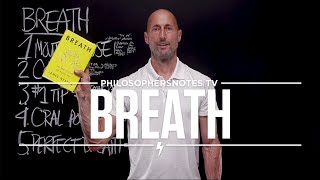
Brian Johnson summarizes and applies James Nestor’s book Breath, emphasizing the importance of nasal breathing, breathing less (to optimize CO2 and oxygen delivery), and specific practices to hack the nervous system. He recounts experiments (forced mouth-breathing at Stanford), personal anecdotes, and provides practical tips: nasal breathing, diaphragmatic (belly) breaths, longer exhales, oral posture (lips closed, tongue on roof — the “magic spot”), breathing rates (~4–6 breaths/min, James suggests 5.5), and sleep practices like mouth-taping.
Chapters
Hi, this is Brian. Welcome back to Philosopher's Notes tv. Today we've got another great book, Breath by James Nestor, subtitled the New Science of a Lost Art Breath. Thank you, James Nestor. James is a great writer for the New York Times, the Atlantic, etc. And this is a good book. So it was recommended to me by one of my dear friends, Zach. Thank you, Zach. And a number of our optimized community members who know that I'm a big fan of the science, art and science of breathing properly. So we've talked about it a lot over the years. We have a class, optimal living 101, class breathing 101. You can check all that out at Optimize Me Breathing. We have notes on a number of the best books on breathing. My favorite tied for this one now is the Oxygen advantage by Patrick McGown, who has become another friend and coach who's joined our optimized coach program as a luminary, sharing his best tips with our community. And we get a note right after he shared an idea. A woman who has suffered from asthma who happens to be named Asma. Very interesting. Hadn't made that connection before. Went out for a run in the morning before she listened to Patrick talk about this, right? Breathing properly. And then she went on another run after she got some tips from Patrick. We'll talk about some of this stuff today. And she had a completely different experience. She used to breathe through her mouth. She tried it through her nose and things changed. It was astonishing. Breathing is a big deal now. We may not think that we should have to study how to breathe. And the reality is we probably shouldn't have to. But our modern lives have changed a lot of things for the better. And some things, most of the fundamentals for the not so great, right? So we've got eating, moving and sleeping. Those should be obvious things. Yet as we've evolved, again, we've got a lot of advantages. But mastering our fundamentals is not one of the things that modern society has helped us out with. So here we go. We're going to study how to breathe properly. So James tells us this. We're going to take a breath right now. He says, no matter what you eat, how much you exercise, how skinny or young or strong you are, none of it matters if you're not breathing properly now again, we can go for weeks without food, days without water, but only minutes without oxygen. It's super important. It is the fundamental of all the fundamentals. And I will also say that my own life changed dramatically when I started practicing some of the stuff we'll talk about today. Breathing, less to breathe, right? Which sneak peek is the number one tip? After I learned this from Patrick, I started deliberately training my breath and I had systematically become more calm, etc. I used to be super anxious and just nervous about everything when I was younger, Right. As a kid. And that maintained itself even as I started meditating. I chipped away at that. It got less significant. And then I changed my diet. I got rid of some grains. For me, they did not work. Adapted more of a paleoesque diet, which I've continued to evolve and spiral up from. But that changed my mood and my calmness dramatically. Reducing some inflammation was amazing. But it was when I flipped the switch on breathing that things really started to change. It was actually astonishing. Which leads us perfectly to the first idea here. We want to hack our nervous system. So your nervous system has a sympathetic part to it, which is kind of the fight or flight. And then it has a parasympathetic aspect to the nervous system, which is more of a relaxed, calm, energized tranquility sort of place. Right. Fight or flight, energized tranquility, sympathetic parasympathetic. Guess what? What do you think the different breathing options we have, whether you breathe through your mouth or through your nose, is related to? Well, back in the day, the only time that we ever breathed through our mouth was when we were in, like, the most fight or flight situation imaginable. We needed to run at our max capacity, and then we switched from breathing through our nose to breathing through our mouth. Now, these days, most of us breathe most of the time through our mouth. Just James tells us that, like, 90% of us have breathing issues. So check in. Do you breathe through your mouth or do you breathe through your nose? If you snore or wake up with a dry mouth in the morning, those are good indications that you breathe through your mouth rather than your nose. Now, what's exciting is that when you learn to flip the switch and change your breathing the way that it's supposed to be, which is breathing through your nose, which we'll talk about today, things radically change. And again, we'll talk details on this. But James wanted to prove it. So he and a friend of his named Anders Olson, who wrote a great book called the Power of youf Breath that will feature soon, enjoyed that as well. Another leading breath guy, the two of them decided to do something crazy. They went to Stanford for the experiment, which is the first part of the book. The experiment was they had a Stanford surgeon plug up their nose surgically so they could only breathe through their mouths. They wanted to test it. What would it be like if we exclusively breathe through our mouths? And he says it was terrible. Fatigue, irritability, anxiety. Boom. Went straight up. He was shocked by how much he changed and how much Anders changed in the process. They pulled it out. Boom. I can breathe again.
This is awesome.
Mouth breathing is not a good idea if you are currently breathing through your mouth or your children are breathing through their mouth. We want to address this. And again, check out the book. He talks about the structural changes from all the soft food, the poor posture, et cetera. Literally, our mouths are shrinking. The wisdom teeth I had pulled out shouldn't have had to pull them out. My mouth should have been big enough to hold them. Same with yours, all the braces, all that stuff. Poor breathing goes in this vicious cycle downward. Really, really powerful stuff in there to consider. So. And again, we can hack our nervous system by training ourselves to breathe through our nose. We can flip the switch from that enervated anxiety fight or flight into the energized tranquility, calm, confidence, etc. But here's something we need to know. The problem is most people are breathing through their mouth, which means they're over breathing. So just as you can overeat, you can over breathe, which is why our number one tip is going to be to breathe less. But the reason why over breathing is a problem is that when you breathe too much, which again, most of us do. And we'll talk about the perfect breath count in a moment. What's interesting is that the issue is no longer oxygen per se. Your body has enough oxygen. It's carbon dioxide that needs to be optimized. So James walks us through the fact that we have 25 trillion, 25 trillion red blood cells. It's an astonishing number. 270 million hemoglobin are within each of those 25 trillion red blood cells, which is crazy to imagine. That's a lot of zeros. Now, within each of those 270 million hemoglobin, you have the space for four molecules of oxygen. He walks us through how it all works. So we all have enough oxygen in our red blood cells, in our hemoglobin. The question is, is the oxygen getting out of the hemoglobin into the tissues and organs that need it? And the way that it gets out, paradoxically, is not by breathing more, it's by breathing less and getting your carbon dioxide levels right. We talk about it in the Note we talk about it in breathing 101, but it's the presence of carbon dioxide that pushes the oxygen out of the hemoglobin. And if you're breathing too much, AKA through your mouth, you have enough oxygen in your body, but it's not getting out of the hemoglobin where it needs to go. And you're going to suffer from that because oxygen is the number one source of our energy. All healthy cells need oxygen to function. Asterisks. The only cells that don't need oxygen to function. Among the cells that don't need oxygen to function, cancer cells. They're anaerobic. Healthy cells need oxygen to function. James talks about the connection between poor breathing and chronic disease as well, and how you can help heal yourself in so many ways by learning how to breathe. Which leads us to in getting those carbon dioxide levels right. So if you can't take slow, deep, rhythmic breaths, it's because you can't currently tolerate carbon dioxide. We need to build that tolerance which will optimize the oxygen that's getting out of your hemoglobin into the places it needs to get. So the number one tip is to breathe less. And the number one way you do that. And again, think about it. We overeat as a culture now. Sounds weird, but. But we over breathe. You got to remember, your mouth is for eating, your nose is for breathing. How often should you eat? How often should you breathe out of your mouth? About as often as you eat through your nose, not very often. So three things we teach in breathing 101. Breathe in through your nose. We can practice right now. Breathe in through your nose, down into your belly or diaphragm. Nice and deep. Because most people breathe in through their mouth shallowly. And your lungs are architected in such a manner that you need to breathe deep to get the most oxygen in and get it out and into your body. So in through your nose, down into your belly, back out through your nose, creates a little more pressure than out your mouth through your nose and make your exhale slightly longer than your inhale. Again, hacking our nervous system. If you're in fight or flight, you aren't taking nice long exhales. You're taking your next breath as fast as you can. So when you take a nice long exhale, that's actually the fastest way to flip the parasympathetic. Relax. We're calm, we're confident, we're cool, everything's okay. Switch in through your nose, down into your belly, back out through your nose, slightly longer on the exhale. So let's do that right now. We'll practice. Move from theory to practice to master. Isn't that nice? The other day, in my number ones, the videos I do before I start my day or after I've started my day on what I'm learning and what I'm thinking about, I actually put a pulse oximeter on my finger that Patrick McGowan recommended I get. And we did some coaching with it, right? And we took one. I took one breath, I put it on, and I can get my resting heart rate to 40 overnight, blah, blah, blah. But during the day, you know, after training a little bit and being intense while talking, It'll be like 70 or whatever. One breath.
Boom.
It drops right down. You feel that cleansing power, the calming nature of a nice, gentle, relaxed breath to flip the switch, nervous system hack. That's our number one tip. And again, we go off on that in breathing 101. And in the Mastery series, it's one of our fundamentals. Eating, moving, sleeping, breathing, focusing, celebrating, prospering. Seven fundamentals. We spend considerable amount of time mastering this key skill. So fourth idea is oral posture. Oral posture. Yeah, oral posture. Got to get that right, too, right? So he goes off on this. Two simple things we want to keep in mind right now. You want to have a J shape to your body, not an S shape. So most people are looking at a smartphone. You know, they're kind of like hunched over like this all day, every day, right? Ah, think about that. Not good for the breathing. You just collapsed your diaphragm. You're definitely breathing in like this. You're losing your power. Science is unequivocal. When you hunch, you lose power, testosterone gets reduced. Cortisol goes up a little bit. Your breathing isn't where it should be. So rather than be an S, right, We want to be a J. I don't know what I was just doing there. Be a J. Be like a Greek statue, he says, have a nice curve to your spine. You're pulling that thread through your head, assuming that kind of superhero version of you. Optimus, best posture. Chest up, chin down, shoulders, a little back. Threads pulling through your head. Boom. Now we've got nice architecture to allow for deep breathing. Then the second part is. So you go from an S to a J. And the second part is you find what Patrick McGowan calls the magic spot in your mouth. First up, close your lips. Can't breathe through your mouth if your lips are closed. Anytime I see Emerson with his lips open. Or Eleanor, Magic Spot, guys, magic spot. And they immediately close their lips, they smile, and they put their tongue not against their front teeth, but on the roof of their mouth, approaching right before you get to your front teeth. Right there. Magic spot. You see it? Magic spot. Lips closed. Magic spot. You're breathing through your nose. Those are the two aspects of oral posture and asterisks here again. Check out this book for more on that. But Patrick McGowan has a great book for kids. In our last PNTV, we talked about Tom Rath's kids book, the Rechargeables. Awesome. Eating, Moving and sleeping. You want one for breathing? A fundamental book for your kids on breathing. Read Always Breathe correctly by Patrick McKeown. He's got a wizard in there that teaches kids how to find the magic spot. Breathe into their nose, down into their diaphragms, back out, et cetera. It's awesome. Oral posture. Who would have thought you'd be learning about oral posture in these episodes?
Here you go.
And then finally, we have the perfect breath. Now, there's a number of different perfect breaths out there, and we talk about a range of them in all of our notes. But the thing we want to know is that all of the great pulmonauts, those who are studying how to breathe.
Properly, which is what James called them.
Pulmonauts across all cultures and all time, are going to tell you, breathe less to breathe. Right now, the range will be somewhere between four and six breaths per minute. James goes with five and a half. We'll talk about it in a moment. Five and a half. Five and a half.
Five & a.
Half. But you also want to know that the longest lived mammals have the lowest resting heart rates, and the lowest resting heart rates come with the lowest respiration rate. You want to have a nice calm heartbeat. You need to have a nice, calm, rhythmic breath rate. Now, his suggestion is 5.5. 5.5, 5.5. Get out of stopwatch, time yourself. Practice this stuff. Inhale for 5.5, exhale for 5.5. That's going to be 5.5 seconds. I'm sorry, 5.5 breaths per minute. 5.5. 5.5. 5. 5. That's awesome. When I'm going to bed at night and when I'm meditating or doing a napitation or whatever, my breath count that I go for is six. Inhale, hold for one, exhale for eight, which gets me right around four breaths per minute. Again, there's a range here to find your coherent breathing pattern, which will radically optimize your heart Rate variability. That's the other thing that happened with me as I started optimizing my breath. My resting heart rate was optimized and my heart rate variability, which is a measure of your parasympathetic nervous system, your calmness, et cetera, will be optimized as well. So 5.5, 5.5, 5.5.
Is. James, perfect.
Breath. We've got our oral posture dialed in. Jay, give me a Greek statue. There we go. Boom. Magic spot, buddy. And then we've got the number one tip. Breathe less. In through your nose, down into your belly, back out through your nose. Remembering the carbon dioxide. It's a subtle point here, but it's the carbon dioxide that has to be optimized, paradoxically, in order to push the oxygen out of the hemoglobin. And again, different contexts, the class, etcetera, we talk about training with your mouth closed, taping your mouth at night, one of the most impactful practices I've engaged in. Emerson, Alexander and I all sleep with our mouth tape over our mouths, et cetera. And then finally eat through your mouth, breathe through your nose. Mouth breathing is not where it's at. Get on that, get your breath dialed in. James, thanks for the great book. And what was the idea for you that jumped out and.
Landed? How can you make it a.
More applied, practical part of your life today? Moving from theory to practice to mastery, which is the whole point of optimizing, so we can become the optimist, best version of ourselves in service to the world one breath at a time.
Today. Hey guys, this is Bry. Hope you enjoyed that video. We have a lot of people ask us what Optymyze is all about. So I just wanted to give you a super quick tour of our site, tell you what we do. We do two primary things. We have an Optymyze core membership and we have an Optymyze coach certification program for people that want to go from theory to practice to mastery. So the core membership is basically 10 bucks a month, depending on whether you do monthly or annual. And you get instant access to over 500 philosopher's notes, the six page PDF, you know, 25 minute or so, MP3 recordings of these great books. And then you get over 1000 optimized plus ones, 50 optimal living 101 masterclasses, et cetera. And we have a free trial the team set up, get it, you know, free for 14 days and then go from there if you like it. So we're blessed to have a lot of people who subscribe to this, including Some of my friends who happen to be some world class people, performance gurus like Tall Ben Shahar, who taught the two of the largest classes in Harvard's history, starts every day with Optimize. Ben Greenfield, friend and coach optimizes, bar none. My go to source for taking a deep, efficient dive into some of the world's best books via the Philosopher's notes. It's an indispensable resource. Thank you Ben. Marcy Shimoff loves philosopher's notes. Mark Devine, retired US Navy SEAL commander, dear friend who starts his days with Optimized plus one winning win in the mind routine to charge him up for the day's battle. If you're serious about leading heroically, I recommend you use them too. Huya. Thank you. 10,000 plus other awesome humans around the world. That's the core membership. Then we have, and I should say we have apps. Excuse me, you can get apps, iOS and Android. You know, we feel pretty proud and blessed to have basically a 4.9 ranking and people saying some great things. You can check that at Optimize Me Apps. And then our coach program is all about helping you master yourself so you can serve heroically, so you can empower others to do the same. We have trained over a thousand optimized coaches from over 50 countries and yeah, really excited about this. This is one of the core levers for us to fulfill our mission to change the world one person at a time together starting with you and us today. We've been told that here's one little thought and we have hundreds of testimonials you can check out about how it's transformed people's lives. And if you want to be a coach, your coaching practice now. Half the people who do this want to be coaches. The other half just want to master their lives. But Barb, a coach of ours, says I already had two coaching certifications, but Optimized coach was indisputably the most valuable I have taken. Thank you Barb. Honored to be part of your life. You can learn more about what we're doing with Optymyze Coach at Optimize Me Coach. There you go. Hope you're doing great. Look forward to sharing more with you soon. Have an awesome day. See.
More from Brian

Heroic +1: What’s THE Most Creative Act in the Universe?: Turning Around Glitches (#2024)









