PNTV: Breathe by Dr. Belisa Vranich (#364)
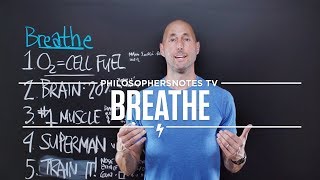
Brian Johnson breaks down Dr. Belisa Vranich's Breathe, arguing that oxygen is your body's primary fuel and the brain alone uses 20% of it. Your posture can boost oxygen intake by 30%, and diaphragmatic breathing, nasal breathing, and longer exhales are trainable skills that sharpen mental and physical performance.
Chapters
Hi, this is Brian. Welcome back to another episode of Philosopher's Notes TV today, another great book, Breathe by Dr. Belissa Vranich. Breathe subtitle the Simple Revolutionary 14 Day Program to improve your mental and physical health. Belissa Vranich is one of the world's leading teachers on optimal breathing. She teaches something called the Breathing class. This book is a result of that. As you know, if you follow much of my work, I have fallen in love with the idea that we can optimize our breathing. Sounds obvious. And it also sounds, at least to me, it used to sound a little weird. Optimize our breathing, something we do, we should do so naturally. Yes, yes, we need to optimize it. As we've discussed in our episode on Oxygen Advantage and a bunch of notes we've covered with our members. And I'm working on a breathing 101 optimal breathing 101 class. But today we've got a philosopher's note on this great book and these five big ideas. So let's talk about it some more. So the first thing we need to know, Melissa tells us, is that oxygen is our primary source of fuel. We, period, our cells need oxygen in order to function optimally. And it is their primary source of fuel, she says, period. Again, as we've said before, and I want to set the table and get you thinking about why we should think about breathing more. And then we're going to talk about some practical ways to optimize how we breathe in our time together today. But again, remember, you can go weeks without eating, you can go days without drinking water, you can, you can only go minutes without oxygen. Eat, move, sleep. We talk about the importance of focusing our mind as another fundamental. But we rarely talk about breathing. In fact, she says this should be your primary practice. It's that essential that foundational Andrew Wilde, the great alternative medicine doctor, tells us that if he could only teach one thing, he would teach people how to breathe correctly. It's a powerful statement. So we'll talk about how to breathe correctly more in a moment. Let's talk about one more thing. Your brain uses 20% of the oxygen you consume. It also happens to consume 20% of your caloric intake, which makes what you eat, obviously super important for your brain and how you breathe. If you want to function optimally, intellectually and creatively, just be able to put your mind where you want, when you want, in a calm, energized way, then you need to prioritize your breathing. Your breath is driving the functioning of your brain, period. So we need to train it. So let's talk about how the number one muscle. What do you think? If I was to ask you what the number one most under appreciated muscle in your body is? Belissa poses this question. What's the number one most underappreciated muscle in the human body? What would you guess? Well, she says it's your diaphragm hanging out right there below your ribs, responsible for your optimal breathing. Your diaphragm, it's a muscle that you need to train, but you probably, unless you're into breathing, have never thought about training your diaphragm yet. We need to think about it and we need to train it. We need to appreciate the fact that it is driving the quality of our breathing experience. She tells us about something called the vital lung capacity measure, vlc, basically an inch below your sternum. You want to measure that and you want to have a big difference between how far you expand out again, your lower part of your body, and how far you can expand or contract in the difference between, again, down here, not up here. We're going to talk a lot about the fact that she's all about getting us down into our diaphragm rather than up here, breathing shallowly into our chest, like we talked about in the Oxygen Advantage by Patrick McGowan. But there's a way to measure that. You can search vital lung capacity, or obviously check out the book for a specific tutorial on how to measure that and calculate your vital lung capacity. You want that to be really, really strong. That's going to be a measure of the health of your oxygenation, and it's going to require you to focus, breathing deeply and also to get a little more flexibility and strength down there in your rib cage region, working out your diaphragm. So we need to focus on our number one muscle. We also want to think about the fact of how we breathe, different breathing styles. So Belista tells us that we can either be vertical breathers or horizontal breathers. So vertical breathers, when they breathe, their shoulders come up, right? They're breathing into their chest, usually through their mouth, by the way, right? And then down, and you see them move vertically. You'll notice when someone's anxious, they're almost gasping for breath, right? Up, down. Vertical breathing says, we don't want to do that. We want to be horizontal breathing. We want to keep this not completely still, but basically right, and breathe lower and be horizontal. We want our belly to expand like we're blowing up with like a balloon, and then contract. We're horizontal breathers rather than vertical breathers. Again, the whole basic idea here is we want to bring our breath and deeper. We want to bring it into the lower part of our body as we train. Before we get into some more specifics, we'll talk about a very simple way to boost your capacity, and that is your posture. So imagine the difference between Superman, who's standing strong, right? Chest is up back, as Eric Goodman says, chest up, chin down. That's the proper posture to kind of elongate your spine, right? That that allows for your vital lung capacity to expand versus Clark Kent's kind of cruising around like this all day, right? And he's at his desk and he's hunched over. We want to assume a tall, lengthened, strong posture. And Melissa tells us that when we stand right and we sit right, which is going to be an expanded sense of self, much like what Amy Cuddy tells us in Presence, right. Not only do we increase our power measurably via her studies, we also increase our capacity to bring in the proper amount of oxygen, she says, up to 30% more when we're actually assuming the proper posture. So notice how often you hunch over, over your little screen or just throughout your day and stand tall, sit tall and allow yourself to breathe deeply and fully. Superman versus Clark Kent or Wonder Woman, and whatever the equivalent is for for her in that regard, be the strongest, best version of you, moment to moment to moment. Start by breathing like that version of you, Deeply, rhythmically, softly, calmly is a good idea. And we want to focus on training. And if breathing is that important, which it is. It's our primary source of fuel, 20% of our brain. Our brain uses 20% of the oxygen we consume. We. We should train how we breathe. Right. Again, it sounds both simultaneously obvious and a little weird, but we want to make it a conscious practice. For me, I've integrated some of Bellissa's techniques and Patrick McGowan's Into My Morning meditation practice, which has become a meditation and breathing practice. Right. That's just my anchor is my breath. So I do actually a restricted breathing practice that Patrick recommends that I talk about in our notes in the first 10 minutes of my meditation. Then the second half, I play around with a practice that Belissa recommends we talk about in the note to expand my breathing capacity and the vital lung capacity. Right. It's a nice complement to one another, but there's a ton of things we can do. We want to start with the idea that we can actually train our breath. The number one tip that we want to take out of our time together today is to breathe through your nose. Breathing through your mouth is associated with breathing up here. Vertical breathing style, shallowly into our chest. We don't want to do that. We want to breathe through our nose. And as I shared in the oxygen advantage, I wear a piece of tape over my mouth at night to train myself. When I'm doing my exercise and training, I'm training myself to breathe through my nose exclusively, including the high intensity stuff. Very occasionally a little bit through the mouth. But we want to focus on breathing through our nose. So notice. How do you breathe? Are you breathing through your mouth? It's crazy when you start getting into this, you see how many people are walking around like this, kind of almost panting through their mouth. When I did a Spartan race, the Beast last month. Was it last month? Yes. We were going up hills and it was amazing how many people were breathing through their mouth, panting through their mouth because they haven't thought about it. But Belisa makes the point. You take two athletes equal in every measure, but one trains themselves to breathe through their nose and the other continues to breathe through their mouth. The athlete that breathes through their nose will dominate the individuals who breathe through their mouth. Why? Because when we breathe through our mouth, we're not getting the proper ratio of carbon dioxide in our bodies. It's the carbon dioxide. Paradoxically, presence of carbon dioxide in our bodies that triggers the release of oxygen from the hemoglobin into our tissues and into our muscles and organs. Right. So knowing that we need to get that carbon dioxide level right, the way to do that is paradoxically to breathe less. People who breathe through their mouth breathe more. Breathing through your nose is the fastest way to breathe at the proper rate. Right? Carbon dioxide. Right. Oxygen out of hemoglobin. It's not enough just to get it into your body, you need to get it out of your hemoglobin into your muscles, and then you get proper oxygenation and you can perform at a higher level, you can think at a higher level, etc. Etc. So that's a super simple thing. Notice whether you're breathing through your nose or through your mouth. Get in the habit of breathing through your nose and then make it a practice 24, 7. You're thinking 24 hours a day. You're thinking about nose, mouth, at least waking hours. And if you're like me, you can tape your mouth so you don't need to think about it at night. 3M tape. Go check out that video. If you don't Know what I'm talking about? And you can also practice breathing to a rhythmic count. So Mark Divine, the Navy SEAL who I reference often, is one of the guys that she references in the book. He's a breathing expert, right? These elite special forces that they're trained in, how to breathe, that's the fastest way to get out of fight or flight. Trigger your parasympathetic nervous system to relax so you can be calm and energized. The only place from which you can make good decisions. And he has something called box breathing that she talks about. You breathe into a count of five. You hold for a count of five. You exhale for a count of five. You hold for a count of five. Then you breathe in for five. And repeat. Hold, exhale, hold. Five, five, five. Box. Five, five, five, five. Box breathing. You can do whatever you want. I do. Inhaling to six, holding for one, exhaling for eight. Which brings us to another big idea. As we train our breath. Breathe through your nose and focus on your exhale being longer than your inhale. And as Belissa says, when you're inhaling, you want to think of two things. You want to think of inhaling through your nose, deep into your lower body and expanding. And then as you exhale, you think of lower body. You're focusing on your lower body, and you're contracting, you're squeezing. Then you have expand and squeeze, expand and squeeze. And we build that vital lung capacity. We're literally working out our diaphragm. So those are some ideas on how to train you breathing through your nose. You're exhaling a little longer. You're focusing on counts, and you're thinking about expanding lower and squeezing lower as you go. Remember your posture. 30% more oxygen coming in. Potential is there. Superman versus Clark Kent. Your number one muscle that you never think of is your diaphragm. Let's start thinking about it so we can serve our brain, which consumes 20% of our oxygen. And remember that oxygen is our primary source. Source of fuel, period. Andrew Wiles. Number one tip. Learn how to breathe. I hope you enjoyed this. Quick look at this great book. If you did, I think you'll enjoy it. And here's to a nice, deep breath. How about we do one inhale to six, hold for one exhale to eight, or whatever breath count fires you up. Let's do it now together. Inhaling low, Expanding. Exhaling low. Squeezing. Repeat. Have an awesome day. See you. Isn't it a bit odd that we went from math to science to history, but somehow missed the class on how to live. For some wacky reason, optimal living 101 never made the schedule. Of course it's too late to go back and change that and you're too busy to read full time to catch up. But if you're like us, you're all about optimizing your life so you can actualize your potential. So imagine this. Imagine having someone read the best books on how to optimize your life and pull out the big ideas that can really change your life. You know those sections? You underline an asterisk and mark all up. Then imagine that guy me connecting those awesome ideas to other great books and helping you actually apply the wisdom to your life today. Well, that's what I do with something we call Philosopher's Notes where I've distilled hundreds of great books into 20 minute super practical summaries. Then imagine me taking the absolute best big ideas from those great books and sharing them with you in hour long Optimal Living 101 classes on everything from productivity, purpose and confidence to nutrition, goal setting and conquering procrastination. Helping you optimize every facet of your life so you can actualize your potential. You've got a personal trainer. I'm kind of like your personal philosopher. Ancient wisdom, modern science and practical tools. That's what our optimized membership program is all about. If you're feeling it, we'd love to have you join us.
More from Brian

Heroic +1: What’s THE Most Creative Act in the Universe?: Turning Around Glitches (#2024)









