PNTV: Bright Line Eating by Susan Thompson (#388)
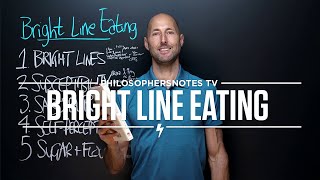
Brian Johnson discusses Susan Peirce Thompson's Bright Line Eating, which uses willpower science and nutrition to change eating habits. The book introduces bright lines, clear rules that remove decision-making around food, and explores why some people are more susceptible to addictive eating behaviors.
Chapters
Hi, this is Brian. Welcome back to another Philosopher's Notes tv. Today we've got another great book, Bright Line Eating by Susan Peirce Thompson. Bright Line Eating Subtitle the Science of Living Happy, Thin and Free Alexandra got this book and when I saw the title, Bright Line Eating, I immediately fell in love with it. Bright Line Eating basically combines the best of what we know on the science of willpower with the best of what we know on nutrition. We'll talk about it more obviously in a moment. Susan Peirce Thompson is a professor of essentially, neuroscience. She's an expert on the psychology of eating. And she used to be super overweight, super obese in fact, and addicted, as she says jokingly but seriously, to everything. So a former addict and a former obese woman who's now one of the world's leading thinkers on the neuroscience of the psychology of eating. So she combines the best of what we know from willpower. In our classes, we have classes on Willpower 101, Habits 101, Optimizing Algorithms 101, and then also the best that we know on nutrition. So it's a really cool combination of the two. I very much enjoyed the book. If you've struggled with your weight and or know someone who has, I highly recommend it. It's a solid approach based in what we know works. So there you go. Philosopher's note. Bunch of my favorite big ideas. We've got five of them we're going to look at now. We're going to, well, start at the top. Bright lines. Bright lines. What does that mean? Well, I went to law school at Berkeley and I spent about a half a semester there. And I got midway through contract law. And one of the things I learned in that brief stint in law school was that good contracts have bright lines. Lawyers like to say that the four corners of a contract, you need bright lines on them. You don't want fuzzy lines. You want to know what everyone's agreeing to. Willpower scientists have adopted that phrase to talk about how good habits are created, how you make a decision once so you don't need to make it a thousand times. Which again, is something we talk about in Willpower101, Habits101 and our Optimizing Algorithms101 class. You don't want to decide every single time what you're going to do. And in this context, you want to have bright lines on your eating decisions. We'll talk about what the most important decisions are. In a moment, you might get a hint looking at Big Idea number five. But you want to create bright lines and navigate what Susan calls the willpower gap. The reality is that our willpower is at least to some extent limited. It's finite. We need to use it wisely to install habits that run on autopilot, just run automatically, so we're not having to think about what we're going to do. We just say this is what we're going to do. Jack Canfield, as we've talked about a number of times, says it's a lot easier to make 100% decision to something than a 97% or even a 98 or even a 99% chance because you always have that little part of your voice that's negotiating with you. We're going to talk about what that is called, in Susan's vernacular, the saboteur. You don't want to have to negotiate with that version of you or all day, every day. You want to make decisions. It's 4pm she says, and donuts are in front of you. You don't want to have to decide when your willpower is depleted. You want to be able to navigate that gap by having very bright lines in what you decide to do. This is a big idea. May sound obvious, but it's a very, very, very big idea. Science is unequivocal here. It works. Remove the need to make decisions is the ultimate decision. Essence of that second thing is susceptibility. She's got a quiz you can find on her website, a susceptibility quiz. So how susceptible are you to negative behaviors related to your eating? She's got like, I think it's a five question quiz. She says it says one to ten scale, right? She says that she is at a spinal tap 11. She's technically at a 10 on this test, but she jokingly says she's at a Spinal Tap 11. She's super vulnerable to addictive behaviors and again, not just in her eating, but in a number of aspects of her life. And she's really used that experience to kind of gain self awareness, etc. But anyway, we need to know where we are on that scale. Alexandra is a 9 out of 10. I wound up being a 6 out of 10, which was kind of somewhat surprising, but not really because I used to be super addicted to Burger King, McDonald's, Taco Bell was a health meal, Cheetos, Doritos, whatever. Fill in the blank with unhealthy foods. But anyway, I was a 6 on that scale. Alexander was a 9. Susan jokingly says she's a spinal tap 11. If you did the same susceptibility quiz for me on technology, on smartphones and email and all the push notifications, I would be unquestionably an 11. Right. And one of the things we talk about in the note is an idea from Irresistible. We'll be doing an episode on that great book soon on susceptibility related to technology, which we talk a lot about in conquering Digital Addiction 101. But the idea there is that when you look at addictive behaviors, once you've done and this is what Susan says as well, she doesn't use this phrase, but same idea, once you have engaged in certain behaviors, you've laid down neural pathways that even if those behaviors aren't currently active, they're there, they're dormant, they're ready to kind of get going again. This is why bright lines are so powerful. When you just non negotiable say I'm never smoking another cigarette or I'm never doing X, Y or Z, it makes it a lot easier. And the phrase from Irresistible that I loved was, if you have a cucumber and you pickle it, there's nothing you can do to make that pickle a cucumber again. So if you've demonstrated addictive behavior in any aspect of your life and you move from cucumber to pickle again, whether that's food or technology or alcohol or smoking or whatever, you got to be honest with it, with yourself and the fact that you're now pickled, right? And the most dangerous time for an addict in Irresistible, you learn is right when you think you figured it all out. Now you don't need to worry so much and you can get these bright lines, let them go. Then what happens? Well, then you reactivate all of that, all those old patterns, and boom, you go back to an old lifestyle again. Bright lines are huge. Susceptibility quiz. Self awareness is always the place to start. How pickled are you in your eating? And every other aspect. Then our next idea here, the third one is the saboteur. So she says there's a part of you that has the best intentions, right? You're going to do the right thing and you're feeling good, particularly when you're well rested and you've exercised and life is going well, right? But then there's always a part of you, even in those moments, but certainly in the moments when you're feeling tired and you're not doing the things you could be doing perhaps in the rest of your life, that voice in your head starts to get a little Bit more chirpy. Right? Well, she calls that voice the saboteur. Right? Saboteur, which is parallel to what Steven Pressfield calls resistance, what Phil Stutz and Barry Michaels call part X. That part of you that kind of wants to bring you down and have you eat that donut at 4:00pm and basically the short story here is you don't negotiate with your saboteur. You give them some bright lines. You basically say, no, this isn't up for negotiation. Again, as Jack Canfield says, 100% is easier than 98% because it's non negotiable. Case closed. He says it's not up for discussion. So if you say you're going to do a certain thing and you truly are 100% committed to it, which you can't do with every single thing in your life, but we want to get really clear on the most important keystone habits. And again, if weight and energy and mood and health is an issue, this is a worthy area to apply this level of intensity to. You're 100% all in. You're not interested in what this voice has to say to you and it's non negotiable. You're going to follow the guidelines, the bright lines, etc. The next idea is self perception theory. So she talks about a really cool concept in psychology called self perception theory. And the basic idea is that your identity is formed as you perceive yourself doing certain things. We've talked about a lot of different frameworks to change behavior, right? There's the identity drives behaviors, drives feelings model, which is much better than letting your feelings drive your behavior and then erode your identity. But she says by observing, this theory says by observing yourself doing certain things, you develop a certain behavior. And I just, I find this idea fascinating. I read this book a couple years ago and I'm going through our little series here as I prepare for optimal weight 101 and kind of reviewing all this goodness. But I recently read Atomic Habits by James Clear and he has another similar idea in what he calls identity based habits, where you create habits based on your identity. And he looks at the etymology of the word identity. The word identity literally means, if you trace it back to its Latin roots, repeated beingness. Your identity, according to the ancients, was being basically formed by whatever you did, whoever you were, repeatedly. That's your identity. It's very similar to self perception theory. So if you act like a healthy person and you do those behaviors again and again and again, that's like you, that's like you, that's like you, your identity is formed. And in fact, James shares a story that one of his friends who needed to lose 100 pounds. Her strategy, her entire strategy was to act like a healthy person. Every choice she was going to make, she acted like a healthy person. That was her identity and she acted like that consistently. Now, in this context, we've got our bright lines to guide us. Susan shares four bright lines. These are the 100%, all in commitments we make non negotiable. This is what we're going to do. The first one is sugar. She says this is the cardinal rule. You have to follow this one. The second is flour, the third is meals, and the fourth is quantities. So I'm going to focus on the first two. Check out the book obviously for this and more. But sugar and flour, these are the two fundamentals that we talk about in nearly all of our nutrition discussions. In our chat on Fat Chance, Robert Lustig, the great endocrinologist, says, why do all these different diets work? Why does Ornish work? The low fat, high carb diet, why does Atkins also work? The low fat, high carb diet, why all these diets work? You can look at traditional Japanese cultures, etc. Why do they all work? Because they restrict sugar, right? They restrict sugar, they get insulin under control. And Susan talks about the neuroscience and the hormonal imbalances that occur when we have too much sugar and we have too much flour, our insulin levels get disrupted, which impacts our leptin levels, which is basically the shutoff valve for our hunger, right? So when your insulin's up, paradoxically, you're eating a ton, but your brain thinks you're starving. Your brain is hijacked, to use her phrase. And you need to rewire your brain, get out of that pickledness. And the way you do that is you reduce your sugar, you reduce your flour. She says we should consider those two substances more like drugs than like foods. And she has a little image in her book where she draws what cocaine looks like in a pile, what flour looks like in a pile, what sugar looks like in a pile. And guess what? They look very, very similar. When you distill the essence of a coca leaf, which is no big deal, you just chew on it, you get a little bit of a buzz like you're drinking some tea with. When you distill that essence into its most refined powder form, you get an addictive substance that will light up your nucleus accumbens and drive you to do things you wouldn't otherwise do, no problem. When it's in its whole form, distilled problem. Same exact thing, she says, with sugar and with flour. Sugar has been demonstrated in the lab to do exactly that, as we've discussed a number of times, slide someone into an FMRI after giving them fast acting carbs, David Ludwig at Harvard has demonstrated, and their brain will light up like a laser in their addiction center, the nucleus accumbens. This is no joke. You need to start here. She says this is the first bright line. You need to eliminate sugar, period, so you can reset your brain to healthy patterns. Then she also says flour pizza is apparently the most addictive food, at least for Americans, right? And a lot of people think it's the cheese. But she says, you know what? I don't see anybody running out for broccoli and cheese. Cheese on broccoli, but they will run out for the pizza. And she says it's the flour that's actually the most addictive part of that. In any case, sugar and flour are our first two bright lines. And in her scenario, in her approach, those are 100% eliminated, gone, no longer part of your life. You don't need to think about it again. Is that hard? Is that extreme? Well, she says, no, it's actually not. We happen to live in a really, really profoundly sick society. Something like 2 billion people are overweight, which is insane. Two thirds of our calories are coming from horrible refined foods. Two thirds of our population are overweight or obese. She says what's extreme is not eliminating sugar and flour from your life. Although if you live in a community or have a cohort and a peer group that doesn't eat very healthfully, then it may look extreme to them. She says what's extreme is 70,000 people have a limb amputated from their diabetes every year. That's extreme. Eliminating sugar and flour, not extreme again, as I quote Krishnamurti all the time, who used to teach literally down the street from me here in Ojai. It is no measure of your health to be well adjusted to a profoundly sick society. I get it. Everybody does it. It can't be bad if everyone does it. But it is sugar, flour, gone. Those are our two primary bright lines. Self perception theory. You want your identity to be strong. How do you do that? You cultivate the behaviors by doing the little things right. Doing the little things right. Make it easy for yourself to deal with part X resistance, the saboteur. The part of you that isn't supportive of you doing the right thing via your bright lines. You don't negotiate with that version of you. You, you need to know your susceptibility. If you've been pickled in this area or other areas of your lives, you got to have the humility to know that and to not dip your toe in those waters lest you fall in again. And then we have the bright lines. Make the decision once so you don't need to make it a thousand times and you free up your energy to live your life. Our health is just a vehicle. This isn't the destination. But we want to get this right so we have the energy, the vitality, the mental clarity and and the mental spaciousness to not need to again negotiate with ourselves all day every day, particularly when we're tired. We need to close that willpower gap. Bright line eating is a great resource to do so. Thank you Susan for the great book. Hope you enjoyed. Here's to your optimal energy. Make today another awesome day. See you.
More from Brian

Heroic +1: What’s THE Most Creative Act in the Universe?: Turning Around Glitches (#2024)









