PNTV: Change Your Brain, Change Your Life by Daniel G. Amen, MD (#262)
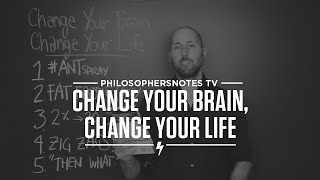
Brian Johnson breaks down Daniel Amen's approach to rewiring your brain: kill automatic negative thoughts (ANTs), feed your brain well since it uses 20-30% of your calories despite being 2% of body weight, expect zigzag progress not straight lines, and ask "then what?" before decisions to see where they lead.
Chapters
Hi, this is Brian. Welcome back to Philosopher's Notes tv. Today, another great book, Change youe Brain, Change youe Life by Dr. Daniel Amen, M.D. change youe Brain, Change youe Life Subtitle the Breakthrough Program for Conquering Anxiety, Depression, Obsessiveness, Lack of Focus, Anger and memory problems. Dr. Daniel Amen is one of the world's leading psychiatrists. He is a clinical neuroscientist. I love that phrase, clinical neuroscientist. What does that mean? It means he's one of the few psychiatrists in the world that uses brain imaging, actual neuroimages to help his patients. It's a really cool idea when you think about it. He makes the point in the book that psychiatrists are the only medical specialists that don't look at the actual organ they're treating. Imagine going to an orthopedist and saying, oh, you know, my knee kind of hurts. And just talking about your symptoms and then them saying, oh, okay, well, this is what's up. We need to do this. They'd never do that. They look at your knee and see what was structurally going on. Dr. Daniel Amen says we should be doing the same things with our brain. And what he's found is that after doing 115,000 specced brain scans is that it matters. You got to be able to see what's going on to properly diagnose and treat individuals. And he's done amazing work to kind of before and after brains via the stuff that he talks about in his great book. Now, personally, we just spent some time with Daniel in his clinics in Orange County, Alexandra. As I mentioned in other episodes, he had a couple of seizures a couple months ago. Obviously that freaked us out. And as we started doing research into what might be going on, we realized that mold might be the catalyst. Long conversation I'm not going to go into, but Daniel Amen is featured in a documentary Dave Asprey created called Moldy. Highly recommend you watch that if you feel interested and inclined. Anyway, we were planning to reach out to Dr. Amen and he happened to reach out to me synchronistically. Literally the day we were going to reach out to him to help with this book and to have that conversation, we got the next available slot in his calendar, went and spent a couple days in his clinics. We both got scanned, got EEGs, all of it was awesome. Spent a few hours with him unpacking it. Thank you Dr. Amen, for both that personal support of our family. We are excited about optimizing and for your wisdom over Your career. Big ideas in the Philosopher's Note. That's a long prelude. Five big ideas I want to talk about here. The book is packed with information on. It's almost like a diagnostic manual for all the different things that could be going wrong with your brain and a ton of practical tips you can apply to your life. We're going to look at five super practical ones now. So the first one is ant spray. Capital A, capital N, capital T. Ant short for automatic negative thoughts. Now I had heard of ants before. It's kind of a popular phrase in the self help literature. But I actually didn't know that Dr. Amen is the one who came up with this until more recently Automatic negative thoughts. He shares the story of how he came up with it. One day early in his psychiatry practice, he had a rough day. He was dealing with some suicidal patients and a couple that just didn't get along and other challenging patients. And he got home and his house was infested with ants just swarming with ants. And he thought that's just gross. And then it just popped into his head that his patients who were suffering had ants. They had automatic negative thoughts going on in their heads. What a great image, right? So when we step back and we look at our thoughts, which is a very important thing to be able to do and capacity. We talked about in a recent episode on Waking up right by Sam Harris. We want to be able to observe what's going on in our minds. And when we observe, we see. Wow. We have a tendency to have automatic negative thoughts. Well, every, every thought we have affects our brains and affects every cell in our body. So we want to be aware of the negative thoughts and spray some ant spray on them. He teaches us how to do that basic cognitive behavioral therapy stuff that we talk about a lot. Challenging our thoughts. First by recognizing that you're currently in a negative looping pattern. Just seeing that is huge. Write it down and challenge it. He walks us through how to do that. He has nine. I think it is different species of ants you can blame. That's a red ant. That's one of the worst things you can do. Blaming other people automatically. I just blame people. You want to get aware of that. Maybe you. Fortune tell is one of the species. Right. Fortune telling where you look forward into the future. Oh, this isn't going to work out or whatever. There's an automatic negative thought Challenge it. Spray some ant spray on it. That's our first big idea. I love that. Automatic negative thoughts. He brought in a can of ant spray into his office as a reminder visually for his clients and patients to pay attention to. Second, big idea is Fat Freddy. He tells a hilarious story about going to, I don't know, like a SeaWorld kind of place in Hawaii. When he was a father, his son was seven years old and they went to all the different shows and they wound up at this penguin show featuring a penguin named Fat Freddy. And Fat Freddy apparently could do crazy awesome things. He could bowl with his nose, he can count with his flippers, jump through a fire hoop or something. Ridiculous. And then the trainer said, hey, Freddy, go get me this. And Freddy went and he got it and he brought it back. Dr. Amen had this epiphany of, wow. This penguin, when asked, will go and get something and come back. But if I ask my 7 year old son to do something like that, he's going to talk to me for 20 minutes, he's going to debate me, then he's not going to do it. My son's a lot smarter than that penguin. What's this trainer doing? So he went up to her after the show and asked that question, what are you doing? How do you get this to work? And she looked at him and looked at his son and said, look, unlike most parents, I don't focus on what Fat Freddy's doing wrong. I focus on what Fat Freddy's doing right. And he had the light bulb moment. Dr. Amen did and realized, wow. In an effort to help his son be a good kid, he was only paying attention to the stuff he was doing wrong. And in the process, he basically trained his son to do wrong things to get his attention. So he reversed that and he wanted to find the things that his son was doing right. He didn't flip him fish because that wasn't his big thing, but he noticed it and was present with it and gave him hugs and rewards for that. And he realized, this is huge. I need to help my patients see the good in themselves and in the people they're interacting with, with whom they're interacting. And he went out and he wound up collecting penguins. He now has 600 penguins. When we were in his office, penguins are everywhere. Little kids area where they can play. Emerson's jumping on and wrestling with this big penguin stuffed animal. He's got a children's book which is all about this, which is awesome. Fat Freddy the penguin. And we want to keep this in mind. Imagine Fat Freddy, the little penguin that could do awesome things. The next time you're focused on your automatic interpretation of negativity when you See a loved one or a colleague or a spouse or a friend or yourself doing something you don't like, we tend to emphasize that we need to stop doing that, rewire our brains on the positive. That's a long look at Fat Freddy. Third, Big Idea, 2% to 20 to 30%. So get this. Your brain is hungry. Your brain is about 3 pounds, which is 2% roughly of your total body weight. Yet your brain, 3, 3 pounds, 2%, consumes 20 to 30% of the calories you consume. The brain uses 2%, yet it uses 20 to 30% of the calories you consume. Therefore, what you're consuming, the nutrient density or toxicity in what you're consuming is going to dictate the quality of your brain. It's huge. If you want to change your brain so you can change your life, you need to start by looking at what, what you're feeding it. And he says, look, it doesn't matter how much of this you do, how much meditation and exercise and everything else. If you're not optimizing your nutrition, your brain is not going to perform optimally, period. I interviewed Dr. Amen this morning. We talked about it briefly and said, well, what one thing. If you're going to eliminate one thing, the first thing he talked about was sugar. Sugar and obvious things like processed foods, unhealthy fats, not all fats. He jokingly said, look, your brain is mostly fat. If someone calls you a fat brain, that's a good thing, and you need to consume fat to have a healthy brain. He doesn't believe in low fat dietary approaches. Anytime I talk about that, I get the most debate on these issues. So we'll leave that over there. But your brain needs healthy food if it is going to function at a high level. So think about what you already know you could be doing nutritionally and become what Daniel Amen calls a brain warrior and start doing it. Ignore the onslaught of ads and everything else that's telling you you should just consume this donut or that, whatever and start dialing it in. Remember, 2% to 20 to 30%. That's crazy to imagine. Fourth, big idea, zigzag lines. This is a really cool one. Now, Dr. Amen has a great graph in his book and he actually had this on his whiteboard when we came in. Now, most of us want growth to look like that. Straight, nice up line. One long, straight line. We started here and then we wound up here. Yeah, we're stoked. And it was super easy. Straight line. The good doctor tells us that's not how growth works, period. Right. A lot of people, when they see them, are kind of like this. They're down here and they're suffering, right. They're not having a lot of highs. Then as he starts working with them, they go high, but then they come down, and then they go high. Then they come down, they come high, they go down, and it zigzags up where they get to a point where they're actually pretty stable again. Remember, you're never going to be perfectly happy all the time. There's always going to be some highs and some lows. But if you do the work, your highs are going to progressively get higher and your lows are going to progressively get higher. Right. But it's not going to be a straight line. You're going to take two steps forward, three steps forward, you're on fire, and then you're going to stumble back. Oh, man. I fell short again. And Dr. Amen says in those moments where we fall short, rather than get furious, we need to get curious. Right? Get curious, not furious. Well, I was on a roll, and then this happened, and then I started doing this and this, and then I didn't feel as well. Wow, that's great data. If you allow it to be. It's a really, really powerful thing. Get curious, not furious. Okay? So when I don't sleep well, or I go too long without eating, or I allow this, this, this, this, this to happen, then I don't function as well. So let me go back to the lab and do some more work and realize that's inherently part of the process. He also talks about the fact that brain imaging studies show that some people address failure in their pain centers of their brain. Something, they make a mistake, something doesn't go the way they want. And part of their brain that lights up is related to their pain center. It actually hurts other people when they experience failures or mistakes. The motivation center in their brain lights up. They've actually either trained themselves or are blessed to have this ability through conditioning or whatever, to be excited about it. They get motivated about it. So. So we need to discipline ourselves to get rid of the ants in our minds telling us something's wrong with us because we fell short and get fired up. As the tools guys say, bring it on. That scares me a bit. I made a mistake. I'm not going to deny it because it makes me feel a little pain. I'm going to lean into it, and I'm going to become a better person as a result of it. You do that and you Accelerate your path up that growth curve in extraordinary ways. Fifth big idea. Then what? He says these are two of the most important words in the English language. Then what? I say forks. I'm combining two of his ideas here. Then what? And forks in the road. The final big idea I have in the note is forks in the road, where Dr. Amen has a great description of. Look, you can imagine two lives for yourself, one which goes over here. If you continue negative habits and all that for another X, months, years, decades, what's your life going to be like? Imagine that. Don't deny it. In our interview, he said positive thinking kills more people than anything else. That might not be quite how he said it, but positive thinking isn't what we're talking about here. We need to be real. We need to have a certain healthy level of anxiety and realize that if we keep on doing these things, that's going to lead to diminishment in our capacity to enjoy life. Might even be dementia at the end of the road. So many people are on that road if they continue their habits. We got to be honest about that and see, that's a potential fork. And then we need to see, well, what would happen if we actually started embodying all these ideas. You followed a program like Dr. Amens, what would your life be like on that path that's exciting. And every single moment is. Gives us an opportunity to see that fork. It's what we talk about all the time, moment to moment to moment to moment. We're choosing, stepping forward into growth, doing what we're capable of doing or not. And he says, ask yourself, then what? If you're going to do something that doesn't serve you and you do it, then what? Then what's your life going to be like? Then you do this, then what? And before you do anything, ask yourself, if I do this, then what? You may not think that doing it once has a big consequence. So why don't you imagine if I do this as often as I have in the past and continue to do it, then what? Then what? Then what? Then what? It's a really powerful question to navigate that fork in our optimal road. Remember zigzags, it's not a straight line. Up, down, up, down. But we're progressing. We're learning from our mistakes. Leaning into it. Your brain is 2% of your body weight, yet consumes 20 to 30% of your caloric intake. Uses that what? Fat Freddy, Remember that awesome fat penguin who could do crazy great things? The trainer focused on the positive things. They were doing. Reinforce that behavior rather than the negative. Bring that into your parenting and your parenting of yourself and everything else. And then the first big idea was Ant Spray. Automatic Negative thoughts. Take your can of ant spray to it, challenge your thoughts, purify your consciousness and watch your brain change and your life change. Hope you enjoyed. If you did get the book, I will have a link to There's a special link to get a ton of free stuff and all that good stuff. So check below. We'll have that in the description if you're listening to this on itunes. All right. Hope you enjoyed. What was the big idea that jumped out? How are you going to make that a bigger part of your life starting today? Get on that and have another awesome day. More soon. See you. Hi, this is Brian. I hope you enjoyed that PNTV episode. A lot of people don't know all the stuff I do beyond these free videos I share on YouTube, so I thought I'd do a quick video to give you an overview of our membership program that you can get access to and get a ton of other stuff. So here's a quick look. Ten bucks a month. Join the Optimal Living Membership program. You get instant access to 250 philosopher's notes on some of the best Optimal living books out there. Old school classics, Positive Psychology, Modern Stuff, Mindfulness, Peak Performance, purpose, neuroscience, wealth, etc. What you may not know is that in addition to the PNTV episodes, I create PDFs on all these great books. So six page PDFs. Let's take a look at one of them. Joseph Campbell, you want to figure out how to live your hero's journey? Well, this is a great place to start. I basically pull out my favorite big ideas, riff on them, connect them to other books and other ideas and help you apply this wisdom to your life today. That's what the PDF looks like again. We have 250 of these on all these different great books and then I record those PDFs as an MP3 so you can listen to that MP3 while you're on a walk or working out or doing some errands or whatever that is. Philosopher's Notes. A lot going on there. And then in addition to Philosophers Notes, you get access to Optimal Living classes. Optimal Living 101 idea here is that all those great teachers come back to the same big ideas again and again and again. I distill those ideas into classes. Super practical, fun, inspiring classes ranging from habits 101, confidence 101, getting stuff done 101 meditation 101 yeah, instant access to all those classes. And then Future classes include Relationships 101, Energy 101, Purpose 101, Business Goals, et cetera. Those are our full length classes. And then I create micro classes. Two to three to five minute little bursts of wisdom on my favorite great ideas from these great books across the domain that you want to optimize in your life. So we have dozens of these so far. I create 50 new micro classes every month. 10 new philosopher's notes every month for 10 bucks a month. So we're blessed to have thousands of members who are enjoying the program and sharing some incredibly kind words with us. And super simple. 10 bucks a month. Cancel anytime. We'd be honored to be a bigger part of your life, and I appreciate your support. And here's to optimizing and actualizing.
More from Brian

Heroic +1: What’s THE Most Creative Act in the Universe?: Turning Around Glitches (#2024)









