PNTV: Choke by Sian Beilock (#298)
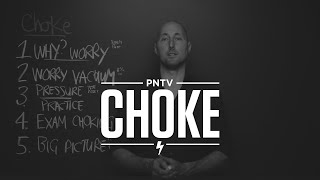
Brian Johnson summarizes Sian Beilock's book Choke and presents five practical ideas to avoid choking under pressure: (1) worry is the root cause and harms performance differently depending on whether a task relies on working memory (intellectual tasks) or procedural knowledge (automatic skills); (2) cultivate a "worry vacuum" through meditation to handle intrusive thoughts and preserve attention (a brief 10-minute meditation intervention improved exam scores in one study described); (3) practice under pressure — make training environments resemble competitive ones to inoculate stress (examples: Pete Carroll, deliberate free-throw pressure drills); (4) exam-specific preparation: take timed practice tests to simulate test-day stress and protect working memory; (5) before high-stress events, remind yourself of the big picture, list values or worries briefly, reappraise nerves as excitement, and reduce self-consciousness. The episode closes with a brief membership pitch.
Questions this video answers
PNTV: Choke by Sian Beilock (#298)
May 21, 2016
A brief 10-minute meditation training before an exam raised the treatment group's average from about a B- to a B+ versus the control group.
$10 per month
Chapters
Hi, this is Brian.
Welcome back to Philosopher's Notes tv.
Today we've got another great book, Choke by Sian Bilock. Choke Subtitle what the secrets of the brain reveal about getting it right when you have to. Doing your best when it matters most. Sian Bilock is one of the world's leading researchers on peak performance and its opposite, choking. Why is it that sometimes when it matters most, we perform our worst? Sian makes the important point that none of us perform perfectly all the time. There's natural oscillations in performance. But what choking is, is when it really counts. And our performance is diminished because of our perceived experience or experience of the perceived stress of the event.
Right.
So why do we do that?
It's one of the things we want to look at.
And how do we deal with it?
Big ideas in the Philosopher's Note.
Five of them here. Let's start with number one. What's the number one reason we choke? Well, it's the fact that we worry. We're worrying about the outcome of our performance when it doesn't really matter that much. We, we aren't worrying that much doesn't affect our performance that much. But when it suddenly really, really matters, whether it's a million dollar putt on the 18th hole in the final round or an exam, that's going to play a large role in determining where we go to school in the next step of our journey, right. We tend to worry, we tend to think about the outcomes negatively and that does interesting things depending on whether we're in the exam room or on a golf course or a tennis court or playing music or whatever.
Right.
So worry is kind of the originator. We're worried about our performance, but it affects us differently depending on what we're doing. So if you're taking an exam, there's something that's very, very important which is your working memory. Right. So if you are doing something intellectual, you need a high level of working memory. You, you need all your working memory available to do well. Working memory is what basically helps you keep a problem in mind while you go to your long term memory and crush it. If you're worrying, it's taking up precious real estate in your working memory and you can't simultaneously worry and crush it. It reduces your bandwidth just enough to reduce your capacity to think deeply. So in this context, it's kind of like you're under thinking you're not using your cognitive capacities to the way you could, right. If you weren't worrying now when you're performing Something like a sports activity that you've done a ton of times, right? Then you don't want to think. So when you're worrying, it's actually making you overthink something that should be automatic, right? They call that procedural knowledge. If you've kicked a soccer ball a certain way for a penalty kick thousands and thousands of times, you just want to let it rip. The that's not the time to think about how to do it. And when you worry, you think too much and fluid motions become rigid and you choke. Right? She uses the example of a field goal kicker. When you do a timeout right before they're going to kick, does that work? Can you freeze a kicker? And the answer is the data says yes. Why? Because they start thinking too much and they start overthinking something that should be automatic. So whether you're in the exam room or you are on a football field or golf green or whatever, you want to notice the tendency to worry and then master certain things. So you can put your attention where you want, when you want and not into worry. Here's the second big idea. You can create a worry vacuum, right? There's a particular technique that you can use to deal with worry. Imagine if you could actually vacuum up your worry. Wouldn't that be cool? Well, what would you guess is one of the primary ways that you can do that? If you've listened to many of these before, my hunch is you may be guessing.
Meditation.
And Sian shares some really cool research on people who meditate and their ability to basically control their minds, control their thoughts. And the experiment involved what they called an intrusive word. So this intrusive word came in and. And they needed to focus on something else. And what they did was they measured and compared meditators abilities to basically deal with the intrusive word versus non meditators. Short story is not surprisingly, but very cool to connect it to choking. The meditators were able to deal with intrusive thoughts better than the non meditators. Which makes sense because what is meditation? Meditation is essentially strength training for dealing with intrusive thoughts. If you're sitting down and we talk about this exhaustively in Meditation 101, so check that out. But if you're sitting down and you're meditating, you've chosen an anchor. That anchor can be your breath, it can be counting, it can be a mantra, it can be a prayer, it can be whatever you want it to be. But you've basically decided for the extent of this meditation. I'm going to sit down and put my attention here. And of course it wanders intrusive thoughts. You bring it back. Wanders. You bring it back. It's literally like doing repetitions to strengthen your mind's ability to focus on what you want to focus on. Now, how this relates to choking is when you are in an exam or on the 18th green or lining up for whatever it is that you do athletically or giving a business pitch, right? Raising money or doing a marketing pitch or whatever it is you do, that's high stress. When those inevitable thoughts come in, you need to have, you want to have, if you want to perform optimally, the ability to turn it off, right? Worry, vacuum, boom. I'm going to put my mind back where I want it to. And guess what? I practice this every single day for five or 10 or 20 or whatever minutes a day. And it's kind of like running a marathon. If you're going to run a marathon, you need to train for it or triathlon or whatever. You don't just jump off the couch and do a high stress event like a triathlon unless you're in good shape and you've been training for it. Well, same thing with life. When you want to perform at your highest potential, you better have trained to get to that point where you can do so. And meditating is a huge tool in the anti choke arsenal. Keep that in mind. Oh, and here's another really interesting thing, and I think it was in Sian's own lab. She's got a really cool lab at the University of Chicago. They've actually done work where they've trained people on how to meditate, like 10 minutes worth of training right before they took an exam. They all took a pretest in her study and everyone did the same, right? Then they gave them half of the group a 10 minute training in meditation. The other half didn't get the meditation training. The group that didn't get the meditation training averaged a B minus. The group that did get the meditation training averaged a B plus after 10 minutes of learning how to meditate. That's crazy. This is a really powerful tool. Keep it in mind. Third big idea, and one that Sian comes back to again and again and again throughout the book, is that you need to practice under pressure. See what I did there? Practice under pressure. You need to make your practice environment as similar to your competitive environment, your high stress environment as you possibly can. So some examples that we've used in these presentations include Pete Carroll, the Super bowl winning coach of the Seahawks in his great book, Win Forever, he talks about the fact that he's constantly putting pressure on his team. Every single play. His team is competing. That's his big thing, competing, Trying to do their best moment to moment to moment. They're always under a ton of pressure, such that when they walk on the field on Sunday, all the way through the playoffs and the super bowl, they've dealt with pressure. They're used to it. Practice under pressure if you want to perform at a high level. Another cool example that Sion gives is free throw shooting. So if you want to make a free throw at the end of the game when it matters most, with your team down by one, no time left or two, right, and you got to make two free throws, well, hopefully you've been practicing under pressure. Now, of course, it's impossible to recreate that situation in practice, but you can come close. And you don't need to recreate the exact stress. You just need to get better at dealing with a little bit of stress. And that helps a ton for the big stress. So get this. Most basketball teams, when they practice free throws, if they do it at all, it's at the end of practice. Everyone's just kind of shooting around. No pressure, no big deal. Now this one coach, she shares a story about, came into this team, they were one of, if not the worst free throw shooting team in the country. They're horrible. And he decided he was going to change that. And the way that he did it was he had them in the middle of practice, they'd just be running drills and he'd randomly have them. Need to make a free throw. One free throw. You need to make it or you're going to have to do sprints. Just a tiny bit of pressure, right? But that pressure was enough under practicing under pressure, along with other things I'm sure allowed this team to become one of the best, if not the best, free throw shooting teams in the country. Worst to first by practicing under pressure. So whatever it is you do, whatever high stress thing you do, think about how you can practice under pressure. For me, these little PNTV episodes are really practice for the master classes and the interviews and other stuff I do, I put myself under pressure first of all by being on camera, right? I used to hate being on camera. Now whatever, I'm indifferent to it and I don't do any edits. So I've got that pressure of no edits. You got one take. Let it rip. That forces me to get comfortable with making little mistakes and continuing to push through such that I can perform at a higher level when I do other things that create more stress for me. So whatever it is for you, giving a presentation at work, well then practice under pressure. Give it to some people and make it matter a little bit. It's not still as stressful as the actual client, but give a presentation to people and have them ask you questions that make you feel a little stressed. Powerful way to deal with the potential to choke is by making your practice as close to the actual situation as you can. The fourth one is an extension of this. It's on exam choking. I talked about it a fair bit in the note. I gave a personal example of me prepping for the lsat. And Sion talks about the practice effect, the fact that simply taking an exam like the SAT or GRE or LSAT or whatever can help improve your performance. Right? But you need to practice under pressure. So if you Short story here is if you're preparing or your kids are preparing for an SAT or GRE or whatever, practice under pressure. When I was studying for the lsat, I took a pre test or whatever and I did reasonably well. But I wanted to do very, very well to get into a great school, to get out of the job that I absolutely did not like. So I had a very high level of motivation to do well, wound up hiring a tutor and did the whole deal there. And I got as many practice tests of the LSAT as I possibly could and I drive home from the job I didn't like and I'd spend a couple hours every night practicing and doing drills and the stuff that I needed to improve and taking these tests every weekend. And I did it timed. Very important to feel the pressure that you're going to feel on exam day, right? So do be rigorous in your timing. Block off all distractions. You, you're all in. No excuses. Whatever you get in this timed session is what you're going to get. Look at your score and be honest about it, maybe even share it with people. And so it matters. So there's stress again, it won't be as high of a stress as when you're actually taking the test, but that will inoculate you a bit and get you more comfortable so you can perform really well and not have your working memory jacked by worry when it really matters the most. I share more about my story, but the long story short is on that I took so many practice tests of the LSAT I joked that I could have written the test. Why don't take it now? My goal was to Get a perfect score, which is insane and not recommended. And I nearly choked because I didn't even get to the first five, the last five questions in the first section. But pulled it together, wound up doing well enough to go wherever I wanted to. That was fun. But the point here is practice under pressure. Get a little bit better by doing that. And then the fifth big idea is before you're going to enter that high stress situation, keep the big picture in mind, right? So she gives a bunch of awesome tips on how to deal with it. I've shared just a couple of them. One of the most practical, useful things you can do before you step into that situation is to remind yourself that your life is about more than whatever it is you're going to do right now. And one of my favorite examples of this was by Faras Zahabi, who's one of the world's leading mixed martial artist coaches. He coaches guys like Georges St. Pierre, etc. He also happens to be a member of our optimal living program. And we've become virtual friends. Just a great guy. I happened to watch one of his interviews. He and I are going to connect for an interview soon. And someone asked him, what do you say to your fighters before they go into the octagon? Imagine that. Imagine going into a fight, talk about high stress and not wanting to choke with your life on the line. And he says, you know, one of the things that I do is to remind them that they're more than this particular fight. Win or lose, they're an awesome person, they're a great person, they're going to succeed in life and they've got people that love them and they're awesome. He reminds them of the big picture, loosens them up. This night is important. Obviously, we're not going to pretend it's not, but it's not everything. So you want to do that as you enter your event, remind yourself of the bigger picture. Sion also says, write down things you value the most in you. It's a great way to turn down the worry. You could also write down your worry for a couple minutes. Just name it. You don't need to go into an archaeological dig about it, but say, look, I'm feeling a little nervous, a little bit anxious. That diffuses the worry, gets it out of your working memory, right? You're not trying to suppress it, which uses working memory as well. You can also say, I'm excited when you feel those nerves. We've talked about that a lot. In the upside of stress, that's been my Biggest thing for dealing with stress. I used to feel nerves before I did something that mattered to me. And I used to think something was wrong with me. Oh, man, I need to calm down now. I know. No, no, no, no. I care about it. I'm excited is such a powerful phrase to say to yourself. Anytime you feel that energy rising. No, you can choose to make it wrong. You can say, look, I'm just excited. I care about this. Yeah, let's go out and crush it. Those are some ideas of how we can rock it. Another little thing, self consciousness. The more self conscious you are in general, the more likely you are to choke. So turn down your self consciousness in little things. Worry less about what other people are thinking in little ways throughout the day. Inoculate yourself from all those concerns, comparing yourself to others and blah, blah, blah. Reduce your choke. Big picture exam choking. We're going to practice under pressure. We've got the free throw shooters, we've got Pete Carroll competing on every play, deliberately bringing stress in so we can deal with it at a higher level. We got a worry vacuum, the meditation practice. If you aren't doing that yet and you're serious about this stuff, get on it. It's huge.
That's the technical description.
And then why do we choke? We worry a lot. It affects us in two different ways depending on whether we're using our brains. Then we actually under think because the working memory is deteriorated, diminished. You don't have the bandwidth to worry and to use your working memory to crash. And if you're doing something that you have procedural knowledge on, you've done again and again and again, then you just need to focus on letting it rip.
It's not the time to overthink and.
Turn fluid actions into rigid. Oops. Choke actions. So what was your favorite big idea? How are you going to implement it into your life? You might want to write it down to make it stick. Share it with somebody. Even better idea. And thank you, Sian, for the great work. And I'm also excited I'm going to be teaching peak performance 101. I'm actually preparing for that the next class I'm going to teach. I think we're going to share that in July. Can't wait. And in the meantime, I hope you have another awesome day. See you.
Hi, this is Brian. I hope you enjoyed that PNTV episode. A lot of people don't know all the stuff I do beyond these free videos I share on YouTube. So I thought I'd do a quick video to give you an overview of our membership program that you can get access to and get a ton of other stuff. So here's a quick look. 10 bucks a month Join the Optimal Living Membership program. You get Instant Access to 250 Philosopher's Notes on some of the best optimal living books out there. Old school classics, positive psychology, modern stuff, Mindfulness, Peak Performance, purpose, neuroscience, wealth, etc.
And what you may not know is.
That in addition to the PNTV episodes, I create PDFs on all these great books. So six page PDFs. Let's take a look at one of them. Joseph Campbell. You want to figure out how to live your hero's journey? Well, this is a great place to start. I basically pull out my favorite big ideas, riff on them, connect them to other books and other ideas and help you apply this wisdom to your life today. That's what the PDF looks like again. We have 250 of these on all these different great books. And then I record those PDFs as an MP3 so you can listen to that MP3 while you're on a walk or working out or doing some errands or whatever that is. Philosopher's Notes. A lot going on there. And then in addition to Philosopher's Notes, you get access to optimal living classes. Optimal Living 101 idea here is that all those great teachers come back to the same big ideas again and again and again. I distill those ideas into classes. Super practical, fun, inspiring classes ranging from Habits101, Confidence101, Getting Stuff Done101, Meditation101, instant access to all those classes and then Future classes include Relationships 101, Energy 101 Purpose 101 business goals, etc. Those are our full length classes. And then I create micro classes. Two to three to five minute little bursts of wisdom on my favorite great ideas from these great books across the domain that you want to optimize in your life. So we have dozens of these so far. I create 50 new micro classes every month and 10 new philosopher's notes every month for 10 bucks a month. So we're blessed to have thousands of members who are enjoying the program and sharing some incredibly kind words with us. And super simple. 10 bucks a month. Cancel anytime. Would be honored to be a bigger part of your life and I appreciate your support. And here's to optimizing and actualizing.
More from Brian

Heroic +1: What’s THE Most Creative Act in the Universe?: Turning Around Glitches (#2024)









