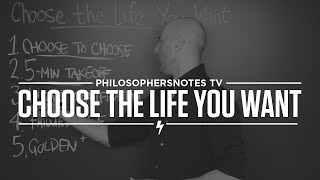
Brian Johnson summarizes Tal Ben-Shahar's Choose the Life You Want (a book of 101 choices for creating happiness). He highlights five core takeaways from the book: (1) "choose to choose" — be aware moment-to-moment choices; (2) the "five-minute takeoff" to beat procrastination (just start for five minutes); (3) balance instant and delayed gratification via "happiness boosters" (integrate short-term pleasures with long-term goals); (4) the "Failure Hall of Fame" — reframe failures as stepping stones and learn to fail well; (5) adapt the Golden Rule and add a "Platinum Rule" to be kinder to those closest to you and to yourself. The host situates Ben-Shahar as a popular Harvard teacher and references his other books (Happier; Pursuit of Perfect/Being Happy).
Chapters
Hi, this is Brian. Welcome back to Philosopher's Notes TV. Today, another great book, choose the life you want. 101 Ways to Create your own road to happiness by tall Ben Shahar Tal. Ben Shahar is one of my favorite teachers. We've done notes on his book Happier, which was based on a class he taught at Harvard which was one of the most popular, largest classes in Harvard's history on positive psychology. He also taught a class there called the Psychology of leadership. The two combined for something like 1400 students. 20% of the undergraduates at Harvard were enrolled in Tull's class at one time, which is pretty extraordinary. Great guy. We did Happier. And then another one of his books called the pursuit of Perfect. They renamed it and now call it Being Happy. I'll put links to both of those below the Philosopher's Notes and episode on it. But anyway, great guy. He does a wonderful job of integrating the rigor of science as an academic with the fun of self help as a great teacher. So let's look at five of my favorite big ideas from this great book. Choose the life you want. The first big idea is we need to choose to choose. This is a big idea. Too often we think that the quality of our life is determined by our choices in the big decisions. Kind of the big decisions, right, of who to marry or what to do in your career and where to go next with your job or whatever. Those are big decisions. Those are obviously important. But the reality is the, the micro decisions, the tiny little choices we make day in and day out and literally, as Tal says and a ton of other great teachers tell us, those choices are every single moment. Those choices add up to the biggest difference in your life. So the first choice we need to make is to choose to choose. The hardest part actually isn't the decision, it's the realization that we have a decision to make. We're at a choice point. So when we're in a challenging situation at home or the office, we need to step back and see, wow, there's a choice right now. I can choose to step forward into growth and be the highest version of myself or not. So being aware of that choice is huge. This is the first chapter in the book. Choose to choose. Choose to choose. Don't be unconscious. First big idea. Second big idea is awesome. And again, the book has 101 choices. Little and big choices we make in our lives. He says, you can do this or you can do that, right? So this one five minute takeoff is in a chapter about procrastination. So he Says essentially you can choose to procrastinate or just do it. And he says the number one tip, he references Albert Ellis in a book on procrastination. I'm going to order today. Quite excited about getting that. But he references Albert Ellis, one of the world's leading 20th century psychologist, where I think he got this idea. Five minute takeoff. So if you're having problems procrastinating, what you need to do, if you want to quit that or want a way to quit it anyway, is to just start. Give yourself five minutes to do something, whether you feel like it or not. We talk about this all the time, but someone who tends to procrastinate is checking in on how they feel way too much. And when we're in a procrastinating mode, I've certainly mastered procrastination in my past. We're thinking that we need to be inspired. Ah, you know, I can't do it because I'm not inspired. I'm not feeling it right. Just start by starting. You move through the resistance and shockingly, you find energy. Five minute takeoff. It's a really big idea. Try it the next time you get stopped. Don't expect wonderful results, but just show up. This is the hallmark of turning pro. It doesn't matter what we feel like, we do what needs to get done. Huge tip to move from procrastination to just doing it. The third big idea, instant gratification. So we all know the power of delayed gratification, but sometimes we need instant gratification. And Tal is the one who introduced the idea of the rat racer, the hedonist and the nihilist and the happy person. We talk about it in the note on his book Happier Again. I'll have links below. You can check out. But the rat racer is always orienting to the future. They're really good at delaying gratification, but they're not as good at experiencing gratification in the moment. Now, the hedonist, on the other hand, is all about instant gratification. It needs to work on having some goals that are motivating them. And the happy person is the one who integrates both, who's able to have delayed gratification via goals that are going to achieve over the long run and instant gratification. And Tal talks about the fact that when he used to burn himself out, he would constantly be working and he wouldn't check in on what he needed to experience now to keep the fuel so that he can stay energized and zestful and all that Good stuff. So anyway, he created something called happiness boosters. Happiness boosters. We want to think about the things that give us joy. Now, for Tal, it's things like listening to music he loves or reading some poetry, even reading some fiction, maybe meditating. I like those things. Not a huge poetry reader these days, but I like those things. And I also like little napitations. That's an energy booster. And I can choose. I can continue to work and grind past the point where I'm starting to get a little tired, or I can step back and do a happiness booster, meditate, take a few deep breaths, even just look out my office window at the mountains is restorative. Maybe go for a hike. What are your happiness boosters? What are the things that you do that make you feel good? And how do you integrate them into your life more consistently? Have a list. And when you're starting to feel a little bit tired, you're going to go do things you're not going to be proud of. Check in and see if you can boost your energy with a happiness booster. Get some instant gratification. That's the third big idea. Fourth big idea. The Failure hall of Fame. The Failure hall of Fame. So Tal has a great line. He says, learn to fail or fail to learn. We need to learn how to fail well. And he says, look, the greatest people in history, the ones we admire the most, are members of the ultimate hall of fame, but they're also members of the failure hall of Fame. And I just love that vision. And whether we're talking sports, like Babe Ruth, the home run king, he led the league in strikeouts five times as well. You can't have one without the other. It goes with the other. Abraham Lincoln failed at business multiple times. Nervous breakdown at 27, lost eight elections. He's one of the greatest human beings our planet has seen, but he's a member of the Failure hall of Fame. Then he talks about Thomas Edison, who Some,093 or something like that, patents some large number, most in history. But he failed tens of thousands of times. Of course, we know that he didn't perceive those as failures. They were just ways not to do it. Ways that didn't work. They weren't stumbling blocks, as Tal tells us. They were stepping stones. We need to orient ourselves that way if we want to do great things again, whether that's in our families being a better parent, when our communities as a volunteer or in our work environment doesn't need to be, you know, cover the magazine type of stuff. But we need to be willing to make mistakes. And when we make those mistakes, we don't beat ourselves up. We say, needs work. What would I like to do? And proudly go for it. And realize you can't have one without the other. You can't have the greatness we aspire to in whatever form that is. And no failure. They go together. But remember, stepping stones, taking you closer to where you want to be, not stumbling blocks. That's the growth mindset versus the fixed mindset, etc. Now, the fifth big idea, the Golden Rule. He says we need to tweak that a little bit and suggest that we think about the fact that it's a little weird that sometimes we treat strangers, people we just met with more kindness and patience and generosity and love even, than we do the people with whom we're closest, who we truly love the most and who love us the most. For some weird reason, we're nicer to these people than we are to those who are closer to us. Closest to us. He says we need to modify the Golden Rule a little bit. He says, do not do unto those who are closest to you that which you would not do unto those who you barely know. It's an awesome little tweak. Keep that in mind. He has another tweak on the Golden Rule that he calls the Platinum Rule. He says, why be nice to other people? Whether it's people closest to us or people we barely know, we need to be nice to ourselves as well. And of course we want to do both. But he says his Platinum Rule is do not do unto yourself what you would not do unto others. It's a huge idea. I talk about this a lot in my classes and otherwise. If you took your mental dialogue out of your head and made it a person and then had that person talk to you the way you talk to yourself, that person wouldn't stay in your life, period. So we need to treat ourselves with the same compassion we would treat others. That's our Golden Rule. Plus the Platinum Rule. And again, remember, bring some more love to those closest to you more consistently. Do not do unto them those you are closest to that which you would not do unto those who are a bit further away from you. That's a quick look at this great book. Choose the Life youe Want. Golden Rule, Platinum Rule, the Failure hall of Fame. It's probably. Join it. Instant gratification needs to be balanced with delayed gratification. Rat Racer. Hedonist. Happy person. Five minute takeoff. If you procrastinate, just get going. Give it five minutes. You'll be shocked. Try this out. It's stunning how you can get in the flow when you do that. And it feels good for so many reasons. Being the kind of person that can move through that resistance and then to realize, wow, this works. You don't need to procrastinate so much going forward. Final idea, choose to choose. Life isn't about the big dramatic moments as much as it is the moment to moment to moment to moment decisions. Choose to choose. Wake up to your life. Realize that every moment gives you that choice. Point and choose wisely. Hope you enjoyed whatever the biggest idea was that resonated most with you. See what you can do to move from theory to practice. Make it a part of your integrated, embodied life. Have fun with it, and I look forward to sharing more with you soon. Have another awesome day. See you.