PNTV: Coaching The Mental Game by H.A. Dorfman (#350)
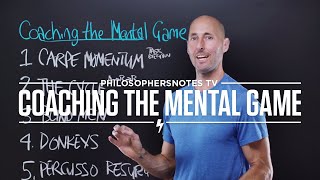
Harvey Dorfman's sports psychology framework teaches peak performance through mental discipline: seize momentum by staying task-focused, manage the three-part cycle of approach, result, and response, and practice relentlessness. The Latin phrase percussus resurgo captures it: struck down, rise again.
Chapters
Hi, this is Brian. Welcome back to another episode of Philosopher's Notes. TV Today we've got another great book, Coaching the Mental Game by HA Dorfman. Coaching the Mental Game Subtitle Leadership Philosophies and Strategies for Peak Performance in Sports and Everyday Life. Harvey Dorfman is an old school sports psychologist. The Major League Baseball website calls him a pioneer in sports psychology. He won a World Series ring as the mental toughness coach for the Oakland A's and the Florida Marlins. Although he preferred mental discipline to mental toughness, it wasn't about being tough per se, it was about being disciplined. Yeah, if you do the right things with your mind consistently, he would say every time, you will have the discipline that leads to the toughness. But don't go for the toughness per se, go for the disciplined mind and that will lead to the toughness that you want to have. So I love mental toughness, particularly as it relates to sports. We have over 20 philosopher's notes now on books like this. I'm excited to get through basically all the great books out there. We've got a ton already. As always. We have a philosopher's note with six page PDF, 20 minute, MP3, bunch of my favorite ideas. Here are five of them for us today. So the first idea in Coaching the Mental game is carpe momentum. Carpe momentum. Seize the moment. Harvey tells us we've talked a lot about carpe diem and the fact that you can't actually seize the day. Dan Millman came up with the phrase I love carpe punctum, which is his take on the moment. And then Harvey created this made up Latin phrase, carpe momentum. And I love this because it kind of captures the elements of both being in the moment and the fact that when you are in the moment, you create momentum. It's the only way to create momentum is being in the moment and then a specific phrase. I often talk about the fact that books come back to a particular theme again and again and again. Well, this is a theme that Harvey comes back to in all sports based mental toughness books. Basically all of them come back to this in one way or another. Task execution. The greatest performers are mentally disciplined such that they're not thinking about the past and they're not thinking about the future. They're just thinking about what needs to get done right now and they're executing that task. Harvey tells us that sports, it's simple. What's complex are the human beings engaged in it. But all we need to do in sports and in life is step Back and then step into the moment, execute the task. And the reality is this isn't just for peak performance on a sports field or arena. This is what all the great spiritual teachers tell us. Eckhart Tolle, the power of now, what is that? It's basically task execution. It's be in this moment, do what this moment is asking of you. Byron, Katie Loving, what is. She says the world never asks for more than one thing from you at once. Do the dishes or do whatever else needs to get done. Just focus on that. Don't create a big story about it, which is going to involve the past and the future. Focus on this moment. Carpe momentum. And in the process, you create momentum. As you focus on that moment, you lose momentum, you get back in the moment. One more thought here. Michael Phelps, the great, whatever, historically great Olympic swimmer, he's won 28 medals or something like that, 22 gold or whatever the numbers are. His big thing from his coach, Bob Bowman is what's important now, what's important now. That was his mantra, which is basically his way to get him into this tax. Task execution. And Bob Bowman says that's what made Michael Phelps different. Most people, he says if most swimmers feel good, they swim good. If they don't, they don't. But Phelps could make himself do what needed to get done. He constantly focused on this. What's important now. Task execution, carpe momentum. The second big idea is the cycle. So another theme that Harvey comes back to is the performance cycle. So there's three aspects to the performance cycle that are repeated again and again and again. In any activity, there's the approach, which is basically task execution. You want to approach whatever you need to do with as much excellence as you can. Completely focused on that. You have control over that. Then after your approach, there's a result. You do not have control over the result. You can do your best and the result can still be less than the best. That's just how it goes, right? This is kind of like the Apollo metaphor we used. Apollo was the patron God of philosophy. He was an archer. And Apollo knew that the only thing he had control over was shooting the arrow straight. But once he released the arrow, forces outside of him could control it and influence it. The wind could kick up, anything could happen. He wasn't in control of the results, therefore he was indifferent to the results and, and he was completely focused on the approach. Now, once the result happens, then you have your back in control. You get to choose your response. So three step process. Approach how you approach the task. The result from it, and then your response to the result. You want to ruthlessly focus on what's within your control, the approach and the response. Let the result be what it is. All you care about in terms of the responses. Getting back into task execution doesn't matter. Pass was dropped, you got a short term memory problem. You don't even remember it. You're back to the next task. What needs to happen. One of my favorite stories here, watching a Super Bowl a few years ago, I don't know what, two, three years ago, Tom Brady did this one play through an interception, but the next time he was in that situation, he ran the exact same play and got a touchdown. Short term memory, he was focused on the approach and the response. Sometimes you're not going to have an ideal result. Irrelevant to the mentally disciplined peak performer. That's our cycle. And again, that repeats itself every single day, not just in sports, but in our lives. The third big idea here is a fun parable which you may have heard. And Dorfman shares this story in the context of gaining perspective. So as a coach working with different athletes, different athletes will have different perspectives. You as a coach need to realize that and cater your language and craft your language to meet them from where they're coming from, right? But he uses this parable to bring the point home. So imagine six blind guys who have never seen an elephant. Rewind. Right. Ancient times. This comes out of India. Classic Hindu, Buddhist, Jainist story, right? So you've got six blind guys who come up to an elephant. They have no idea what it is. And they each approach the elephant from a different perspective. So the first guy comes up and he touches the elephant's side and he says, wow, the elephant's like a wall. It's just this thick mass. It's like a wall, right? And another guy comes up from the, from behind and he touches the tail and he says, nah, the elephant's like a rope. Feel this thing, it's like a rope, right? Another guy comes from the front, he touches the trunk and. And he says, ah, man, the elephant's like a snake. Another guy touches the ear and he says, no, it's like a big fan. And then the sixth guy touches it from. Touches the elephant's leg. He's like, this is like a tree trunk, right? Now these are blind guys who had one perspective, a partial perspective, but they were all convinced they were 100% right, right? So they had a partial truth, but they thought that partial truth was 100% right. And Ken Wilber makes the Point that no one is smart enough to be 100% right. We all have a partial perspective. We're like those blind guys. Now, we might be touching the tail and the side and the leg, but we're still partial. We're never going to be 100% right. So the best among us, the wisest communicators and relators among us know that, and they step back, and they never pretend they're 100% right, and they never pretend that someone's 100% wrong. No one has 0% of the truth, and no one has 100% of the truth. So if we want to navigate challenging conversations, whether that's with our spouse or with someone who voted for someone else politically, we don't want to start with the differences. We want to start with what we share in common and say, yeah, okay, I can see that perspective. Right? We want to find the partial truth in our mutual perspectives. And. And then we want to respectfully, gracefully get to the outer edges still with humility, that we may not have it all figured out while we navigate toward a shared truth. That's a good way to build perspective. The blind men. And then he had a couple other great parables. So let's share one more. He's got a story about donkeys. So this story is to bring the point home that as a coach, you can't make everyone happy all the time. Not possible. If you try to do that, you're going to drive yourself crazy, and you're not going to perform at a high level. So here's the story of the donkeys you might have heard as well. So rewind. We're back in ancient times. You've got a father and a son who need to travel across a few different towns to sell their donkey, right? So they start off early in the day, and the dad is walking with the rope pulling the donkey, and the son, the little boy, is on the donkey, and they cruise into the next town. And some people are in that town, and they say, I can't believe it. You know, the boy with strong young legs is sitting there on the donkey while his father's walking. What's going on? Right? So the dad and then the son say, oh, wow. And they switch places and they walk into the next town. And this time, the son is leading the donkey, and the dad is on the donkey, right? And now the townspeople say, I can't believe it. Right? That's strong man sitting there on the donkey while his little boy's got a walk. What's this world Coming to. That's crazy. So the dad and the son are like, really? Okay. And they both hop on the donkey. So now they're both riding the donkey into the next town. And those people say, are you kidding me? Two people on the donkey? That poor donkey. That's so inhumane. I can't believe they're doing that. So they jump off, and the dad's thinking about it for a second, and he comes up with a brilliant idea to go to the shop in town, and he buys this big piece of bamboo and. And some rope, and they tie up the donkey's legs and they tie him to the bamboo pole. And the father and the son carry the donkey into the next town. And of course, in that town, everyone's looking at it and saying, are these guys crazy? Why are they carrying their donkey? And the moral of the story is obvious. You can't please everybody all the time. So quit trying. Do your best. Do you feel to be right? Learn from your mistakes and let that be adequate. Remember the donkeys. And there you go, donkeys and blind men. Then, our fifth big idea here is percusso risurgo. So another Latin phrase. This one is a real one. Percusso risurgo. This is from a section on relentlessness. A mentally strong, a mentally disciplined and tough competitor is relentless. And in working these cycles and executing the task, they're struck down and they rise again. Percusso risorgo. Struck down, rise again. Relentlessly. Angela Duckworth misses science of grit, says that if she was ever going to get a tattoo, she would get one that says, fall down six times, rise seven or fall down seven times, rise eight. Doesn't matter. Struck down or rise again. We need to be relentless in our pursuit of our highest potential. We will be struck down as we're pursuing goals that are worthy of us and we must rise again. That's what the mentally disciplined among us do. Knowing we're not going to make everybody happy all the time, knowing our perspective is always going to be limited and being spacious for others, and then approaching the cycle with a level of mastery or approach, results, response. We can control the approach and the response, not the results. So quit thinking about that. Connect this back to 4Dx. The four disciplines of execution focus on the lead. Measure the lead. The lag is the result of your activity. The lead is your approach and your response. Focus on that which can influence the result. And then carpe momentum. Now, what needs to be done? What's important now? Execute the thing that's in front of you. Moment to moment. To moment. To moment. To moment. I've got this written on my whiteboard right now. Task, execution. What's important now? The mentally strongest among us focus on that ruthlessly. Moment to moment. To moment. Oh yes. The most spiritually enlightened do as well. I love it when there's parallels and there always are. So coaching the mental game, what was your favorite big idea? What jumped out and landed? How will you go from theory to practice, making a more integrated, embodied part of your life starting today. Get on that and make today another awesome day. See you. Do you know what the word hero meant in ancient Greek? Get this. It didn't mean tough guy or killer of bad guys. It meant protector. A hero has strength for two. A hero's secret weapon. Love, Compassion. Empathy. Quite simply, a hero cares. And very importantly, a hero is willing to do the work required to optimize and build the strength to make a difference in their families, communities and world. And you know what? Our world needs heroes today more than ever before. We need you to be a hero. And helping you optimize your life so you can actualize your heroic potential is what Optymyze is all about. We have dozens of what we call wisdom packs to help you optimize every facet of your life. From getting more clarity on your purpose to setting and achieving goals. Dialing in your energy with the best wisdom on nutrition, movement, sleep and meditation, and creating grounded confidence and the ability to show up at your best day in and day out. Our wisdom packs are filled with hundreds of philosopher's Notes which are 20 minute book summaries that help you apply the most powerful ideas from the best books to your life today. And members get dozens of hour long masterclasses to master the most important facets of their lives. Every hero has a guide on their hero's journey. Harry Potter had Dumbledore, Dorothy had the Good Witch of the North, Luke Skywalker had Obi Wan Kenobi and Yoda. I'm kinda like your virtual Obi Wan with a little less hair and well, no lightsabers, but otherwise. Or perhaps more accurately, I'm kinda like your philosopher guide who stuffs your wisdom packs with all the best ancient wisdom, modern science and practical tools from all the best Yodas, Dumbledores and good witches out there so that you're supercharged and ready to rock your epic heroic quest. If that sounds like fun, we'd love to have you join us. Optimize your heroic potential actualized.
More from Brian

Heroic +1: What’s THE Most Creative Act in the Universe?: Turning Around Glitches (#2024)









