PNTV: Drive by Dan Pink (#289)
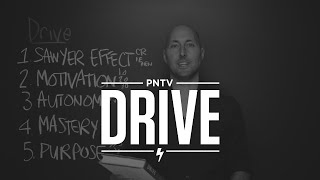
Dan Pink argues that carrots and sticks actually undermine motivation. Real drive comes from autonomy, mastery, and purpose. Pink calls this Motivation 3.0, and Brian Johnson walks through how it works with examples like the Tom Sawyer effect.
Chapters
Hi, this is Brian. Welcome back to Philosopher's Notes tv. Today, another great book, Drive by Dan Pink. Drive Subtitle the Surprising Truth about what Motivates Us. This is an awesome book. Dan Pink is an extraordinary writer. He also wrote A Whole New Mind.
And and to sell as Human.
We need to cover both of those. Still for now, let's look at the surprising truth of what really motivates us. Philosopher's Note with a bunch of big ideas. Five of my favorites here. We'll start with number one. What doesn't motivate us? What doesn't motivate us are contingent rewards. Contingent rewards. If you do this, then you'll get that. We think it works because it's everywhere.
We're going to talk about it.
The next big idea. He calls this motivation 2.0. Carrots and sticks.
Right?
If you do the this, then I'll give you that. But the reality is, the research shows pretty much the opposite, that when you make something contingent, you remove the intrinsic motivation to do it, which is the most powerful motivational drive, which is part of Motivation 3.0. He also talks about something called the Sawyer effect to bring the point home. So you might remember that Tom Sawyer, Mark Twain tells us, had the task of painting a fence and he didn't want to paint the fence at all. Right. Wasn't excited about that, to say the least. But what did he do? He acted like it would be the coolest thing ever. Right? He's like, oh, yeah, I get to paint the fence. This is awesome. And then what happened? Then his friends wound up paying him for the privilege of painting the fence.
Right.
Well, the interesting thing is the opposite happens as well. When you pay people to do something, there's an implicit it's not worth doing on its own. Any jokes Dan Pink does about the fact that you want to get your kid to never want to take out the trash again, pay him to do it. Right. And I talk in the note about longer conversation about chores and allowances. Both are good, but you don't want to combine the two. You don't want to pay someone allowance for doing chores. Chores are really a moral opportunity to serve your family. That's what we do. We pull together. Different people do different things. But when you put money on that, and it's important to have an allowance so you can learn how to deal with money. Right. But when you conflate the two, you diminish what should be intrinsic motivation in a sense of moral kind of responsibility to pull your weight in your family. Right. Whole other conversation. The point here remains. You want to get rid of the carrots and sticks. If then contingent rewards and find more intrinsic ways to motivate. Here's an example from the Johnson house. So we've been thinking about this where our son Emerson's three and a half years old, right? And. And every single time we've done the dishes or taken out the trash, we've made it seem like it's awesome, right? Not knowing about the Sawyer effect in this context, but it's exactly what we're doing. We're like, hey, you know, we get to do the dishes again. When you're older, you'll be able to help out. Right now you're a little bit too little. And then what happens? He wants to help out all the time. He does all the little things because he's fired up to do it. We didn't say, oh, this is a pain, I can't. When you're older, you're going to have to do this. No, make it awesome, make the mundane cool. And then he's excited to do it. So that's our quick look, somewhat meandering look at the Sawyer effect. Contingent rewards is not where we're at. So let's go to motivation 1.0, 2.0 and 3.0. So motivation 1.0 equals survival, right? The drive in motivation 1.0, kind of the operating system that's running humanity, right? Back in the day was motivation 1.0. Old school operating system. All you needed to do, the fundamental drive was to survive 2.0. What did we bring in? We brought in carrots and sticks. This is our contingent reward. If you do this, then you'll get that. If you don't do this, then you're going to get that. That's how nearly all businesses operate today, right? And Certainly in the 20th century, the best businesses and the best individuals, though, have moved to a deep sense of Motivation 3.0. This is intrinsically motivated and it has three facets to it, which are our next three big ideas. Autonomy, mastery and purpose. In this Motivation 3.0, the drive is to basically express yourself and to live with more autonomy, more mastery and more purpose. So let's walk through each of those in detail. Autonomy. Autonomy is kind of an umbrella way of looking at intrinsic motivation. The opposite of autonomy is being controlled. If I have autonomy, I have control over things that I do. He talks about the different T's of autonomy, right? So you can have control and autonomy over your time, over your task, over your technique, over your team. There's one more I'm missing there. And over your technology, right? How you do it or not, or all those things can be controlled. If all those things are controlled, then there's more of coercion to get you to do things than an autonomous choice to do things. Dan says that autonomy is like the sun of the Self Determination Theory universe. So the researchers he talks about a lot in the book include Edward Dece and Richard Ryan. We profiled Ed Deci's work in. In why we do what We Do Right. They created Self Determination Theory, sdt. And at the heart of Self Determination Theory is an ability to determine your own self and what you're doing. That's autonomy. And this is another reason why the contingent rewards are so dangerous. If someone's basically coercing you through carrots and sticks, you lose your autonomous choice. And again, there's a ton of fascinating research that you can take kids who enjoy drawing, for example, and you can say, hey, we'll pay you to draw. And then you watch them in the weeks ahead. It diminishes their engagement in the activity they once found intrinsically motivating. Now, because you tied in contingent rewards to it, they actually decrease their performance. You snuff out the third most vital drive.
Right.
That's a quick look at autonomy. The second facet of our motivation 3.0 is mastery. So this is probably my favorite chapter in the book. He talks about the three Laws of Mastery. The three laws of mastery are. One, mastery is a mindset. Mastery is a mindset. We'll talk about these in detail in a moment. Two, mastery is a pain. And three, mastery is an asymptote. One of my favorite words, asymptote. So, number one, three laws of mastery. Mastery is a mindset. Specifically Carol Dweck's growth mindset or incremental mindset. You're not fixed if you think that your talent is fixed. You won't even put in the effort to try to get better. So mastery starts with a mindset shift where you know that you can get better if you put in the work the second law, which is very important to embrace this. It's a pain. Mastery is a pain. We just talked about this in our review of Peak by Anders Ericsson, who's the authority on expert performance. We talked about the fact that it takes a lot of deliberate practice to get better. It's a pain. You need to stretch outside of your comfort zone. Remember the fact that you're not going to grow and get better if you aren't willing to go out of your comfort zone. And that's not easy. If you're not grimacing a bit while you're doing whatever it is you're doing, you're not focused enough, you're not trying hard enough. It needs to be a little bit of a pain so you can move out of your comfort zone. And then your body adjusts to create a new level of homeostasis and overcompensates. But that requires a little bit of that pain. Same thing with going to the gym. If you want to grow your muscles, you got to go a little beyond your current capacity. Not so much that you injure yourself or snap, right? But enough that your body has to overcompensate and get stronger. The third idea is a cool one as well. Mastery is an asymptote, right? What does that mean? It means that if you had a straight line and you had a curved line that was approaching it but never quite hit it, that's an asymptote, right? So mastery is an asymptote, which means that you're never going to achieve perfect mastery. You're always going to be stretching, you're never going to be approaching that line, your true mastery and actualization. But you're never going to quite hit it. And that's a really important thing to keep in mind. You're never going to hit it in any one thing you do, and you're never going to hit it in the ultimate game of life. And when you embrace that fact, then he says, you know that you're not going to get mastery on day three, which makes it more likely that you might get it on day 3000. But then you also know that at that point you're going to stretch your standards. You're going to continue to show up and get a little bit better, knowing you will never fully hit that. The perfectionists among us think that it's not an asymptote. They forget the fact that it's an asymptote and that it's painful and that it requires a mindset of long term commitment to getting a little better day in and day out. Fifth big idea is purpose. So we have autonomy, mastery and purpose. The three facets of motivation 3.0. Purpose. You need to be engaged in something bigger than yourself, right? That's the essence of purpose. And again, carrots and sticks. It's all about you. You're either going to get a bonus or you're going to get a higher salary or whatever. With Motivation 3.0, it isn't just all about you. You're intrinsically committed to doing something that's in service to something bigger than yourself. He has two great questions to help us elucidate our purpose. The first one is a big question and the second one is a small question. The first big question is this. He shares the story of an advisor to John F. Kennedy who said to him, one of the early, first women to be in Congress, right? He said, look, jfk, you're trying to do too much. Great leaders can be summarized in one sentence. Abraham Lincoln's sentence was something like he saved the Union and freed the slaves. And you had Roosevelt, whose sentence was something like he won the war and let us out of the Depression. One sentence these great leaders could summarize their entire lives into. And she said, jfk, you're at risk. You're trying to do too many things and you're at risk of having a muddled paragraph. What's your one sentence? So I ask you, what is your one sentence? If you were going to capture your legacy, which we just covered in one sentence, what would it be? And Dan tells us it can be he raised, or she raised three. Three healthy and thriving kids who made a contribution to the world. Awesome, amazing sentence. It could be something in a different scope, right? What is your one sentence? That big question that captures the essence of who you are and what you want to do. The little question that we ask connects that big, big vision to our next baby step. And he says, did I get better today? At the end of each day, ask yourself if did I get a little bit better today? You connect that one sentence, big vision, dream of what you want to do in the world with your small question of did I get a little bit better today? That's the essence of creating and cultivating our purpose. Stretch. Hold that dynamic tension by getting a little bit better day in and day out. March toward that. As you gain more mastery, you create more and more autonomy in your life and you tap into the really strong drive of motivation 3.0. You let go of the contingent rewards of our if then carrots and sticks. And that is a super quick look at this great book drive. I hope you enjoyed and I look forward to sharing more soon.
See you.
Hi, this is Brian.
I hope you enjoyed that PNTV episode.
A lot of people don't know all.
The stuff I do beyond these free videos I share on YouTube, so I thought I'd do a quick video to give you an overview of our membership program that you can get access to and get a Ton of other stuff. So here's a quick look. 10 bucks a month Join the Optimal Living Membership program. You get Instant Access to 250 Philosopher's Notes on some of the best optimal living books out there. Old school classics, positive psychology, modern stuff, Mindfulness, Peak Performance, purpose, neuroscience, wealth, etc. And what you may not know is that in addition to the PNTV episodes, I create PDFs on all these great books. So six page PDFs. Let's take a look at one of them. Joseph Campbell, you want to figure out.
How to live your hero's journey?
Well, this is a great place to start. I basically pull out my favorite big ideas, riff on them, connect them to other books and other ideas, and help you apply this wisdom to your life today. That's what the PDF looks like again. We have 250 of these on all these different great books. And then I record those PDFs as an MP3 so you can listen to that MP3 while you're on a walk or working out or doing some errands or whatever that is. Philosopher's Notes. A lot going on there. And then in addition to Philosopher's Notes, you get access to Optimal Living classes. Optimal Living 101 idea here is that all those great teachers come back to the same big ideas again and again and again. I distill those ideas into classes. Super practical, fun, inspiring classes ranging from Habits101, Confidence101, Getting Stuff Done101, Meditation101, instant access to all those classes and then Future classes include Relationships 101, Energy 101 Purpose 101 business goals, etc. Those are our full length classes. And then I create micro classes. Two to three to five minute little bursts of wisdom on my favorite great ideas from these great books across the domain that you want to optimize in your life. So we have dozens of these so far. I create 50 new micro classes every month and 10 new philosopher's notes every month for 10 bucks a month. So we're blessed to have thousands of members who are enjoying the program and sharing some incredibly kind words with us. And super simple. 10 bucks a month. Cancel anytime. Would be honored to be a bigger part of your life and I appreciate your support. And here's to optimizing and actualizing.
More from Brian

Heroic +1: What’s THE Most Creative Act in the Universe?: Turning Around Glitches (#2024)









