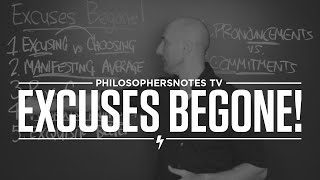
Brian Johnson (Philosopher’s Notes TV) summarizes Wayne Dyer’s book "Excuses Be Gone," presenting five core takeaways aimed at replacing excuses with empowered choices. He emphasizes practicing to raise your "manifesting average," turning pronouncements into committed (and recommitted) actions, cultivating vigorous enthusiasm through connection to the divine within, and developing "exquisite belief" — deep self-trust that reduces excuses and increases self-efficacy.
Chapters
Hi, this is Brian. Welcome back to Philosopher's Notes. TV Today, Kindle book, Excuses Be Gone by Dr. Wayne Dyer. Great book. Philosopher's Note, bunch of big ideas. We've got five of my favorite big ideas here, along with a new piece of chalk. Always an exciting moment. We have notes on Dyer's power of intention, real magic, among others. One of my favorite teachers, great wisdom. This book is packed with big ideas on how to deal with what Dyer describes as the 18 primary excuses in our lives. First big idea we want to focus on here is we need to recognize that there's always a choice between excusing and choosing. So the entire book is basically getting us to move from excusing to choosing. If we don't like something in our lives, we want to quit making excuses about why we don't have what we want and choose a more empowered response. Excusing to choosing. Basically taking the locus of control that we put outside of ourselves every single time we make an excuse. I'm too old, I'm too young, I came from this family or my genetic background is this or that or whatever, or et cetera, et cetera, et cetera. Excuse, excuse, excuse. We put power outside of ourselves. The locus of control is outside of ourselves. Psychologists are unequivocal. You need to bring that control within an internal locus of control. Now, of course, you can't control everything that's going on in the environment, but you can control how you choose to respond to any given situation. So we want to get rid of the excuses, make them be gone and choose what we want in our lives. That's what the book is about. Second big idea, manifesting average. So Dyer talks about the fact that if you wanted to increase your bowling average, let's say that you have a certain average as a bowler and you wanted to get better, what would you do? You'd practice. And you'd practice whether it's an hour a week, or if you wanted to get really good, maybe an hour a day, or if you wanted to go pro on it, you'd hustle and you'd put in your 10,000 hours. You'd be practicing a solid four, six hours a day, four, five, six days a week to get your bowling average up. Right? If you were truly all in committed about it. Well, if you want to increase your manifesting average, the consistency with which you're able to create the things you want in your life, whether that's optimal health or a certain business or relationships or living on purpose or whatever, you need to practice. You need to put time into getting better at manifesting Big idea. We know this to be true, but we need to pay attention to it and actually live it. Manifesting average is only built via practice. Third, big idea. P versus C. These words did not fit in that little section, so I will write them here. Pronouncements versus commitments. We need to pay attention to the frequency with which we make pronouncements about what we're going to do, how we're going to change our lives that we actually aren't 100% committed to doing. And we want to stop doing that. Because when we make a lot of pronouncements, I'm going to do this, and two or three days later you're not doing that. Excuses tend to come in. If you want to make excuses, be gone. We want to discipline ourselves to quit making so many pronouncements and focus on making commitments. And when we make those commitments, remember that this biggest part of commitments is recommitment. You're going to be all excited. You're going to make a pronouncement and in fact, a commitment. But guess what? You're exhilaration at the stage in which you make the commitment is going to wane. It's going to waver. Then you need to recommit again and again and again and again. So think about that. I talk about this in the context of heroes in the beginning. Eknath Eswaran, the great meditation teacher, tells us that in Sanskrit there's a phrase for individuals who are heroes. In the beginning. They start a meditation practice with trumpets and fanfare, and everyone's celebrating their new practice, their pronouncement. Then the moment it gets hard, they tiptoe out the back door is what Eswaron says. We want to notice how often we do that and make commitments. Make commitments. One of the things I was talking to Steve Chandler's group of coaches about last weekend was an idea related to commitments that Eric Maisel shares. Eric Maisel is one of the world's leading creativity coaches. He wrote a great book called Fearless Clothes Creating. He talks about the fact that you need to belligerently commit. Belligerently commit to a project, whether it's a novel you might be writing or a business you're creating. Belligerently commit. But then he says, belligerently commit provisionally. You don't know what data might come in that might influence your decision and what you committed to. But you do want to move from flighty pronouncements that you don't intend to go for to belligerent commitments or with an asterisk that, hey, you might find out that down the road this isn't quite what you want to do. That doesn't mean that when you don't feel like meditating, you don't feel like writing your novel that you said you were going to write. It doesn't mean that you walk away. Then that's the last time you want to walk away. You want to commit, recommit, do what needs to get done, continue to do what needs to get done, and check in and see. Wow. Knowing what I now know, is this really the path that I want to pursue? Big idea. We'll be talking about that more and more, but pay attention. P versus C. Pronouncements versus commitments. We want to err toward commitments, make less of them, 100% commitments. And then go crush them. Vigorous enthusiasm. So Dyer tells us that passion trumps excuses. If you want to make excuses, be gone. Get passionate about your life. And he says, think of it like a vigorous enthusiasm. Vigorous enthusiasm. I love that phrase. And of course, he connects enthusiasm to its Greek roots, En plus theos. God within. That, Dyer tells us, is the most important relationship in our life. The connection to the relationship with the highest within ourselves. The divine, universal intelligence, God, whatever you want to call it. Everything we do these sessions is essentially to help us connect more deeply to the highest within ourselves so we can live with a vigorous enthusiasm. When we have a vigorous enthusiasm, we're not making a lot of excuses. We're choosing day in and day out, moment in and moment out, stepping forward into growth. And we're connected and guided by something bigger than us. So all the things we want to stop doing, the habits we're going to let go of, the things we're going to introduce into our lives from the exercise and nutrition and rest and everything else, is really all about helping us connect to the divine within so we can live with a vigorous enthusiasm. That's our fourth big idea. Fifth big idea. Exquisite belief. Another phrase I love, exquisite belief. When we are connected to the God within, we have an exquisite belief, an inherent trust in ourselves and in that life force. Universal intelligence. The God that's within, that's flowing through us. It's confidence 101. It's intense trust in self. When you intensely trust yourself, you have a supreme level of confidence. As Dyer describes it, you don't need to make excuses. They're gone. Things won't always go the way we want. We don't need to make excuses about it. We can learn from it. We can make the obstacle the way it get a little bit better. Turning poison into medicine. Not comparing ourselves to other people and how they're doing and whether we're ahead or behind or whatever but focusing on how we can more authentically express ourselves more consistently by connecting to the highest within ourselves, focusing on our commitments rather than going from pronouncement to pronouncement to pronouncement to pronouncement. And then in the process of course we're increasing our manifesting average. Which does what? That's a great way to boost our self efficacy. The Science of Self Confidence Self efficacy says the number one way to boost your confidence is prior success. If you practice this stuff and you get a little bit better, guess what? Your belief in your ability to do it goes way up and you excuse less and choose more and more and more and there you go. Quick look at this fun great book. Let's make our excuses begone and have another awesome day. See you.