PNTV: Grain Brain by David Perlmutter (#205)
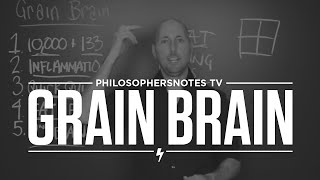
Brian Johnson reviews David Perlmutter's argument that grains and excess carbohydrates drive brain inflammation and disease. Modern wheat consumption hits 133 pounds yearly, while humans ate grains for only 10,000 years. The gut produces 80 to 90 percent of serotonin, making nutrition, exercise, and sleep foundational to brain health.
Chapters
Hi, this is Brian. Welcome back to Philosopher's Nerds tv. My first one after a week off. I missed you. I'm excited to be back. Great book. Grain Brain by David Perlmutter. Grain brain, Philosopher's Note, bunch of big ideas. This book is packed with rigorous science on the negative effects of grain on our brain. David Perlmutter is the only medical doctor in the United States who's both a board certified neurologist and a member of the American College of Nutrition. Super passionate, hard hitting, direct smart, grounded, scientifically rigorous guy. One of my new favorite teachers. We did a note in one of these episodes on another one of his books called Power up youp Brain on the neuroscience of enlightenment. And I'm going to do one later this week on his newest book, Brain Maker. Excited to share more on that. For now, five big ideas. I'll also preface this by saying, as a former vegan reading about and adopting a lower carbohydrate, high fat diet. If you had told me that I would do this five years ago, 10 years ago, I would have laughed. No possible way. But as I opened up to experimenting more and experienced the benefits, moving from a primary grain based diet as a vegan to a primarily fat based diet and what I'm doing these days, the benefits have been, for me, extraordinary. We'll talk about that in more detail in other episodes and other stuff that I do in my membership program and all that. But for now, first big idea, two numbers. I want us to think about 10,133. First, 10,000, 10,000 years ago. That's all it was when we first started eating grain in any quantity. Now, if you look at our evolutionary history over the last two and a half million years, 10,000 years is a heartbeat. It's nothing. And that's as recent as it's been that we've started eating grains. Now. We used to eat a tiny amount, a miniscule amount, perlmutter tells us back in the day. These days we eat. So we ate a tiny, tiny amount of what he calls einkorn wheat, right 10,000 years ago. These days, the average American consumes 133 pounds of wheat. Not Einkorn wheat, but some radically genetically modified and adapted form of wheat. We're going to talk about that more in an episode on Wheat Belly. I'm studying nutrition now, excited to share a bunch of new stuff in the days and weeks ahead. Anyway, think about that. 10,000 years ago is when we first introduced domesticated grains, had tiny amounts before, and now we eat 133 pounds of it a year. You don't need to think very hard to come to the conclusion that that just doesn't make sense. We evolved over millions of years doing one thing. Now we're doing something radically different. Might that be a contributor to the issues we're experiencing? And specifically, our second big idea, inflammation. If you read anything on vitality, well being, nutrition, optimal health, etc. What you'll quickly discover is that at the root of all diseases, even if different diseases have different symptoms and hit different organs within our body, they all have an underlying factor or cause, which is inflammation. Different people have different vulnerabilities, whether that's to their brain or their hearts or other parts of their body. But the root cause is inflammation. So we want to look at what's causing inflammation. And as you can imagine, in a book called Grain Brain subtitle, the surprising truth about Wheat Carbs and sugars, your brain's silent killers talks a lot about what's creating the most inflammation in our systems. And as you guessed it, it is grains, excess carbs, etc. And he specifically says that gluten is a silent poison. A silent poison. If you have gluten sensitivity that you know of, you shouldn't be eating gluten, period. And he says most of us, whether we are aware of it or not, or even if it's subclinical, even if we don't show up as having sensitivity, we are sensitive to it. And again, convincing arguments that he presents on the power of that. But test it if you have any brain issues. And this book, again, is all about optimizing your brain. I didn't mention the issues that he looks at, but everything from ADHD to depression to chronic headaches to Alzheimer's, obviously all neurological brain issues. And they're all impacted by our nutrition and specifically by our levels of inflammation. So gluten is a huge one. I haven't had gluten in a long time. But check in on that if you have any challenges focusing your attention or with mood or with. Or whatever. And we all do to a varying degree. And you eat a lot of wheat, and we all know processed carbs aren't good, but even the wheat isn't great for us. Next big idea. I'll use that as a segue on a quick quiz that he gives whenever he gives a presentation, puts up a little slide and he's got four pictures on this slide, right? He says, hey, which one of these has the highest glycemic index? GI Glycemic Index is basically a measure of how quickly your blood sugar goes up when you eat something. Right? Blood sugar is another huge variable we're not going to talk about right now that impacts your health. You want to get it in control. He says if you have to avoid one disease, avoid diabetes. That's the precursor to so much stuff that we don't want to experience. And of course, diabetes is related to our ability to regulate our blood sugar. So he has this slide up that has four different types of food and he says, which one do you think blows your blood sugar up the most, the fastest? Is it a slice of wheat bread or is it a Snickers bar? Or is it a spoonful of pure sugar? Or is it a banana? Which one? Slice of whole wheat bread, Snickers bar, spoonful of sugar or a banana. Which one would you guess jacks up your blood sugar the most? Most people wouldn't guess the slice of whole wheat bread, but that's exactly what it is, which is nearly equivalent to a slice of white bread. Now, people deny this, he says, but it's an indisputable fact and it has consequences. So there's your quick quiz again. Practically speaking, check in if you're eating a ton of processed carbohydrates. You don't need me to tell you that that needs to go. And then if you're willing to explore and experiment with what Dr. Perlmutter talks about, eliminate gluten and then consider eliminating your grains as well. It's a big idea. And again, if you had told me this five, six, seven, eight, nine, ten years ago, I would have literally laughed at you. And now I laugh at myself. Fourth big idea is fat. So this is one of the crazier things I've experienced. About two and a half, a little over two and a half years ago, Alexander and I moved away from a primarily vegan grain based, low fat diet to a more paleo approach. Eliminating the grains, bringing some animal protein in and bringing some fat in. Then I worked with a guy named Ben Greenfield, who's just a machine. Check him out@BenGreenfield.com super passionate about this stuff. I had my blood tested by WellnessFX, which I highly recommend. Ben was one of their consultants who our friend Sarah Gottfried had recommended, worked with him. He had me eat a ton more fat than I'd ever eaten, reducing my carbohydrates even more and focusing on bringing healthy fats into the equation. Stuff like avocados, coconut fat, coconut oil, olives, olive oil, et cetera. Omega 3 fats, not omega 6 fats. Whole other conversation. That used to be the fifth big idea, and I moved it out for this one. But you want to look at your ratio of omega 3 to omega 6 fats. Almost all of us are consuming way too much omega 6 fats, which is vegetable oils, which is not where you want to play. Whole other conversation for now. Fat. There's a difference between eating fat, fat, eating fat versus being fat. So I perhaps, like you, used to operate under the idea, the myth that eating fat equals being fat. It's not true. And my own personal case study of one demonstrates that. I went from a low fat diet essentially to a moderate fat to a really high fat diet, and my body fat percentage dropped from a little under 20% to under 10%. Nine, nine and a half percent easily. And I eat a crazy amount of fat. Again, another conversation. We talk about that, but we want to get rid of the myth that eating fat equals being fat. Not true. It's our intake of sugars and too much carbohydrates that leads to fat. Paradoxically, it's not the consumption of fat per se. Big idea number four. Fifth big idea is the fact that we have a second brain. Did you know that you've got your brain in your head, in your skull that we all know about, But Perlmutter talks about the fact that we have a second brain in our gut. And one of the stats that just blows me away is the fact that in this second brain, 80 to 90%, 80 to 90% of your serotonin is produced in your gut. So we all think about depression, for example, as a chemical imbalance in your head. The short response to that is, we'll talk about this in Brain Maker soon is that's just not true. That your gut, your nutrition, the quality and health of your intestines and your gut is what's going to impact your brain more than the little antidepressants you're going to take. So that serotonin that you want to have coursing through your system, 80 to 90% of it is coming from your second brain in your gut. I find that just absolutely astonishing. So think about that. And then the question again is, well, how do I optimize that if I want to have great biochemistry and the serotonin that makes me feel good going through my body, how do I optimize that? And our nutrition is such a huge lever. He talks about our big three, the fundamentals that we talk about all the time, nutrition, exercise, and rest. He dedicates a chapter to each of them in this book. They're the core fundamentals that all great teachers come back to. So there you go. So much more we can talk about. We'll save it for more. I'm giddy to share more on nutrition here and again in the classes that I'm teaching, etc. Second brain. You've got one in your gut. It's producing more serotonin than the brain in your skull. Fat eating it does not mean being it. Again. We're talking about healthy fats, omega 3 based fats versus our vegetable oil omega 6. Quick quiz. We had our glycemic index. Wheat bread versus Snickers versus spoonful of sugar versus banana. Shockingly, the wheat bread has the highest GI index. Inflammation. We want to identify the things that are leading and creating inflammation. Leading to and creating inflammation and get rid of it. At the very least, get rid of your processed carbs. Look at getting rid of your gluten and look at reducing, eliminating your grains, potentially substituting the fat. And then we have our two numbers. 10,000 years ago, it's like that. Evolutionarily, 133 pounds of wheat. That's nuts. From basically zero to 133. Kind of crazy. All right, grain brain. David Perlmetter is awesome. Hope you enjoyed and I look forward to sharing more with you soon. Have another awesome day. See you.
More from Brian

Heroic +1: What’s THE Most Creative Act in the Universe?: Turning Around Glitches (#2024)









