PNTV: How Champions Think by Bob Rotella (#377)
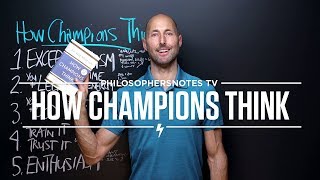
Brian Johnson breaks down Bob Rotella's book on champion mentality, using examples from LeBron James and other athletes. Rotella argues that champions think differently about pressure, failure, and their own abilities. Mental toughness isn't about being tough, it's about managing your thoughts.
Chapters
Hi, this is Brian. Welcome back to another episode of Philosopher's Notes tv. Today we have another great book, how champions think by Dr. Bob Rotella. How champions think in sports and life. Dr. Bob Rotella, as you may know, is. Is one of the world's leading sports psychologists. He's been at this for decades. He's worked with a ton of the leading golfers out there. I think his athletes, his golfers have won over 80 major championships. If you know golf, you know, that's a lot. He's also worked with LeBron James, rock stars like Seal, etc. So again, one of the world's leading sports psychologists. This book is how he tells us to think like champions. I picked it up after reading Chasing Excellence by another great mental toughness and peak performance coach, Ben Bergeron, the CrossFit Games coach. He quoted Rotella. We'll talk about that quote in the fifth. Big idea here. I loved it and didn't realize he had written this book. So I picked it up, got it, and here we are. So, great book. Philosopher's note, as always. There it is. Beneath my notes for this little talk, a bunch of my favorite big ideas. Five of them here. Let's start at the top. So I like to talk about the fact that if you look at one of my books, you'll see all the underlines and asterisks and circles and pages folded over, etc. And there's often a word that just jumps out again and again and again and again. In Lead yourself first little episode we did a couple back, the word was inputs, right? They said you need to create solitude and get rid of all the inputs. In this book, you want to think like a champion. The word was exceptional. Exceptional. Exceptional, Exceptional. Exceptional. He said it again and again and again that the greatest among us are committed to being exceptional. And by definition, if you want to be exceptional, you need to be exception. I mean, the definition literally is unusual, not typical. Right? So that's where it starts. Champions are willing to think exceptionally and say, you know what? I want to be an exception. I'm willing to do things that are going to be exceptional, different than what most people do. And then I want to be the absolute best I can be. Not just an exception and barely outside of the normal, but. But how great can I be? They have a burning desire to be as exceptional as possible. And this is similar to Ben Bergeron's idea in Chasing Excellence, his first characteristic of the dozen characteristics he teaches his athletes. Number one was commitment. Most people say, meh, I'm good enough, whatever. I don't need to work harder. But the best among us say, no, that's not good enough. I'm not content with where I am. I'm not willing to be complacent. I want to know what I'm capable of. I'm committed to being the absolute best version of me I possibly can. Again, that's why we do what we do. Optimize comes from the Latin optimus, which means the best. The question is, what's the best version of you look like? Think exceptionally. Be willing to dream. Let go of the limits. Think about what you at your absolute best would look like. Seriously, not rhetorically. Press pause. Think about you at your absolute best. Energy, work, love wise, you expressing the absolute best version of you. What's it look like? Be exceptional. Think exceptionalism. Second big idea is our actually from the same chapter where he talks about exceptionalism. In the very beginning, he talks about LeBron James. And the first time that he met LeBron James, early in his career, he was already a superstar. And Rotella knew his physical attributes, something like 6 foot 8, 250 chiseled pounds, explosive speed, et cetera, et cetera. So he was already impressed with LeBron. But he sat down with him and he said, hey, tell me about your goals. What do you want to achieve? And LeBron told him that he wanted to be the greatest basketball player in history. Exceptionalism. And Rotello said, I knew that he was skilled. I knew he had a lot of gifts. But when he said that, Rotella said, I knew he really had talent. It wasn't just his physique and his athletic skills, it was his mind and the fact that he was willing to think that big and then to match it with energy that was commensurate with that level of ambition. Obviously, it's not enough to think big big. You have to follow it up. Otherwise you fall into the vice that Aristotle talks about. You want to be magnanimous, you want to have a great soul, but you can't just dream about these things. You've actually got to do it, otherwise you're going to fall short and be silly anyway. So he told LeBron, that's fantastic that you want to be the greatest player in history. Then he said, where do you think you stand in relation to that goal? LeBron thought about it. He said, you know what? I think I'm doing pretty well. But if I want to be the greatest, I've got to win championships. And if I want to win championships, I've got to work on my three point shot, to help my teammates, etc, etc. Rotello said, okay, great, let's set some practice goals such that you can achieve that goal of becoming a better three point shooter, such that you can achieve your meta goal of being the greatest ever. So Anyway, he told LeBron to create a montage of him crushing his three pointers against the best defenders in the league, right? And to watch that montage of a few minutes of video and really feel himself performing at that level. And then he told him to hire a shooting coach and to make 200 three pointers off the dribble every single day, and Then make another 200 three pointers, catch and shoot three pointers, 200 off the dribble, 200 catch and shoot 400 three pointers a day. And Rotella said the number was arbitrary, but he needed to create a practice goal and then execute it every single day. And he said, I don't care where you find or how you find the time and how you find the energy, find it if you're committed to being that great and, and this is what you've said is getting in the way, and we agree this is what you need to do to make progress on that goal. Then find the time, find the energy. Obviously this doesn't have anything to do with LeBron. It has to do with you. So when you think about you at your exceptional best, what comes to mind? What do you want? What's your ultimate goal in life? And how do you stand in relation to that goal? And then if Rotello is sitting here coaching you, what would you guys come up with? What would you need to do on a consistent basis, on a daily basis in order to achieve that goal. Back to Bergeron, he says, the way you develop confidence is you identify the most important thing you need to do in order to hit your long term goals. And then you do it every single day. The hardest thing you need to do in order to hit the goal, then you have a level of confidence if you know you're doing your best. Which leads us to our next idea, you and God. So we've got you and LeBron. How about you and God? This is from a chapter on a confident self image. Rotella talks about how important it is to have a confident self image. Champions create their own reality. They have a very confident sense of self and self image. And we actually have classes on both Confidence 101 and Self Image 101. You can check out and they optimize membership. But anyway, with his golfers, he often says Imagine to cultivate this level of high self confidence, he says, imagine that God showed up and had a conversation with you, and God told you, hey, don't worry about it. You're going to have a great career. You're going to win dozens of tournaments, you're going to win several majors. It's all good. I've taken care of the results. All you have to do is just keep on working hard, right? And then before the golfer could ask God, oh, awesome, which tournaments am I going to win? God disappears. Poof, he's gone, right? And the goal for his assignment is to simply show up and work on their game. Work on their game, work on their game. And he says, you want to show up every Thursday night. You want to go to bed before your. Whatever it is. Thursday morning, before you start your tournament, which Thursday, Friday, Saturday, Sunday, right? If I'm a golfer, four rounds, you show up on Thursday morning, you're like, hey, maybe this is the tournament I win. Awesome. God's taking care of the results. I've worked hard. Let's have fun. Let's let it rip. We want that level of confidence where we believe that if we show up, if we do the work, it's taken care of, right? So again, think about what God would say to you and then think about what you need to do. LeBron had to find the time and energy for his three pointers. What are you going to find the time and energy for? Have that level of self confidence. And we can talk about this in a number of ways, but when I think of God coming and talking to us, I think of Eric Butterworth, who wrote a book called Discover the Power within you. This is one of Oprah's favorite books. Butterworth was a mentor of Maya Angelou and Amazing Guy minister, right? And he said, basically, you already have the power within you. That divine power is already within you. And then we talk about this a lot in different contexts, but the brief story is he says that that power is within you. It's kind of like the Niagara Falls, right? So the Niagara Falls has all this power, and it needed to be harnessed, it needed to be tamed, if you will, and then channeled in a specific direction. And Butterworth says, we're very much like that. And he riffs on the Sermon on the Mount where Jesus said, the meek shall inherit the earth. And he says, we actually mistranslated the word that was used in the Greek in the initial gospels, right? It was Praetus. Right? So meek was praetus. It's A meek translation and a weak translation of the word praeus, which really means tamed or disciplined. The disciplined shall inherit the earth. Those who have figured out how to allow God to flow through them harness that energy, kind of like Niagara Falls. Those are the ones who shall inherit the earth. So our job is really to create the structures in our lives such that the divine can flow through us more and more consistently. So think about that metaphor. If it resonates with you, think about God visiting you. If that resonates with you. And let the best within you come forth. That's a confident self image. Very quick look at that. And then we have another key aspect of Champions. Rotella tells us that he teaches his athletes and performers to do two things. One, train it, and then two, trust it. You've got to work really, really hard to develop your skills. And then you go from practice to performance. You let it rip. You trust it. You're not thinking about it when you're performing. You're putting in all the thoughtfulness and the hard work and the deliberate practice, and then you let it rip. We talked about almost exactly the same thing. An overachievement by John Elliot. He says you need to have a training mindset, and then a trusting mindset, the training mindset again. You show up, deliberate practice, deliberate practice, etc. And then the trusting mindset. He says you want to have a brain more like a squirrel's than Einstein's. You shut off your conscious mind, you let your subconscious mind let it rip. Right? So training it, trusting it. One other little nuance we talk about in the note, Lanny Basham and his son Troy Basham, two of the leading mental toughness coaches out there. Lanny's son Troy has a great line. He says that in terms of training, elite performers practice differently than average performers. Average performers practice until they can get something right. Are they practice until they can get something right. Fantastic. I can do this. Okay, I guess I'm done practicing. That's an average performer, an elite performer practices until they can't get it wrong. It's a big difference between practicing until you can get something right and practicing until you can't get it wrong. In terms of three pointers, we talked about LeBron's 200, 200 three pointers. I mentioned George Mumford, the great coach of Michael Jordan and Kobe Bryant. When he was working with Kobe Bryant and Kobe was working on his three point shots, he made 1300 three pointers a day in the off season when he was training that practicing, training it, training until he can't get it wrong. And Mumford says, you got to have this exceptional dream. You got to know what you want, then you got to know what the price is. And you got to know you can probably achieve that which you want, Right? But you got to know the price, and then you got to know if you're willing to pay the price. He says that's a very, very big if you can achieve it, probably, if you're willing to pay the price. And don't underestimate what the price is. He says you need to be willing to do it thousands and thousands and thousands of times, and then do it another thousand and thousand times, the mundane basic fundamentals that championship execute. Which leads us to our fifth big idea, enthusiasm. Rotella says that enthusiasm is the catalyst of champions that love for what they do. And I actually got this book because of a quote in this section that Bergeron referenced in Chasing Excellence. He said something along the lines that in this context of talking about grit, he quoted Rotella, who said that it's a lot easier to stick to something that you love. It's kind of like riding your bike downhill. That's a lot easier than riding your bike uphill and sticking with something you don't love. Enthusiasm for what you do is really, really important. And so if you're doing something that you generally love, you got to know that that's challenging to maintain your enthusiasm when you're really a professional and you're really doing it and doing those thousands and thousands and thousands of reps. And there will be a lot of times where you don't feel like it, you're not feeling particularly enthused. You need to bring it and figure out a way to show up with that enthusiasm consistently. And if you're doing something you don't love, you either need to reframe it such that you do love it, and you find all the ways and reasons why it's something awesome you want to give your life to, or find something that's going to have that passion for you in order to actually be the catalyst for your own greatness. Champion style. As Ralph Waldo Emerson says, nothing great was ever achieved without enthusiasm. So how's your enthusiasm? How's your training? And when you need to let it rip, are you just trusting it, doing it enough times such that you can't get it wrong? Elite style, hanging out with God, right? You've got God coming in saying, it's all good, I'll take care of the results. You just show up and do the work. And then you do the work to allow the divine to flow through you. Which, by the way, enthusiasm means en. It comes from the Greek words en plus theos, God within. That's enthusiasm. Two little Greek words, en plus theos equals God within. Right? So we want to cultivate. It's already there. You want to cultivate the ability to allow that divine potential to come through more consistently. Think of LeBron James and the time and energy he needed to commit to mastering his craft. And by the way, he went from being a decent three point shooter to being a phenomenal three point shooter next year and of course won his championships. Continues his quest. What I love most about him, by the way, is apparently his ultimate goal right now is to be on the same basketball court with his son one day. You have to be 40 something years old, so he's got to maintain his peak capacity. His son obviously has got to make that. But that's what's inspiring him the most right now, his longevity to be able to share an NBA basketball court with his son. How awesome is that? That's exceptional thinking. The question is, who are you at your absolute best, your optimist best, the most exceptional version of you? Are you willing to dream about that? And then are you willing to match that ambitious, audacious vision with equally exceptional behaviors day in and day out? That's a quick look at how champions think. Dr. Bob Rotello highly recommend it and I hope you enjoy anything. Jump out and land. If so, think about how you can make it a more integrated, applied, embodied part of your life today and make today another awesome day. See you.
More from Brian

Heroic +1: What’s THE Most Creative Act in the Universe?: Turning Around Glitches (#2024)









