PNTV: Improv Wisdom by Patricia Ryan Madson (#138)
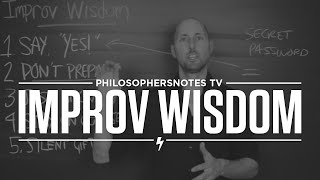
Brian Johnson breaks down Patricia Ryan Madson's Improv Wisdom, focusing on five maxims: Say Yes, Don't Prepare, Just Show Up, Stay on Course, and appreciate Silent Gifts. He connects these ideas to Reynolds, Maisel, and Maslow, then offers practical prompts to actually use them.
Chapters
Hi, guys. This is Brian. Welcome back to Philosophers Nerds tv. Today we've got another great book, Improv Wisdom by Patricia Ryan Madsen, professor at Stanford for decades in their drama department taught improv. Let's apply this wisdom to our lives. Is the big idea. Steven Pressfield in Turning Pro wrote, this is one of his indispensable books. Indispensable books. Anytime someone like that says a book is indispensable, I go out and get it and read it. So here we are. We have a philosopher's note with a bunch of big ideas. Then we've got my five favorite big ideas here, Improv wisdom. Patricia walks us through 13 maxims. 13 maxims of improvisationally living. We'll start with number one. That's the first big idea here. Say yes. She talks about the fact that her students wanted to understand how to live fearlessly like an improv actor. What's the secret password? The secret password. Secret password to improv living equals yes. Say yes to life. Say yes to the opportunity, say yes to reality. Quit arguing with it and really embrace it. Improv only works if the actor and the actresses who are working together say yes. If an actor says, da, da, da. Whatever's going on, and the other one says, no, I don't like that. It just doesn't work. They have to say yes. It's the first rule that improv acting. And it's the first rule of improv living. We need to say yes to life, say yes to reality. Find more ways to say yes to your life rather than trying to reject everything and arguing with reality, etc. First big idea. Say yes. Big, bold, happy, merry, yes. The second maxim is don't prepare. So Patricia integrates some really cool philosophies. One on improvisation by a teacher. I don't know their name. And another one on constructive Living by David Reynolds. David Reynolds is amazing. We have a note and a PMTV episode on his work, Constructive Living. Dan Millman introduced me to David Reynolds's work. Dan Millman bases a ton of his work on on constructive living. So does Patricia. The whole idea with Constructive Living is, you know, you can prepare, you can do all you want to get a sense of what you want your future to look like. But the only place that you can do anything meaningful is right now. So don't prepare. Improvisational actors don't prepare. They don't memorize lines. They just show up, which is the third big idea. We're going to talk more about David Reynolds in a moment. Just show up. So don't prepare. Get in the moment. What is the moment asking of you? Be here now in a very engaged, active way. We talk about this again and again and again. Really cool way to do it. Don't prepare. Just show up. That's the third maxim. Just show up. Where are you not showing up in your life? How can you show up more? How can you say yes to your commitments to yourself, your commitments to your creative partners or your family or whatever it is? Where do you need to be physically to do your work, to do your best? Show up there. Whether it's the gym or with the family at a certain hour over dinner or whatever it is, just show up. Build that habit. As Woody Allen says, 80% of success is just showing up. We need to just be there. The improv actor isn't ready. They haven't fully prepared, but they need to walk out on stage. And the act of walking out on stage is what allows them to get in the rhythm of it and to enjoy the whole experience that comes from there. So there you go. Say yes. Don't prepare. Just be right now. What is the situation demanding of you? And then just show up. Then what do you do? Well, then you have some other maxims. Then we come to stay on course. Stay on course. This is a really cool idea based in constructive living as well. And she says, look, we get confused these days. Too often we're asking ourselves, how are we feeling? How am I feeling right now? Am I feeling inspired? Am I feeling motivated? Hmm, that's an interesting question to ask. And it can be a dangerous question to ask because our feelings are fleeting. If we base our life and our creativity based on how we're feeling in any given moment, we may or may not get a whole lot done in our lives. She says a much more effective way to live is to ask yourself, what's my purpose right now? What's my purpose? What do I want to bring to this moment? Eric Maisel, another one of my favorite teachers on creativity, says, how can I make myself proud? Right. Right now, how can I make myself proud? That's a really cool concept that helps us stay on course. If you're constantly checking in on how you feel, good luck with that. We want to get to the place, David Reynolds says, where you're the type of human being who does what needs to get done when it needs to get done, whether you feel like it or not. That's a mature, healthy human being feeling like it has nothing to do with it. And the irony is that the action that we don't feel like taking actually produces the feeling we want. So we get it backwards. We think we need to feel good in order to take action. What Patricia and these great teachers say is you need to take action in order to feel good. It's a huge shift. And you do that by identifying your purpose, how you can make yourself proud. And that's a way to stay on course. Key maxim for improv Living improv wisdom now this final idea is amazing. Silent gifts. Silent gifts. Patricia talks about the fact that we are so blessed in our lives and we take so much of it for granted. Abraham Maslow says that taking things for granted is the most powerful, non evil evil the world. So it's not actively evil. It's not like you're out hurting somebody, but it nonetheless is evil. And it really diminishes our well being and our overall sense of interconnectedness. And Patricia talks about the fact that we need to see the silent or the hidden gifts that are in our lives every single moment that we take for granted. For example, right now you're watching this video. How are you watching this video? Maybe it's on a computer, maybe it's on a smartphone. That's amazing. Pause for a moment and think about the fact that some miraculous way I'm able to sit here in a studio recording this, you're able to watch it x hours or days or months or years later via some concoction of plastic and electronics. It's amazing. Then you think about all the people who went into creating that thing that you're watching this on and are you sitting down? Are you sitting in a chair or laying back on your bed or maybe in your car? Whatever you're doing, just listening to this, where are you? Think about the people who helped create that and allowed you to experience the benefit of that that you may not pay a lot of attention to. So we want to go through our days recognizing our silent gifts. That's a big part of improv wisdom, is to appreciate the gifts we're being given on all day long, every day. I love to do this. When I'm eating food, I'll look at the food I'm eating. If it's a salad, I'll imagine everything that went into that piece of lettuce to arrive on my table. I can't possibly think of everything that went into it, but I can think in a few broad strokes about the farmer and his team and of course Mother Nature providing what we needed. And then you've got someone who's picking that and then putting it into a box, which is going into a truck, which is going to a distribution center, which is going to a shopping center or store, which is then staffed by these amazing human beings I'm never going to meet who dedicate their life force to put that on the shelf so that I can come in and buy it and I can bring it home and feed my family with that. That interconnectedness that exists within those silent gifts is something we don't want to take for granted. Maslow says self actualizing human beings appreciate, have fresh appreciation. They appreciate the mundane more than people who are not actualized do. So let's not take these things for granted. Let's find our silent gifts. Let's say yes to life. We don't need to prepare so much. Of course we need to prepare a bit for certain things. But you know what? Let's put that away for a moment. Let's embrace the improv fearlessness of being in this moment and just show up, stay on course whether you feel like it or not. What does that have to do with it? Do what needs to get done. Live on purpose. Don't make yourself proud and realize that your action is going to create the feelings that you didn't have, you didn't think you had. Latently present Secret password equals yes. There you go. Improv wisdom. Super quick. Look. Hope you enjoyed it. What was your favorite big idea? How can you apply it to your life? Theory, practice, become embodied. That's what this is all about. And I hope you enjoy. I enjoyed sharing this wisdom and I can't wait to share more with you soon. So have another awesome day. I look forward to seeing you soon. See you.
More from Brian

Heroic +1: What’s THE Most Creative Act in the Universe?: Turning Around Glitches (#2024)









