PNTV: Leading an Inspired Life by Jim Rohn (#317)
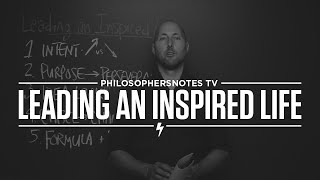
Brian Johnson (Philosopher's Notes TV) summarizes Jim Rohn's Leading an Inspired Life in a short, conversational video. He extracts five core ideas: (1) the law of diminishing intent (take action immediately and sustain with tiny daily steps), (2) discipline and purpose fuel perseverance (interest + purpose → grit), (3) feed your mind daily (at least 30 minutes) and search for life-changing ideas, (4) character is formed by chiseling away small faults over time, and (5) the formula for success: a few key disciplines repeated every day ("two easies": easy to do, easy not to do). The episode closes with a promotional overview of Brian's Optimal Living Membership (access to Philosopher's Notes, PDFs, MP3s, classes; $10/month).
Chapters
Hi, this is Brian. Welcome back to Philosopher's Notes tv. Today I've got another great book, Leading an Inspired Life by Jim Rohn. Leading an inspired life. No subtitle necessary. I interviewed Daniel Harkavy, the author of Living Forward, recently, and he said this book was a must read. I pay attention to people I respect when they say a book is a must read. So I got it and read it and here we are. Jim Rohn, as you may know, was one of the leading motivational speakers and kind of personal development gurus of the 20th century who inspired everyone from Tony Robbins and Darren Hardy to a ton of other people. We covered another one of his books before. This one is. It's kind of like sitting down with an old school coach and you know, he presents his wisdom in a very conversational, down to earth style. Super practical ton of big ideas. We've got a bunch of them in the Philosopher's note, five of them here. We're going to talk about an idea that we talked about in Living Forward by Harkavy, Diminishing intent. The law of diminishing intent kicks off the book and very early on he talks about this. He says, when you are inspired. So when an idea fires you up, right, you may have an insight. You have an idea of, wow, I could really do this and I'm feeling really good about it. The emotions are high and. And you want to pursue a noble course, right? Your intention is very strong. He says take action immediately, right then Tony Robbins, Jim Rohn was his mentor, says take massive action right then. And if you don't, what's going to happen is the next day or a week or a month later, it's just going to dissipate. Roan calls this the law of diminishing intent. You start fired up and it goes like that over time. You've got to take action right here. And then you want to take consistent action so that that motivation goes up rather than down. So you want to take massive action, Tony Robbins style. Then you want to figure out a way to take tiny baby steps on a consistent basis every single day, which will be our formula for success. We're going to talk about in a moment. So the law of diminishing intent. Notice if you get really excited about something and you and then don't do anything about it and change that. Take action before your intention diminishes when your emotions are hot. In the note, I talk about the fact that in Willpower 101 we talk about this. We also talk about the fact that when Your impulses, not your ideal visions, but your impulses are hot. You need to learn how to cool those. Right? You need to step back and not take action when you're about ready to engage in your suboptimal addictive behaviors. So you want to get good at stoking the fire of noble intention, right? And eliminating cooling, putting out the fire of the impulsive behaviors. That's the essence of discipline. Ron is all about discipline. He says, look, the most important word you can have in mind when you want to think about leading an inspired life is discipline, AKA willpower, self control, whatever you want to call it. Research is unequivocal. That is the key to optimizing and actualizing. Second, big idea is a great one. He says, if you want to persevere, which is obviously required in leading an inspired life, things aren't always going to go well. You need to have a deeper purpose that goes beyond just yourself. If you're just merely interested in something, you can be fired up for a while. But the moment something challenging happens or 10 challenging things happen, or a really big challenge happens, you're not going to persist, you're not going to be gritty, you're not going to persevere unless you have a purpose bigger than yourself. In the note, I talk about the fact that Michelle Gielen in Broadcasting Happiness talks about the same idea and so does Angela Duckworth. So Michelle and her husband Sean Acor, have done research and they identified three variables that account for up to 75% of success. Right. Those three variables include optimism, engagement, and then the one we're going to talk about right now, which is helping other people. If you want to be successful, it's not about how much help you get, it's about how much help you give. She calls them work altruists. Well, that's a purpose beyond yourself. When you're looking to find ways to help other people, that's a great way to develop your perseverance. Angela Duckworth echoes this wisdom, the Science of grit. The scientific definition she provides of grit is intense passion plus intense perseverance equals grit. You sustain action on a long term goal via grit. Now, passion has two components. The two components of passion are interest. Right? You need to be interested in something. It needs to be intrinsically motivating for you. You can't do it because you feel like you should. You have to be genuinely authentically interested in it. But then that's not enough. If that's all it is, as Jim Rohn says, well, you're not going to face the challenges with a lot of grace and power and grit and perseverance. You need to have a purpose. And purpose is very, very simple. It's something outside of yourself. It can't just be about your lifestyle design or just about you creating the crate, the perfect life. It's got to be about people that matter for you, people who will be let down if you don't follow through on your disciplines. Think about that and have them in mind and see how you can benefit them. If you persevere, have a purpose in order to fuel your perseverance. The third big idea is another really fun one. He talks about the fact that you need to feed your mind daily. He says, at least 30 minutes a day. Feed your mind with challenging knowledge and wisdom and inspirational practical ideas. And he says that ideas, any one idea, can change your life. And he says it's kind of like a combination lock. So imagine you've got a combination lock, right, with all these different numbers going on here. He says, look, the reality is that you're a lot further than you may think. You've already figured out that one. You figured out that one. You figured out that number and that number and that number. You only have one more number left to figure out before your life makes a significant shift in a really positive direction. Opens the door of opportunity. He says, well, you need to be on the search for that idea that can open that door. And I mentioned in the note, of course, this is what I'm doing every single day. I sit down and I read, and I'm looking for these big ideas so I can optimize my own life and help my family and help you. My purpose, right? Can one person find one idea in the video I'm creating right now that can help unlock this part of their combination? Boom. Open doors to opportunity. It's what fires me up. It's exciting for me to find these little ideas and these keys that can unlock the door to opportunity. Then the reality is, once you open this door, there's your door to opportunity, right? Boom. You go through that, now you're over here, you realize that there's infinite potential. There's so many more opportunities. And then you just search for all the little combination locks that you can find, the little 1% optimizations you can make day in and day out, not as a hassle or a pain, but as this fun, creative game to see just how far you can go. In my interview yesterday that I did with Jim Afromo, one of the world's leading mental toughness coaches, he says, this is what it's all about. Championship. Who won't settle for silver, they want gold, they want to do the best they can, are driven by that desire to see just how far they can go. So have fun exploring these ideas. Don't feel like you need to implement every single one perfectly. That's not what the idea here is. The idea is, can you get just a little bit better, a little more insight, a little more clarity than you had 10 minutes ago, and then go embody it a little bit more today than you did yesterday? Again, you compound that over time and you completely change your life. Which, again, is going to be our fifth big idea here. The fourth big idea is a really cool one. He talks about the fact that the root of the word character comes from the Greek word for chisel, or that which is created by a chisel. Right? It's kind of a stamp. But he uses the word chisel and he says, look, your character is formed not with a magic wand that you just kind of wave and suddenly you have really, really virtuous character, but with a chisel. And I talk in the note about Michelangelo, who would say that he could see his statue, the work of art was within the piece of rock or marble. When he looked at that whole marble, he could see David, for example. Then what did he do? Then he had to chisel away at it. Marble is very, very hard. You can't just kind of dust it off. You're chiseling away at it and chiseling away at it and chiseling away at it. We. Well, we need to see ourselves within that marble, our ideal selves, the virtuous version of us, with deep character. Then we need to chisel away at every little thing that gets in the way of us expressing that highest version of ourselves. Right now, we're not taking a sledgehammer to it. You're not going to change your life with a sledgehammer overnight. You're going to do it chiseling away day in and day out, showing up and revealing that potential that's already there. So keep that in mind. Your character is created via chiseling. I love that image. Which brings us to our fifth idea here, which is a formula. He says, look, there's a very simple formula to success, and there are two easies. The formula for success is this. He says, it's a few disciplines repeated every day. That is your formula for success. To identify the key disciplines, what are the few things that you need to do? Your keystone habits as we described them in habits 101. The few things that if you do them every single day, you can achieve extraordinary success. He says, that's it. It's not that complicated. You need to identify those key habits and then you need to do them with the discipline we talked about here, right? Maintain that intention every single day. Jeff Olson calls that the slight edge. And he says, look, these things are so easy. Jim Rohn says, you have two easy's, right? These things are easy. We're not asking you to do something heroic every day. We're asking you to do whatever it is you say is important to you. So for me, it's going to bed early, getting up early, and rocking an AM1 and an AM2. Deep work time block. That's basically my entire creative life, right? Can I have five days a week, AM one, AM two, and then Saturday and Sunday, I do an AM one as well, which means I get up early, I work for a couple hours, I take a little break, hang out with my son, then I work for another couple hours. Can I do that every single day, day in and day out? Few disciplines repeated every day. That's my key to success. It's working so far. I'm excited to see what that looks like compounded and extended over time. What are your few key disciplines that you need to engage in? Key phrase every single day, not once in a while, but every single day. That is Jim Rohn's formula for success. Now, he says, we have two easy's here. The two easies are, it's really easy for me to do what I just described in my life. And whatever you identify, those things are easy. It's not hard for me to go to bed early and to get up early and then to work for AM1 2 hours, not that hard to do. And then to take a break and to do that again for another couple hours. That's not particularly hard to do. It's easy to do. But he says it's also easy not to do. Two easies, easy to do, easy not to do, Right? Deceptive how easy it is. But we need to choose the successful among us. He says, choose to do that which is easy to do every single day. Failures do not. Failures allow negative habits. Well, guess what? Negative habits spiral down in precisely the same way that positive habits spiral up. Slight disadvantage versus the slight edge. So take some time. Identify what your key disciplines are. See yourself. See the highest version of yourself inside that marble. One of the ideas we talked about in the note that I don't have up here is pull Power. Have a vision of your future that pulls you towards it. Then identify your key disciplines and be fired up about that potential and do them daily. They're pulling you toward what you're capable of being. Know that any one idea can change your life. And when you aggregate all these and compound them not perfectly, but doing them just a little bit more each day, you can do extraordinary things. Purpose fuels perseverance Quit looking for all the help you can get. Of course we need help at times, but focus on how you can give yourself to the world. How can you help more people in your world? And when you're stuck and you're really challenged and you want to give up, think about the people in your life who are going to suffer if you give up. And on the positive side, going to benefit from your grit, from your perseverance. Remember, it's both interest and commitment to something bigger than yourself. Purpose. When you're fired up, that's the time to take massive action, to get going and then create your little mini habits so you can create sustainable tiny action day in and day out. That is a quick look at leading an inspired life. I hope you enjoyed what was your favorite big idea. As always, think about it. Write it down in your own words if you want to make it stick. Share it with somebody if you really want to make it stick. And then most importantly, figure out how you can live it just a little bit more today. Hope you enjoyed and I look forward to sharing more. See you. Hi, this is Brian. I hope you enjoyed that PNTV episode. A lot of people don't know all the stuff I do beyond these free videos I share on YouTube, so so I thought I'd do a quick video to give you an overview of our membership program that you can get access to and get a ton of other stuff. So here's a quick look. Ten bucks a month. Join the Optimal Living Membership program. You get Instant Access to 250 Philosopher's Notes on some of the best Optimal Living books out there. Old school classics, positive psychology, modern stuff, mindfulness, peak performance, purpose, neuroscience, wealth, et cetera. And what you may not know is that in addition to the PNTV episodes, I create PDFs on all these great books. So six page PDFs. Let's take a look at one of them. Joseph Campbell, you want to figure out how to live your hero's journey? Well, this is a great place to start. I basically pull out my favorite big ideas, riff on them, connect them to other books and other ideas and help you apply this Wisdom to your life today. That's what the PDF looks like again. We have 250 of these on all these different great books. And then I record those PDFs as an MP3 so you can listen to that MP3 while you're on a walk or working out or doing some errands or whatever that is. Philosopher's Notes. A lot going on there. And then in addition to Philosopher's Notes, you get access to optimal living classes. Optimal Living 101 idea here is that all those great teachers come back to the same big ideas again and again and again. I distill those ideas into classes. Super practical, fun, inspiring classes ranging from Habits101, Confidence101, Getting Stuff Done101, Meditation101, instant access to all those classes. And then Future classes include Relationships 101, Energy 101, Purpose 101, Business Goals, etc. Those are our full length classes. And then I create micro classes. Two to three to five minute little bursts of wisdom on my favorite great ideas from these great books across the domain that you want to optimize in your life. So we have dozens of these so far. I create 50 new micro classes every month and 10 new philosopher's notes every month for 10 bucks a month. So we're blessed to have thousands of members who are enjoying the program and sharing some incredibly kind words with us. And super simple. 10 bucks a month. Cancel anytime. Would be honored to be a bigger part of your life and I appreciate your support. And here's to optimizing and actualizing.
More from Brian

Heroic +1: What’s THE Most Creative Act in the Universe?: Turning Around Glitches (#2024)









