PNTV: Making Life a Masterpiece by Orison Swett Marden (#213)
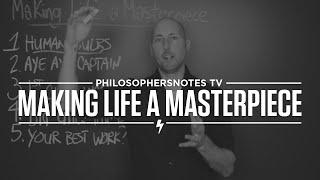
Brian Johnson breaks down Orison Swett Marden's Making Life a Masterpiece into five practical themes: increase your "candle power" by tapping into larger energy sources, captain your own ship toward a clear destination, do first-class work with proper rest, master small stresses to handle big ones, and treat your life as your best work yet.
Chapters
Foreign. Hi, this is Brian. Welcome back to Philosopher's Notes tv. Today, another great book, Making Life a masterpiece by Orison Swett Marden. Orson Sweatt Marden was the founder of Success magazine back in the day, early 1900s. We've done a number of notes on his great books. He can. Who thinks he can an iron will. I'm going to be sharing another one on the miracle of right thought soon. He's a really interesting blend of kind of a Ralph Waldo Emerson meets James Allen. All about the potential we have within us and the need for us to have a deep level of integrity, tenacity, grit, resolve. These are the words when I read his books, come back to again and again and again as we talked about with Thich Nhat Hanh. Mindfulness and concentrating your energy or some big Thich Nhat Hanh words. Philosopher's note five big ideas here. The first big idea on making life a masterpiece he talks about what does that mean? I don't have it here as one of the big ideas, but true success is the intrinsic. It's being true to ourselves and good to others. We talk about in the notes. Want to keep that in mind. That's what the masterpiece looks like. Not necessarily doing great things and impressing people with our fame and our wealth and our power, but doing the little things to the best of our ability. We'll talk about that a little bit more. But as we do that, we recognize that really what we are. Sweatt Martin tells us we're like human bulbs connected, little light bulbs connected to an infinitely greater universal current of power. And he says, look, if you want to express a greater level of that power, you need to increase what he calls your candle power. So this was written in 1910 or so shortly after Edison and others harnessed the power of electric light. They measured it back in the day as candle power. We have wattage these days, candle power. He says, look, if you're a four candle power person, you're not going to be able to process and handle 10 candle powers of light. It's there, it's waiting for you. But you need to have enough power and stability in order to allow that to come through. So think about that. And all the work we do together really is to help us go from being a 4 candle power or a 20 watt bulb to a 10 candle power, 100 candle power. Can we be a thousand candle power? He says, can you be an arc light, the source of all this light? I like to think of it as a lighthouse. We want to be a light in our communities shining brightly, modeling what's possible while we help and empower others to do the same thing and live with more happiness, meaning and mojo, etc. So all of our work together in these episodes and the philosopher's notes and the classes and everything else is essentially about that. That's entheos to have the enthusiasm that comes from connecting to something bigger than ourselves and letting that light shine through us with a ton of candle power. So there's our first big idea, human bulbs and your candle power. Second big idea is I, I captain. So if we want to allow that light to come through us such that we can shine with a radiant enthusiasm, we need to be captains of our own ship. Stephen Covey tells us the first habit of successful people is to be proactive. We need to be the captains of our own ship and sweat. Martin talks about the fact that a captain on a journey, when he approaches and he sees fog descending on the ocean or a storm coming in, or even a hurricane coming in, the captain doesn't approach that stuff and then turn back around and go back to his home port. If he did, you'd no longer have a job as a captain. Right. So we want to approach it with the same level of clarity. What does the captain do? The captain focuses on his compass and he drives through the fog, through the storms. It's what a good captain does. So Sweden, Martin tells us we need to approach it the same way. Storms, fog, even hurricanes are inevitable for us as we navigate our lives. But rather than the moment we feel a challenge turning around and going the other way, we want to discipline ourselves to look at our compass and drive through those storms, go to our destination. We're going to talk about this with Kelly McGonigals. I'm working on her new book, the Upside of Stress. And see that these challenges, storms metaphorically, actually give us power to tap into latent reserves we didn't know were there. Stress is actually good, she tells us, and teaches us how to use it wisely. So anyway, we want to be the captain and we want to remember another point that he makes that we talk about in the note. He says, no one ever drifts into something desirable. No one ever drifts into something desirable. And if we want to be a good sea captain, we need to know our destination. As we talked about with Earl Nightingale, if you go to any captain on any boat, you see a huge cruise liner or whatever, you can walk up to them and say, hey, what's your next port of call? And they'll Answer you immediately in one sentence. Oh, we're going here. They know where they're going, they know their next destination. They we need to know our next destination. You can't get through the storms unless you have a sense of where you're going. Otherwise you will turn back and retreat, whether that's to your old port or pulling the covers over your head in the morning, where are you headed? And then fix your compass to that point, do what needs to get done day in and day out to navigate and move through those storms. So remember, you are the captain. Aye aye Captain. Third big idea. First class work. So Swet Martin is all about, as I mentioned in the little prelude here, preamble, grit, determination, resolve, persistence, tenacity, etc. And he also says you can't operate at a high level if you're always working. You have to rest, you have to have time for recreation. First class work, he says, can't be done without a fresh mind. And it's not about driving yourself all the time. In our class on getting stuff done, we talk about the fact that you need to oscillate. You have phases of being really on and phases of being off, on, off, on. And you want to build that rhythm a la the power of full engagement into your life on a micro level, literally every 90 minutes, building in rest on a mid level head, having good nights of rest and time with your family and on a macro level, on a weekly basis, on a macro level, taking some vacations, etc. But the idea here is we need to sustain our energy over the long run. As JP Morgan says, I can do a year's worth of work in nine months, but not in 12. JP Morgan, one of the most successful business guys back in the day. I can do a year's worth of work in nine months, not in 12. We need to rest if we want to have a fresh mind and do first class work. Which is why I'm all about the daily rituals, your fundamentals, going to bed early, that's my thing. It may not be your thing, but digital sunsets such that I can wake up alarm free, fresh and have another great day. You can't do great work without freshness. When I find myself grinding and getting a little bit lower energy, it's a sign it's time to rest a little bit and come back fresh. Check in on your rhythms and see if you can create more positive rituals such that you have more freshness consistently. If that's an issue, alright, the fourth big idea here is big little things. Sweatt Martin tells us that really creating a masterpiece comes down to the little things. That it's not about the huge challenges or opportunities or catastrophes. It's about the little things. And that if you're the kind of person that gets all bent out of shape on the little things, there's no way you're going to handle the big things with grace. So we want to master the little things. We talked about this with Richie Davidson in the Note on the emotional life of your brain almost 100 years after Swett Martin wrote this. Richie Davidson, one of the leading neuroscientists, basically proved this particular idea. He brought people into his lab and he saw that how they responded to little tiny stresses, a little burn with a thermode, whatever that is, and looking at upsetting pictures, the degree of their response to those little things was correlated with how they responded to big things. Now that's exciting because we can work on the little things and build the muscles. We have more grace and poise with the bigger things. So think about what little things might annoy you more than you know they should. You know, it's sub optimal that you get a little bit frustrated in traffic or when there's a line at the grocery store or, or when your kid or your spouse or your colleague or whatever does something that's just slightly annoying and you respond inappropriately, strongly practice on those little things. Those little things are big things. Building the muscles so you can handle the bigger things with more grace. That's our fourth big idea, the fifth big idea. He shares a question that a sculptor back in his era was asked. Someone asked this sculptor, what's your best work? What's your best work? And the sculptor said, my next. My next work is going to be my best. That's the attitude we want to have when we're creating a masterpiece. We want to be excited about our lives. We want to be looking forward with anticipation, with hope, with optimism, with an idealism that the next work is going to be our best. We're not sitting here beating ourselves up with shame about things that may not have gone right or celebrating old successes as if those glory days are gone forever. We want to see that we've gotten all that experience, all that wisdom, so we can apply it today, in this moment, today, to create our next greatest work, to make our lives ultimately a masterpiece. Ralph Waldo Emerson says that genius appeals to the future. That's what a genius mind orients toward. And if we want a masterpiece, that's what we want to do. So there you go. Your best work is still to come. I'm excited for you. Can't wait to hear about it. Master the big things via the little things. Day in and day out, moment to moment. First class work. Remember you need a fresh mind to do first class work. Think about your rituals, what you can do to dial it in. Know that it's an experiment. Some days you'll be on or some weeks you'll be on. Other days you won't be. No big deal. Just get a little bit better. Take the data into your lab and create a slightly better masterpiece. Remember, you're the captain of your own ship. When you find challenges, don't turn around and immediately go backwards. Drive through that storm via your compass, set on your destination. Know what you want in your life and navigate toward it. And then ultimately remember you're just a human bulb connected to something bigger than yourself. True power comes when we let that flow through us. We want to move from four candle power bulbs to 10 to 20 to 30 to 50 to 100 to 250 to 1000. How bright can we be for our communities? And there you go. Hope you enjoyed and I look forward to sharing more with you soon. Have another awesome day. See you.
More from Brian

Heroic +1: What’s THE Most Creative Act in the Universe?: Turning Around Glitches (#2024)









