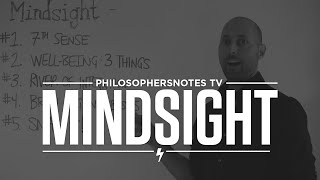
Brian Johnson (Philosopher's Notes TV) summarizes Dan Siegel's book Mindsight: he defines "mindsight" as a "seventh sense"—the ability to focus attention on and observe the inner workings of the mind—and argues it can be cultivated through practice. Cultivating mindsight changes brain structure (neuroplasticity) and promotes "integration," pictured as a river between rigidity and chaos; integrated people show FACES (Flexible, Adaptive, Coherent, Energized, Stable). Johnson emphasizes brain-hygiene basics (exercise, nutrition, rest), cites historical sleep declines (from ~10→8→7 hours over the past century-plus), and presents SNAG (Stimulate N neuronal Activation and Growth) as the mechanism by which targeted practice rewires the brain. The video ends with a pragmatic encouragement to begin practicing rather than waiting for perfection.
Questions this video answers
January 11, 2015.
A "seventh sense": the ability to put focused attention on the inner workings of the mind and observe and shift them.
Flexible; Adaptive; Coherent; Energized; Stable.
Exercise; Nutrition; Rest (sleep).
After Edison's 1879 light bulb, average sleep declined from ~10 hours to ~8 hours in the 20th century and to ~7 hours in the 21st; a substantial share of people now get under six hours.
Chapters
Hey guys, this is Brian. Welcome back to Philosopher's Notes TV. Today we've got a good one. Mindsight by Dr. Dan Siegel. Mindsight. We've got the philosopher's note. We've got about 10 big ideas in there. Then we've got my little mind map on the back here with the key big ideas that I want to walk through today. Less than 10 minutes, we'll see what we can get through. We'll start with Dr. Dan Siegel, Harvard MD one of the world's leading neuroscientists and psychotherapists. Just a good guy. I've gotten to know him over the last maybe eight years or so. And he's just the living embodiment of what he describes and what he teaches. He's big hearted, good human being and he's also brilliant. So this book is packed with wisdom. We will start with this first idea. What is mindsight? Well, Dan describes it as our seventh sense that we didn't know that we have. So we've got our first through fifth senses. We can see, we can touch, we can smell, we can taste, we can hear. Our five senses, our five primary senses. Our sixth sense is this idea that we can kind of sense our bodies. The seventh sense is mindsight, an ability to put a focused attention on the inner workings of our mind. That's mindsight. To be able to actually observe what's going on in our minds and then to be able to do something about that and to shift it. So that's mindsight. Now that leads us to the second idea here, the three keys of well being. So what are the three keys of well being? This is basically the structure of Dan's book and he kind of maps it out. Number one, mindsight can be cultivated. Really important thing to know about well being. It's not like we're born with a fixed amount of mindsight or ability to look into our minds. And it's cultivated like anything else we want to have in our lives. We can cultivate it via practice. That's number one. Number two, when we cultivate mindsight, we change the very structure of our brains. Neuroplasticity. Unbelievably fascinating. We're going to be spending a lot more time on neuroscience and studying that a lot. And I'm excited to unpack it more. But it's just amazing what we can do. When we focus our attention in very specific ways and develop mindsight, we actually change the very structure of our brains. That's the second idea. So one mindsight can be cultivated Two, when we do it, we change the very structure of our brains. And number three, that leads to integration. So integration is kind of the key word for dance work. Mindsight leads to integration, and that leads us to the third idea here, which also leads us to an opportunity to do a little. A little doodling here. So the third idea is a river of integration. Let's draw a little river of integration. So here is our river of integration. Now, like any good river, this river has two banks. On one side, we have rigidity. On the other side, we have chaos. Rigidity and chaos. So the river of integration flows through these two banks. Rigidity, chaos. We want a certain amount of structure in our lives, and you want a certain amount of spontaneity in our lives. But too much structure equals rigidity. Too much structure equals chaos. Healthy people flow. Unhealthy people get stuck either in rigidity or. Or in chaos, or they toggle between the two. So the whole practice of mindsight is to help us cultivate integration. And Dan is a big fan of acronyms, and he tells us that the river of integration can be described as faces. Faces represents we're flexible, we're adaptive, we are coherent, we are energized, and we're stable. So when we're integrating, we have flexibility. We can kind of move. We're not rigid or chaotic. We're flexible, we're adaptive. We can respond to our environment. We're coherent. Everything lines up. We're energized, we're connected. We have some vitality, and we're also stable. That's the dynamic of a healthy, evolving human being in any complex system is where Dan got that idea. So that's our river of integration. The fourth idea we'll cover here is brain hygiene basics. Check out the time over here. Brain hygiene basics. I just love this idea. Again, leading neuroscientist, leading psychotherapist. And Dan talks about the fact that before we get into all the fancy stuff, we need to get the basics nailed. The basics as he describes them. What would you guess they are? Well, we talk about them all the time. Number one, exercise. Number two, nutrition. And number three, rest. So we've got exercise, nutrition, and rest. Now, again, we talk about this all the time, but Dan, leading psychotherapist, tells us we've got to focus on the fundamentals. If we want to go far, we've got to start with the near. We've got to focus on the basics. So our bodies evolved over millions of years to move. It's not natural to sit all day long. It's horrible. Not a good idea. So move your body tall. Ben Shahar tells us not exercising is like taking a depressant. John Ratey, another Harvard MD Tells us that exercising is like taking a little bit of Ritalin and a little bit of Prozac. Those are good things. Move your body. Number two, nutrition. We don't need to make this complicated. Eat more whole foods and less refined foods. Another simple rule is if your great great grandparents didn't eat it, you shouldn't eat it. Not complicated. The stuff that passes for food these days is pretty absurd. Focus on whole foods, less refined foods. Don't make it a big deal. That's nutrition. The third aspect of brain hygiene basics is rest. So get this. We're going to do a lot of work on not just neuroscience, but also rest and sleep. I've got three notes coming up. One on take a nap. Change your life. Another one on power sleep, and another one on the power of rest by some of the world's leading researchers on sleep and rest. Here's one of the things I learned in 1879. It was just in 1879 when Thomas Edison invented the light bulb. At that point, people slept on average 10 hours a night. Not on average, but the Average person slept 10 hours a night. Right. In the 20th century, that went down to eight hours. 20% decrease. Millions of years of evolution. And in the last hundred years, we went from 10 hours of sleep shortly after the sun sets, we used to go to bed. Shortly before the sun rises, we used to get up. Not a big deal. Not complicated circadian rhythms. So we went from 10 to 8 in 100 years. And then in the 21st century, we dropped the average down to seven hours a night. And 33%, or something like that of our US population gets less than six hours of sleep. That's insane. You are not going to master this stuff if we aren't mastering these basic fundamentals. So look at this and think about how you can take some baby steps to optimize your brain hygiene basics and go from there. Final big idea is the final acronym. So we've got faces of rivers of integration, and then we've got snagging. So this goes back to neuroplasticity. Dan says that we can s. Stimulate A neuronal. I'm sorry, stimulate N neuronal. A activation and G growth. Stimulate neuronal activation and growth snag. So we want to snag our minds and snag our brains. And as we do that, your brain again changes itself. There's something called neurogenesis and synaptogenesis. You can actually create new systems, synapses create new neurons and rewire your brain. You can thicken the myelin, which insulates the electrical patterns and makes it more likely you're going to do that behavior in the future. Snagging our brains allows us to rewire our brains. Unbelievably cool stuff. So that's a basic look at this. Came in a little under 10 so far. We'll wrap it up. Mindsight. Dan Siegel. Mindsight is our seventh sense. The three aspects of well being are, one, you can cultivate mindsight. Two, when you do that, your brain structure changes, and three, that leads to integration. We've got our little river of integration flowing between the banks of rigidity and chaos. We've got faces, we're flexible, we're adaptive, we're coherent, we're energized, and we're stable. We talked about our brain hygiene basics, exercise, nutrition, rest, and the fact that we can snag it and change our brain. The other cool idea that he ends his book on, that I end the note on anyway, is this idea that we just need to get going. We don't need to be perfect, we just need to get going. It's like rolling a ball up a hill. It takes a lot of effort in the beginning, but as you get that ball up the hill and it goes down the hill, you go into what he calls the valley of coherence. Once this momentum gets going, it takes care of ourselves, it takes care of itself. Human beings have a default of health, and we just need to get the process going. So there you go. Hope you dug it. Got something good out of it. And I look forward to sharing more with you soon. All right, have an awesome day. See you.