PNTV: My Fight Your Fight by Ronda Rousey (#252)
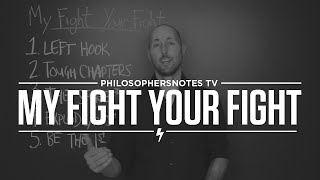
Brian Johnson summarizes and reflects on Ronda Rousey’s memoir My Fight, Your Fight, extracting five actionable lessons: (1) "Left hook" — turn setbacks (e.g., a broken right hand) into strengths; (2) "Tough chapters" — hardship is part of the hero’s journey; (3) "The Secret™" — there is no shortcut, only relentless hard work and process-focused goals; (4) "Explode & rest" — alternate intense effort with deliberate recovery; (5) "Be the first" — audaciously pursue being the pioneer. The episode mixes Rousey anecdotes, related references (Dana White, Jim Loehr, Ryan Holiday), and practical application prompts.
Chapters
Hi, this is Brian. Welcome back to Philosopher's Notes TV Today, another great book, My Fight, you fight by Ronda Rousey. My fight, your fight, Ronda Rousey. For those few human beings in the world who do not know who Ronda Rousey is, she was recently voted by ESPN and as the number one fighter in the world. She's also the biggest star and the highest paid athlete in mma, specifically the ufc. So the last episode was on GSP Georges St. Pierre, another one of the world's leading MMA fighters. That book was recommended to me by his head coach, Faraz Zahabi, and another member recommended this book. So I figured we'd make this this week. Fight Week. I like to think of Ronda Rousey. If Bruce Lee was alive today and he was a woman, he'd be Ronda Rousey. So, philosopher's note, bunch of big ideas. We've got five of them that we're going to cover. We turn these episodes into podcasts now where people just listen to them. So if you can't see the whiteboard because you're listening or the chalkboard, five big ideas include left hook. We're going to talk about building a left hook after you break your right hand. Second Big idea is tough chapters. Every great hero's journey has tough chapters. Third Big Idea is the secret. TM Hint. There is no secret to success other than hard work. Fourth Big idea is you need to explode and rest oscillating. We've talked about that a lot. We're going to talk about it a lot more. And the fifth big idea is to be the first. So let's jump in. First Big idea, Left hook. Rhonda's book is basically an autobiography with her incredibly inspiring story and then some wisdom gems in the beginning. And I just love biographies, by the way. If you don't read a lot of biographies, I think you will dig it. Particularly if you're only kind of sort of into self help. It's a great way to tap into really, really practical wisdom and see the fact that the people you admire, whether it's Ronda or GSP or Scott Adams who created Dilbert, or Pete Carroll who is the head coach of the Seattle Seahawks, or Michael Phelps, whoever you admire. Elon Musk, I'm reading his biography now. They've been through so much and a lot of times we think that they just arrived at the pinnacle of success without any challenges. That's never true. And to read their stories is a really, really cool way to see how they face their obstacles and move through it in a very human way. They. These aren't perfect human beings. As Maslow says, there are no perfect human beings. And it helps us synthesize that wisdom into our own lives, integrate it into our own lives and super inspiring. So biographies rock.
I particularly like sports biographies.
And we're back into the first big idea, left hook. So Ronda Rousey shares the story of how once she was in a fight and she broke her right hand. She didn't even know she did it during the fight, but afterwards she realized, ah, I broke my right hand. How do you respond to that? Well, if you're Ronda Rousey, you respond by saying, awesome, I broke my right hand. Okay, Obviously, I'd prefer not to do that, but I did. So I'm going to have an amazing left hook at the end of this. I'm going to use this disappointment in one sense to get better. This isn't going to make me weaker. This is going to make me stronger. She's the literal living embodiment of Ryan Holiday's the Obstacle Is the Way. How do you take poison, as Buddhists describe it? And Alex Lickerman, in his book the Undefeated Mind, he says, we need to take poison and turn it into medicine. That's what Rhonda's doing when she says, oh, I broke my right hand poison. I'm going to turn it into medicine. An extraordinary left hook. So we need to have that level of clarity of how we're going to transform difficulties into opportunities. So pause and think about your life and what right hand have you broken? What obstacle has come into your way, and how do you turn that poison into medicine? How do you see that challenge as the best possible opportunity you can have in your life right now? It's a really powerful way to approach life, and you want to practice building that ability. You might get overwhelmed by the thought of that. You know, you just got laid off or you ended a relationship or whatever. You just feel overwhelmed. You can't see how that's a good thing right now. Well, I'd still encourage you to see if you can get a little better perspective than what you have right now as you move up the spectrum. But then I'd encourage you to practice building that muscle when something little annoying happens. Maybe you get a parking ticket, and maybe you're at a stage of your development where you flip out over that. You get super upset. Okay, you have a 25 or $50 check to write. It is what it is. How do you look at that in a positive way? If I get A parking ticket. It's been a while, but it does happen on occasion.
Right.
My immediate alchemy is, oh, well, okay, first of all, I have a car. Well, first of all, what can I learn from this? So I don't get another ticket? And then how do I see the benefit here? Oh, cool. I get to write a $50 check. Whoever wrote that ticket has a family, and I'm going to help support that individual and the other individuals within that governmental agency. I'm going to be able to support them in this way. That's great. And I have a car. That in itself is a miracle that the wealthiest person in the world didn't have 150 years ago. That's pretty awesome. And I can use little, tiny, mundane examples of frustration in a positive way. We want to do that as often as we can with the little irritants. So we build the muscle such that we can handle the big challenges when they come. Rhonda, again, is a living embodiment of that. That's our first big idea. Second big idea. Tough chapters. She has a great story about a crazy time in her life. And crazy all caps. Crazy. A boyfriend of hers was in rehab trying to recover from a heroin addiction. You can imagine how challenging that is. She had three jobs. Rhonda had three jobs while she was training to get into the MMA world.
Right?
She was a judo medalist, and then her life kind of fell apart, and she didn't know what she wanted to do. Then she had three jobs while she was trying to get into the MMA when no women were really making any money. She wanted to be the first one in the ufc, which we're going to talk about. The fifth big idea, three jobs. The third one was her least favorite. It was a night shift at 24 Hour Fitness. I think she's sitting there in her car, just going through such tough times, and she psyched herself up by saying, look, one day I'm going to be super, super successful, and I'm going to write an autobiography, and it's going to be an awesome autobiography. And this is going to be one of those chapters that you read where the hero is down and out, but they make it through. And that's how I'm going to view this right now. And I'm just going to get it together, pull it together, and go do what needs to get done and write the next few pages of my story. I love that. So, again, when you're looking at your life and the challenges you have, how do you see it as an inherent part of the hero's Journey. We think that our lives should just be perfect. But the fact is, you would never go see a great Hero's Journey movie if it didn't have challenges. And the more challenges, the better. That's what makes a hero a hero. As I've said a number of times, you face dragons metaphorically and sometimes real in movies, right? Not lizards. They're real challenges. So we need to have this attitude that it's just part of the process. It's making us stronger. Let's make the poison, turn it into medicine again and again and again. I'll talk about some more in the note. We'll leave it at that for now. Third big idea is the secret tm. Rhonda says everyone's looking for the secret. What's the secret to success? And she says very bluntly, it's hard work. There is no secret. Show up and work harder than anyone could ever expect you to work. Her work ethic is astonishing. It's the same as gsp, which we just covered. It's just nuts. The amount of effort that these guys put into excelling at their craft is truly ridiculous. Grant Cardone 10x style 10x the vision 10x your work effort and you have a shot at doing something extraordinary. But there is no secret. There's no vision board you're going to stare at long enough that's going to bring your dreams to life. Good thing to remember. She also talks about process versus outcome goals. Obviously, we need to focus on the process goals. We're not going to talk about that now. We will talk about the fourth big idea. She talks about rest beats. Rest beats like reading music. There are rest beats in her performance when she's fighting. She says you need to learn when to explode and when to rest. So I've drawn this a ton of times, representing Jim Lore and his idea of making waves. But Rhonda tells us that one of the reasons why she can be so intense in her fights in the last X fights have been so brief that we haven't seen her endurance side of things. But she can go so intense for so long because she's resting at times that her opponents are still working. And so she's able to explode into rest. She's able to oscillate between exploding and resting. Exploding and resting. Jim Lore, who came up with that model, says he saw the same thing in tennis athletes, right? So the greatest tennis performers, the thing that differentiated them, one of the keys was that they recovered more deeply between points so they'd play the point, really hard, then they'd recover, they'd play hard, they'd recover. Whereas the people who didn't perform as well were peaking, but they weren't recovering. And he says something that's just genius. He says, you burn yourself out or you get tired, not because you're working too hard per se, but because you're not recovering enough. And it's fascinating for me to see that when I get myself a little bit at the edge, it's when I'm not properly recovering, it's not that I'm working too hard, it's that I'm not taking enough time to recover. So you need to build in your recovery as much as you do your effort, and whether that's physical training or, in Rhonda's case, fighting, or in tennis players playing tennis. But for us normal human beings who aren't engaged in those particular activities but still want to perform at a high level in, I shouldn't even say normal individuals, but just people who aren't in those particular contexts, what do we need to do to. To build in recovery? For me, it's noticing. Look, I've been going hard for 90, 120 minutes. I need a simple break right now. Let me go do a few minutes of meditation or training or go for a walk or a hike or workout or whatever. Oscillate. Don't go on all the time. You can't explode, explode, explode, explode, explode. And not ultimately explode. You've got to explode and rest. So think about that. What's the one thing you could do to build more recovery into your life? And I'll say again, I'm looking at my whiteboard in my office where we produce these. I have Digital Sunset written in huge letters. Now, I'm almost always good with that, but I notice when I don't do that, it compromises my sleep, which is my number one way to recover. I want really good sleep. And if I stay online past the time the sun goes down, it subtly alters my recovery. And I don't like feeling anything but on, so. So that's really important for me.
That's my number one.
What's your number one recovery tool? Get on it. Fifth, Big idea. Be the first. So Dana White, who's the head of the ufc, wrote the forward to the book, and he shares a story that in 2011, just a few years ago, he was asked, when will women be in the ufc? And he immediately answered, never, Never. They're never going to be in the ufc. But that was before he Met Ronda and Rhonda when no one was in the ufc, and she said, I am going to be the first woman in the ufc. Everyone thought she was literally insane. Her mom thought she was insane. Everyone she trained with. That's just impossible. There are no women in the ufc. You can't do that. And he said, never. They're never going to let anybody in. She didn't care. And her mom, although she thought she was insane, would always challenge her. Her mom would say, look, be the best. Someone needs to be the best in the world. Why not you? Why not you as the best in the world? And then her mom also said her mom was a world champion judo champ as well. Right? But her mom said they are literally handing out Olympic medals. Literally, they're handing them out. Why don't you go get one? Why not be the first? So whatever it is that you are committed to achieving in your life, think about that and realize someone needs to be the first at whatever it is.
You'Re going to do.
And someone needs to be the best. Now, you obviously need to have that huge vision matched with huge effort, and then you're still not guaranteed the success, right? Of course you're not guaranteed that, but you can go for it. You can be the first. That level of audacity is nuts. I have a bunch of other examples in the note. We'll leave it at that for now. I'll share one more story. John Elliot, who wrote Overachievement, kind of the science of overachievement, he says, all the extraordinary people who we admire in history and today who have been true revolutionaries, whether it's political or artistic or sports or business or whatever, when they said what they were going to do, they were nuts. They were crazy until they were right, and then they were geniuses. So there you go. Why not be the first? Remember, bake in recovery. Explode and rest. The secret TM is hard work, tough chapters. That's all that's going on. If you're having a really, really hard time right now, that's part of your hero's journey. You can't have a hero's journey without challenges. Left hook. That's what Rhonda got out of having a broken right hand. She's going to have an amazing left hook at the end of that. So look at your challenges, alchemize them, poison into medicine, and fight your fight as well as you possibly can. Hope you enjoyed. Look forward to sharing more. And again, if you're into this kind of thing, I think you'll love the book.
See you. Hi, this is Brian. I hope you enjoyed that PNTV episode.
A lot of people don't know all.
The stuff I do beyond these free videos I share on YouTube, so I thought I'd do a quick video to give you an overview of our membership program that you can get access to. Get a ton of other stuff. So here's a quick look. 10 bucks a month Join the Optimal Living Membership program. You get Instant Access to 250 Philosopher's Notes on some of the best Optimal Living books out there. Old school classics, Positive Psychology, Modern stuff, Mindfulness, Peak Performance, purpose, neuroscience, wealth, etc.
And what you may not know is.
That in addition to the PNTV episodes, I create PDFs on all these great books. So six page PDFs. What's take a look at one of them. Joseph Campbell, you want to figure out how to live your hero's journey? Well, this is a great place to start. I basically pull out my favorite big ideas, riff on them, connect them to other books and other ideas and help you apply this wisdom to your life today. That's what the PDF looks like. Again, we have 250 of these on all these different great books. And then I record those PDFs as.
An MP3 so you can listen to.
That MP3 while you're on a walk or working out or doing some errands or whatever that is. Philosopher's Notes.
A lot going on there.
And then in addition to Philosopher's Notes, you get access to Optimal Living classes. Optimal Living 101 idea here is that all those great teachers come back to the same big ideas again and again and again. I distill those ideas into classes. Super practical, fun, inspiring classes ranging from habits 101 confidence 101, getting stuff done 101, meditation 101, instant access to all those classes. And then Future classes include Relationships 101 Energy 101 Purpose 101 business goals, etc. Those are our full length classes. And then I create micro classes. Two to three to five minute and little bursts of wisdom on my favorite great ideas from these great books across the domains that you want to optimize in your life. So we have dozens of these so far. I create 50 new micro classes every month and 10 new philosopher's notes every month for 10 bucks a month. So we're blessed to have thousands of members who are enjoying the program and sharing some incredibly kind words with us. And super simple. 10 bucks a month. Cancel anytime. Would be honored to be a bigger part of your life, and I appreciate your support. And here's to optimizing and actualizing.
More from Brian

Heroic +1: What’s THE Most Creative Act in the Universe?: Turning Around Glitches (#2024)









