PNTV: Nobody Wants to Read Your Sh*t by Steven Pressfield (#382)
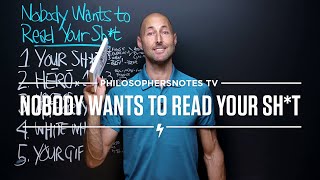
Brian Johnson (Philosopher's Notes TV) summarizes Steven Pressfield's Nobody Wants to Read Your Sht, extracting five practical ideas for creators: (1) "Nobody wants to read your shit" — people are busy, so creators must earn attention by focusing messaging, energizing content, and repeating that across work; (2) tell stories as hero's journeys (beginning, middle, end; call to adventure, mentor, threshold, trials, return) to make communication compelling; (3) adopt a voice of authority by establishing credibility and, ideally, embodying the practices you teach (be an exemplar); (4) pursue your "white whale" — the project that scares and challenges you most, where growth and impact lie; (5) transform your raw material (the "shit") into your gift by doing the hard refining work so your output becomes valuable. Johnson weaves comparisons to Dan Pink and Brené Brown, and stresses dignity, embodiment, and disciplined focus for creators.
Chapters
Hi, this is Brian. Welcome back to another Philosopher's Notes. Tv Today we've got another great book, nobody wants to read your shit by Steven Pressfield. Nobody wants to read you'd shit, subtitle and other tough love truths to make you a better writer or entrepreneur or creator of any sort. Nobody wants to read your shit Now. When I first saw this title on Amazon, I literally looked at it and I laughed. And I'm like, really, Steve? I already have that voice in my head telling me that nobody's interested in the stuff that I do do. I need you screaming it at me from the COVID of this book. That was literally my internal dialogue. Then I said, you know what? I love Pressfield. I'm all about the growth mindset. Let's get some tough love. Ordered it, got it, read it. Right after reading the book we just profiled in our last episode, the Artist's Journey, and absolutely loved it. It's phenomenal, packed with ideas. If you're a writer, I think you'll particularly enjoy it. But the reality is, well, we are all writing our own heroes stories. So if you're into Steven Pressfield and you're obsessed about reading all of his nonfiction books, books like I am, then I think you'll enjoy it. This is either his 19th or 20th book. I've read either 10 or 11 of them. This is the fifth one we've covered like this. Check out a link below where you can see all of the other episodes and get the philosopher's notes on the war of art. Do the work, Turning pro, the artist's journey, and this one. Philosopher's note. Bunch of my favorite big ideas. Five of them here. Let's start with your shit. So we'll start at the top. Nobody wants to read your bleep. Your shit. Pressfield walks us through the arc of his writing career and basically says, look, I've done a lot. When you're a professional writer for as many decades as he has been, you go from genre to genre to genre. So he's done everything from advertising sales and that copywriting to writing movie scripts to. To novels to nonfiction, et cetera. And he's picked something up in each of them. But he says the most important thing he ever learned was on day number one of his first day, first day of his first job as an advertising copywriter. And he said, it's the job that I least liked, that I had the least amount of respect for yet, from which I learned the most. This was what his mentor told him. Nobody wants to read your Shit. What does that mean? Well, it means that people aren't mean. It's not like they just don't want to read it because you're an idiot or whatever other story you might have about why they don't want to read it, but it's just that they're busy. People are extraordinarily busy. And we need to do the work, the hard work, to cut through the noise and actually give them something worthy of. Of their time and attention. That's what this book is all about, is focusing our energy so we actually create something worthy of someone's time, such that they'd be crazy not to read your stuff, right? You do the work and create something that's high enough value such that they would be a fool not to read it. He gives us a number of tips, but three primary ones. Number one, he tells us that we need to. Let's go ahead and use the chalkboard. We need to focus our messaging, right? We need to get to the point. So for me, it's more wisdom and less time. For you, it's more what? How do you get to the point and focus? And then he doesn't use this word, but the basic idea is you need to energize whatever it is you're doing, right? So you need to make it interesting, fun, sexy, scary, whatever it is, but you need to energize it. It's focused. It's energized. And then he says you need to repeat that basically across everything that you do. Focused, energized, across all the different work you do, from all the writing you do to the products that you create, etc. Now, in the note, I talk about the parallels between this and Dan Pink's ideas in To Sell as Human. So Dan Pink makes the point that we're basically all in sales and this book is for storytellers, right? But the reality is we are all storytellers. We're telling ourselves stories and we're always telling others stories and we're always selling, basically. So Dan Pink has his ABCs, the new ABCs of selling. And I see some parallels between what we just put up and what Pressfield talks about and what Dan Pink talks about. So the quick overview, we have the new ABCs, right? ABC, B, C, A is attunement. So Dan tells us we need to be attuned. We need to have empathy. Steve talks about this a lot in the book. We need to have empathy. And he says we need to shuttle back and forth between our perspective and our audience's perspective, whether it's a reader or someone watching a video like this or an employee who you're training, whatever it is, right? A kid who's listening to you, be attuned. That's rule number one of his ABCs. The second one is we need buoyancy. Did I spell that right? That's a weird word to spell buoyancy, which means we need to simultaneously have levity and gravity. We can't just be out of control and kind of manicy, right? We've got to ground that energy. So we've got gravity and we've got levity is how Barbara Fredrickson describes it. That's buoyancy, which is very similar to the being energized. And then the third one is clarity, which is very similar to our focus. He says, you need clarity. What story are you telling? Right. What are you selling? The way that Steve talks about it is, what's your concept? Everything he says has to start with a concept. It doesn't matter what we're talking about. Whether it's a salad or epic hero's journey in a movie, everything has a concept of what's your concept for your life, for your product, for whatever it is you're writing or creating. So There we go. ABCs. 1, 2, 3. One other final little point that I talk about in the note. After reading this book, I started reading Brene Brown's new book, Dare to Lead. It's funny because in the first few pages, she basically talks about the exact same thing. She says that telling a story, as she does so wonderfully, about being vulnerable and being scared. Before she was going to give one of her first big talks, and she had this fear. And she said, the reason I was afraid, among other reasons, was these people were giving me their most precious resource, which was their time, their time and their attention. And she didn't want to let them down. This is ultimately what it's all about. Let's do the hard work so that we are delivering our gifts, which will be our final idea here in a meaningful, coherent, powerful way. Second idea. That was a long first one. Steve talks about the fact that all stories are really hero's journeys. And he says a good story has two components. It's a hero's journey in three parts. We'll talk quickly about the hero's journey. He breaks it down into 10 different steps, but the hero's journey plus three parts. Beginning, end, middle, end. Look at any movie you've ever watched. Beginning, middle, end. But he says you should apply that to Your dissertation. You should apply that to your next talk to your boss. You should apply that to a letter you need to write to your landlord. Make it a hero's journey, with a beginning, a middle, and end. Make it compelling. Tell us a story. The note. I talk about each of the 10 different aspects of a hero's journey, but the basic idea is you have a hero, right? So the hero sitting there. Side note, if you haven't watched Finding Joe yet, check out that documentary. You can find it on Amazon, I'm certain. I'm pretty sure it's on Netflix, etc. I happen to be in it with Laird Hamilton, Tony Hawk, Deepak Chopra, some other great teachers and individuals. But it's a great modern adaptation of Joseph Campbell's wisdom. Basic idea is you have our hero in the ordinary world hanging out, doing their thing. Then they get a call to adventure. And that can show up in a number of different ways, right? From a whisper in their mind to someone actually showing up and either bringing them or inviting them to this new journey. A special world. Steve describes it as the hero usually refuses the call initially, right? And then they meet a mentor and a guide who helps them cross the threshold. And then they cross the threshold from the ordinary world into the special world, right? And that's usually found at the darkest place. As Campbell says, the only way to really know whether you're on your hero's journey or not is because the path has not been trodden before. There's no worn trail into this unknown forest. You got to go where it's darkest. Which we'll talk about in the White Whale, right? But it's. But anyway, you cross the threshold, you have your adventure, you meet the villain, you battle them, the dragon. You get your treasure, and then you need to return back to the ordinary world. The villain catches up to you, you gotta escape again, right? And then you finally get home and you're a different person. You've gone through your initiation, you're a different person right? Now you're here, and you're ready to go on and give your gifts to the world and figure out how to reintegrate. And what's interesting is, in the artist's journey, he talks about what happens when you return. Check out that episode and those notes for more. Long story short, there is. You find your true voice, and you dedicate your life to creating a body of work coherent with that. But for our purposes today, we are all writing the story of our lives. The question is, is your story interesting enough for you to jump out of bed in the morning and want to participate in it. And if you were reading your life story, would you get kind of so bored you just close the book? That's not what we want. We got to create vitality and answer that call to adventure. The energy is going to be expressed one way or another, positively or negatively. So if you're feeling stifled and stuck, do an inventory on where you are. Are you ignoring a call? Step up, go live your hero's journey. And if you're telling a story, break that down into three parts. Beginning, middle, end. Third big idea is the voice of authority. So voice of authority comes from book number six out of eight. So the way that Steve organized this book, there's something like 119 micro chapters. He writes in a super pithy, more wisdom and less time, boom, in and out style. Over a hundred of those organized in eight books, depending categorized by different genres. There's a book on ad sales, there's a book on fiction, There's a book on general nonfiction. There's a book on self help. So this idea is from a book on self help. He says, if you are writing a self help book, you better come from a voice of authority. In other words, you better know what you're talking about and you better, when people look at you, they better say, okay, this person knows what they're talking about. There's some integrity there, some coherence. He says, if you're a woman writing a dieting book, for example, you better be, in his words, a size 2, washboard abs, bunch of pictures that prove you know what you're talking about. And he gives us a bunch of different ways to establish credibility as a voice of authority. The last and most important one and most challenging one is essentially to be an exemplar, to actually truly embody the ideas that you're talking about. Now, a lot of us who are paying attention to content like this are actually in that business, whether we're writing blog posts or whatever. So this is particularly relevant. But for all of us, it's relevant. Whether you're a trainer or a coach or an HR executive, you better be embodying the ideas that you are teaching. Lead yourself first. Who's going to listen to someone? And again, you could be a parent with kids, they're not listening to what you're telling them. They, they're doing what you do. That's how you're going to teach someone. Be an exemplar, be the embodiment of the truths you're trying to teach in the note. I talk about two other contexts. One, we nearly launched a certification program for coaches. Optimize coach. Right. We had hundreds of people express interest. It was amazing. We almost did it. I realized it wasn't quite the right time. And we'll come back to it. I'm excited to do that. So. But the number one thing for that coaching program was going to be and will be be an exemplar. If you want to be a coach in any regard, you need to be an exemplar. You need to embody these ideals as a voice of authority. People need to look at you and say, that person has something I want. They're further along in a line of development than I am, and I'm willing to pay them to teach me how to get there. If you're going to prescribe things to people, you. You got to have it figured out to a certain degree, and we want to be honest about that. And then I also riff on about. Riff about Confucius. Confucius, 2500 years ago, said the same thing. He said, don't worry about being recognized for whether or not you have skill and talent. He said, focus on being worthy of being recognized. That's your obsessive focus. Am I worthy? I literally said that to myself. Am I worthy of standing in front of this camera and teaching powerfully? I want to be. I want to be able to impact you in a meaningful way. And that's my life's work. There's a word for that in English, which is dignity. Dignity literally means to be worthy of. To be worthy of something is to be dignified. Right? So I actually had that. I took it off, but I had that on my chalkboard in our studio. Dignity as a reminder to be worthy of sharing these ideas. Dignity. Dignity. Dignity. We want to be exemplars if we want to be voices of authority. Fourth big idea. Otherwise, guess what? Nobody's going to want to read or listen to our shit. The fourth big idea is white whales. So in this context, we have Steve telling us, look, the number one question people have is this. I have so many ideas. What should I focus on again? Whether it's writing or HR development or whatever, you have so many entrepreneurial ideas. I have so many ideas. What should I do? He says, go after your white whale. Moby Dick Ahab. White whale. What's the thing that scares you the most? The thing that challenges you the most? That's what you need to go after. That's what's going to demand the most from you. And that you're going to be able to learn the most from, be challenged the most by, and get the most out of, and give us the most powerful return on your invested energy. So the question is, big empty box here. What's your white whale? What's the thing that when you sit down, you say, look, if I had no fear, these are the things I would contemplate doing. Which one jumps out at you on that list? The thing that, again, if you knew you couldn't fail, you would go for it. Well, Pressfield likes to use military metaphors. He's a former Marine and written a ton of stuff on the Spartan warrior ethic, etc. He says elite warriors, when they hear the sound of gunfire, they run toward it, right? Scared people run away from it. Elite warriors run toward it. He says, elite artists run toward the thing that scares them the most because they know that's where their potentiality lies and where they're going to have the most ability to actually have impact. All of which leads us to our fifth big idea, your gift. We start with your shit, we end with your gift. And you can think of it as. And Pressfield has an amazing way to end all of his books. You always end his books. And you're like, yeah, let's do this. And he jokingly says, in the War of Art, it follows the same hero's arc. He's Obi Wan Kenobi counseling you, Luke, to trust the force, right? And you've got the villain resistance, etc. But we want to use. We want to alchemize the shit, if you will. We need that as fertilizer for the seed of your potentiality so you can actually actualize your potential and give us what you've got. Give us your gift. He says, you need to live your life as an artist and a creator and a human being, like a miner who's refining the ore into gold in whatever you do, you're working so hard on these big three of focus and energizing it and being attuned and buoyant and clear. You're doing the work, right? And you're sifting through everything and refining that ore. And so we have that solid gold. Rumi talks about the same idea. He says you need to basically put yourself into a furnace and extract this silver from the dross, right? We don't want your dross. We want your silver. We want your goal. We want you at your absolute best. That's not easy to do. Get clear on what inspires you, what scares you. Be willing to do the work. See, you're a voice of authority. If you're doing the self help or in any aspect of your life, you're actually showing up as an exemplar. You're living your own hero's journey. And you are again using that shit as wonderful fertilizer for the potentiality that exists within the seed that is you and your awesomeness. There you go. Nobody wants to read your shit. They're too busy. But when you do the work, we all want to get it. We all want to experience you at your divine, most radiant best. So give us what you got and have another awesome day. See you.
More from Brian

Heroic +1: What’s THE Most Creative Act in the Universe?: Turning Around Glitches (#2024)









