PNTV: On Becoming a Leader by Warren Bennis (#335)
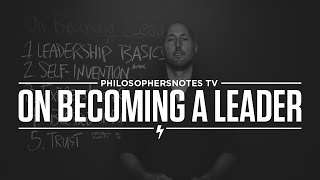
Brian Johnson summarizes and reflects on Warren Bennis’s On Becoming a Leader, highlighting core leadership qualities (vision, passion, integrity, trust, curiosity/daring), the importance of self-invention and authentic self-expression, and practical steps to earn trust. The piece is presented as a Philosopher’s Notes TV episode aimed at distilling big ideas for personal leadership development and preparation for a Leadership 101 course.
Chapters
Hi, this is Brian. Welcome back to Philosopher's Notes tv. Today we've got another great book on becoming a leader by Warren Bennis. On becoming a leader. Warren Bennis is one of the world's leading authorities on leadership. This is a 20th anniversary version of a book that I read nearly 20 years ago when I was first becoming a leader. 24, 25 year old entrepreneur, founder, CEO of a startup in the old dot com boom. Raised $5 million, went from two employees to 45 employees, hired the CEO of Adidas to replace me right when the market crashed, brought in an investment bank, wound up selling it to one of our competitors, etc, etc. My learning curve was very, very steep and I recall very much enjoying this book. And as I'm Preparing for Leadership 101, which I'm teaching soon. Reread it, enjoyed it. Philosopher's Note, bunch of my favorite big ideas, five of them here. We'll start with leadership basics. So what are the leadership basics? Warren walks us through the different elements that make up a leader. He says, look, leaders come in different shapes and sizes and they're all different in a lot of different ways. But they basically all have these qualities in common. The first is vision. A vision of where they want to go. That's the number one starting point of leadership is where are you leading or where are you intending to lead people to? What's your guiding vision? What do you want and why? Starts there. So in the note I asked the question again and again and again. What do you want? What's important to you in your life? What do you want to create? Leaders create. They don't complain, they criticize. By creating, what's your guiding vision? That is our first attribute or ingredient of leadership. The second is passion. Warren tells us that leaders have a passion for life and for the possibilities of life and for their chosen vocation. Whatever it is they've decided to give their lives to, they, they love, they're passionate about it. And that passion is contagious. The third ingredient is integrity. They are whole. As we talked about with James Stockdale's Thoughts of a Philosophical Fighter Pilot, Integrity means to be of one piece, integrated versus disintegrated, right? We need to be a coherent whole. Then trust is a fourth element. But he says, look, trust is the only one of these qualities that can't be acquired. You can't go out and learn how to learn trust, right? You can't acquire it. You need to earn it by living a certain way, which we're going to talk about. In the final big Idea, then we have two more ingredients, curiosity and daring. He combines the two together. Curiosity and daring. You need to be curious about life, passionate about learning and growing, and you need to be willing to take risks. He says that leaders embrace mistakes, embrace failure as part of the process of discovering the optimal path to bring their guiding vision to life. Check out those qualities, see where you're strong, see where you can grow and have fun with that. Next big Idea. There's our basics. Next big Idea is self invention. Bennis tells us that leadership is really basically actualizing your potential. And he says, I can't stress too much the importance of self invention. He says, authenticity is so critical to leadership and we've got to remember that the Greek root of the word authenticity is the same as the same in author and authenticity, which basically is short for to. To be authentic is to literally write your own story, to be the author of your own life. If you are conforming and you're letting society write the story of your life, that's literally the antithesis of leadership. You've got to be willing to write your own story. Invent yourself day in and day out if you want to become an effective leader. Which is related to our third big idea, we need to express ourselves. We rather than try to prove ourselves. He says there's a big difference between the drive to express yourself most fully, which he says is the most primary human drive, is the desire to fully express ourselves, Maslow style. Right? What one can be, one must be fully expressing the latent potentialities in our lives. That's very, very different than trying to prove yourself. If you're trying to prove yourself to the world, you're going to tend to conform because leadership, and that's the opposite of leadership, what we need from leaders is this desire to discover our own truths and then fully express ourselves in line with those truths. But if we're trying to prove ourselves and impress other people with who we are, that is the exact opposite way to go about expressing ourselves most authentically, which is connected to our next big idea. He talks a lot about Ralph Waldo Emerson and that great essay self Reliance. Throughout the book he references a number of leaders. The book is basically him articulating ideas he got from decades of interviews and research with world class leaders. One of them was Norman Lear, the television producer and creator who talks about Emerson's idea of the blessed impulse. The blessed impulse that we have this little voice within ourselves that's guiding us to, to our deepest truths. In self reliance, Emerson says, trust thyself every heart vibrates to that iron string. We must trust ourselves if we're going to fully express ourselves and invent ourselves in the most authentic way. And Bennis tells us we all have that silent voice. Leaders pay attention to it, right? We need to cultivate our ability to trust our intuition, trust our instincts and listen and pay attention to that voice. And that's not an easy thing to do, but we want to make a habit out of doing that. What does your little voice whisper to you? Pay attention and live in integrity with it. Which leads us to our fifth big idea, trust. Again, trust is the one ingredient that we can't acquire. We have to earn. He says there are four ways we can earn trust. One, we need to be. He says constancy is the first attribute of a leader who elicits trust, which is obviously important. If you want to lead people, you do so by earning their trust. He says you need to be constant. He says life may throw surprises at you, but you've got to have a constancy that people can count on. He says another attribute is congruency, where. In congruity, where who you are and. And what you say is important is consistent with who you are. Ralph Waldo Emerson again says, what you do speaks so loudly I cannot hear what you say. Leaders are in integrity with that. In this context, he calls it congruent. With what they say is important and what they actually do, they embody those ideas. That's important for eliciting trust. Our third variable is reliability. We show up, we're consistent, and. And our fourth variable in creating trust is integrity. And in this context, it means we basically follow through in our commitments. When you have those four things. Congruency. I'm sorry, constancy, congruity, reliability, and integrity. You're going to build trust, he says. People will follow you. You will be a qualified leader. When you have those four things in place, come all the way back up to these other ingredients. You have a guiding vision. The number of times he came back to the importance of knowing what you want. What is it you are committed to creating in your life? This was the dominant theme. What do you want? What are you going to dedicate your life to? Know what your guiding vision is. Get fired up about it. Live in integrity with your ideals. Earn that trust we just talked about. Be willing to be curious and daring in pursuit of following your blessed impulse. Expressing yourself. Quit trying to prove yourself and express yourself and be the author of your own story. Actualize your potential on your terms. What one can Be one must be. What must you be? Here's to becoming the most powerful leader you can be. The world needs powerful leaders more than ever. Let's be one. Have an awesome day. See you. Isn't it a bit odd that we went from math to science to history, but somehow missed the class on how to live? For some wacky reason, optimal living 101 never made the schedule. Of course, it's too late to go back and change that and you're too busy to read full time to catch up yet. If you're like us, you're all about optimizing your life and actualizing your pot. So imagine this. Imagine having someone read the best books on optimal living and pulling out the big ideas that can truly change your life. You know those sections you asterisk and underline and mark all up. Then imagine that guy me connecting those ideas to other great books and helping you apply them to your life today. Well, that's what I do with something we call Philosopher's Notes where I break down each great book into a simple 6 page PDF, 20 minute MP3 and 10 minute Philosopher's Notes TV episode. Then imagine me taking the absolute best big ideas from those great books and sharing them with you in fun, inspiring, super practical optimal living 101 classes on stuff like purpose 101, confidence 101 business 101 meditation 101, that sort of thing. You've got a personal trainer? I'm kind of like your personal folks. Philosopher Ancient Wisdom plus Modern Science plus Common Sense plus Virtue plus Mastery plus Fun. That's what our optimized membership program is all about. We'd love to have you join us. Check us out at BrianJohnson. Me join.
More from Brian

Heroic +1: What’s THE Most Creative Act in the Universe?: Turning Around Glitches (#2024)









