PNTV: Originals by Adam Grant (#283)
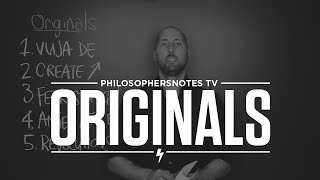
A Philosopher's Notes TV (PNTV) video by Brian Johnson summarizing Adam Grant's book Originals: How Non-Conformists Move the World (Feb 2016). Brian outlines five practical insights for being original: (1) 'Vuja Day' — see the familiar with fresh eyes and challenge defaults; (2) increase production — create a high volume to raise odds of original work; (3) reframe fear as excitement ('I am excited') to harness high arousal; (4) channel anger 'for' victims (empathetic anger) rather than venting; (5) revolutions as long, sustained burns rather than instant explosions. The episode closes with a membership pitch for Johnson's Optimal Living program.
Questions this video answers
March 19, 2016
#283
$10 per month
250 PDFs
Chapters
Hi, this is Brian.
Welcome back to Philosopher's Notes TV Today.
Another great book, Originals by Adam Grant. Originals subtitle How Non Conformists Move the World. Adam Grant is one of the world's leading management thinkers. He is the top rated professor at Wharton and, and just a fascinating guy, writer and storyteller. His prior book, Give and Take, I Still need to Feature, it's been translated.
Into something like 27 languages. One of the best selling books by.
Basically everyone's rankings in 2013. This book is fantastic. Just came out as I'm producing this February 2016 philosopher's note. Bunch of big ideas. Five of my favorite ones we're going to take a quick look at now. So to be an original, right? To be willing to not conform and to express unique, interesting, meaningful ideas in the world. We start with Vuja Day. We all know what deja vu is. Deja vu, of course, is when we experience something for the first time, but it feels like we've experienced it before, whereas Vuja Day is the reverse. We experience something familiar, but we see it with fresh eyes. We can make distinctions that other people may not be able to make, right? Vuja Day. He brings this idea home in the form of a great study which is just fascinating on default web browsers. So what browser are you using to watch this right now? If you're on a normal computer, if you're using a default browser, check in on that. Because research shows that people who choose either Chrome or Firefox, rather than using the default of Safari on a Mac or Internet Explorer on a PC, if you use the default browser, according to research done on individuals involved in customer service, right? This guy studied like 30,000. One of Adam's friends studied like 30,000 customer service agents. He was trying to understand who stays at a job longer and he wound up looking at the data and he saw this weird correlation between performance and the browser they used. Short story, individuals who used the default browser. Two thirds of the individuals or something like that used the default browser and they underperformed the people who took the time and had the initiative to download a browser they preferred again, either Chrome or Firefox, right? They significantly outperformed the default browser group in basically every measure. They stayed at the job longer, they had higher sales, they had higher customer satisfaction, et cetera, et cetera, et cetera. Default browsers, a default view of life where we just go through the motions. We do what everyone expects us to do. That is not a pathway to originality. We gotta be willing to look at the default experience of life and challenge it, have the initiative to do something different, which is what these individuals. The researchers hypothesized that if you had the initiative to change your browser, you probably also had the initiative to change your work environment. You were willing to go off script and do things a little differently than those who just went with default. So what browser are you using and are you too readily accepting defaults? Can you reach out, stretch out and challenge the normal and see it a little bit differently? Vuja Day that's our first big idea. Second big idea. We need to increase our levels of production if we want to be an original. One of the chapters I underlined, basically every word in it.
Awesome.
Talking about individuals who have been originals, right? Extraordinary creators, whether it's Shakespeare or Picasso or Beethoven or Mozart or Bach or whoever. And short story here is that if you look at these exemplary performers, the ones who have just produced masterpieces, they produce them while producing a crazy volume of content of whatever it is, whether it's artwork or music or plays, if you're Shakespeare or whatever, in the same period of time that they produced their best work, they produced a ton of other stuff that wasn't always exceptional. It was technically sound, but it wasn't always great, right? A very, very small fraction of their work was actually great. But the mere act of producing at such a huge level increased the odds of producing something that was truly original. So he says, unequivocally quoting Ira Glass of this American Life and then the Cereal podcast. He says, look, the number one way that you can boost your productivity is to produce a lot, alright? So the second big idea if we want to become originals is we need to create a ton. Adam Grant shares some fascinating research on great original creators ranging from Shakespeare and Picasso and Beethoven, Mozart and Bach. These individuals who created truly great masterpieces also created an incredibly high volume of work. Oftentimes we think that, hey, if you want to do great stuff, you got to do less, right? But make it better. Well, the research shows that actually odds of creating something truly great increase when you create a ton of stuff. This is again, if you look at Shakespeare, the number of plays and sonnets that he wrote, ton of work produced, only a little bit of that became truly great. But he needed to do all that to make the distinctions to become truly original. Same with these great composers, Picasso, etc. Reminds me and I talk about it in the note of the £50 equals a idea from Art in Fear. In that book, the authors tell us about a little experiment a teacher ran where he said, hey, look, I'm going to split you class into two groups. Everyone on this side is going to be judged. They're going to be given an A or a B or a C, depending on the quantity of work that you produce. If you produce £50, you get an A. £40 is a B. £30 is a C. You guys on this side, I'm not worried about how much you produce. I just want you to produce one perfect piece of pottery, one perfect pot. Then you'll get an A. Right? Fast forward. The group that produced 50 pounds to get the A had all of the great work. The majority of the great work came from this group. Whereas this group just sat there and theorized about how they could create something perfect while this group was working and getting a little bit better. So. So we want to think about 4%, 4%, 4%, 4%, just get a little bit better. Be willing to ship your stuff to market, right. And churn it out. Produce a high level, create a ton. Third big idea, fear. This is another one of my favorite ideas. Actually, this is tied for first for my favorite idea ever, how to deal with fear. We talked about it in Presence by Amy Cuddy and in the Upside of stress by Kelly McGonigal and Alison Wood Brooks. A researcher, Adam tells us, brought people into a lab, stressed them out by having them give an impromptu speech. If you want to stress anybody out, have them give an impromptu speech.
Right.
He shares a great line from Jerry Seinfeld, who says, we all know that people fear public speaking. Most people fear public speaking more than death. Jerry Seinfeld, Adam tells us, made some joke along the lines of, if you have to go to a funeral, you'd be better off in a casket than giving the eulogy. Ridiculous. So anyway, you want to stress people out, put them into an experiment where they have to give an impromptu speech.
Right.
And now she had them split into two groups. One group said, I am calm as they're feeling their heart race and they're anything but calm. She had them say, I am calm and try to relax themselves. The other group said, I am excited.
Right.
So the lesson here is that when we are feeling fear, we're at a high emotional arousal state. Right. It's really hard to drop that down into a low emotional arousal state. But if you're feeling fear, you're also on a spectrum having negative thoughts about what's going to happen.
Right.
You think something's going to go wrong. Now, if you can reframe your fear in something positive, like being excited Right.
Wow.
What would happen? Well, then you can maintain the high arousal state without trying to do the impossible of drop down into a completely relaxed state, and you can use that energy wisely. Much easier to go from negative high arousal to positive high arousal than to go from high arousal to low arousal. And this, these three words, I am excited, is a shockingly easy way to make that switch. And again, when people tell us, calm down, that is perhaps the worst possible.
Advice, because you can't just calm down.
Adam uses the great metaphor of it's like driving down the freeway at 80 miles an hour and slamming on the brakes. High arousal, you can't just turn that off immediately, but you can go from fear to excitement. He says that's like going from the stop system.
Right?
You can try to turn the arousal off, or you can just press down on the accelerator some more and go. We want to activate the go system by having a positive state of high arousal.
That idea is so huge.
Perhaps it's just because I used to be anxious about everything, and now when I feel any nerves, it's not, oh, something's wrong with me. It's, wow, I'm excited. Everything that's happening to me is happening to me to help me perform at a higher level. I am excited is a great way to convince ourselves that everything is as it should be rather than freak ourselves out. Anger. You can have anger at someone or for something or someone. This is really fascinating. It's part of a chapter on how to rock the boat, right? And be a change agent, be original without falling overboard. You got to keep yourself steady. He's got a lot of great practical ideas on how to go about doing that. One of them is how to deal with anger. He talks about this fascinating research that are a ton of counterintuitive research studies in the book. This one on anger I thought was worth pulling out. Basic idea, venting is not healthy. It doesn't dissipate anger. It fuels anger in an inappropriate, unhealthy, suboptimal way. They had individuals into a lab and they had them receive feedback from somebody, Right? They couldn't actually see the person, but they received feedback from them.
I don't think they could see them.
That was super harsh, right?
That was. They did something.
I don't even know what they did, but they did something. And these individuals gave them super harsh feedback, right? Oh, this is just worthless.
It's not good. Unoriginal, etc.
Right? And then so all these people are angry. It makes anybody angry to get that feedback, right? Then they had them in the second part of the experiment, hit a punching bag. In one group hit a punching bag thinking about the individual who gave them that feedback, right? Kind of venting their anger at this individual. The second group hit the punching bag, they released some of that energy, but they didn't think about the individual. They weren't venting their anger at the specific individual. They were just punching the bag and they were told that it was going to help them build their physical strength or whatever. Right? Then the third group just sat there quietly. The group that hit the punching bag thinking of the individual who upset them got even more hostile. And in the third part of the study, they were the ones most aggressive. And again, not in a healthy, constructive way, but a destructive way. The other group stayed in the in the go position. They were using their high arousal in a more positive way while the group that just sat there started to initiate the stop phase. Right, but the point here is that rather than venting, which just makes you more angry and the better you feel, the more hostile you actually become. Not just to the critic, but, but to those around you, kind of bystanders, right? So if you vent a lot, stop doing that. Research shows it's not a helpful thing to do. You'd be much better off rather than thinking about who you are angry at, to think about who you are angry for. Empathetic anger is what researchers call it. Who are the victims of this perpetrator's anger?
Right.
It might be you or it might be other individuals. Think about with compassion victim these individuals and think about how you can create more justice in the situation. Right? And be helpful and constructive rather than vicious and hostile. Right? Anger for empathetic anger versus anger at Quit venting. Develop the empathetic anger to remain steady.
As you rock the boat.
Fifth big idea is revolutions. He shares some great ideas by a guy who led the non violent youth movement in Serbia. Amazing story. Who's now trained a number of revolutionaries around the world. And he says, look, a proper revolution is not a cataclysmic explosion as much as it is a long lasting burn. Right? So we think of revolutions as this cataclysmic explosion. It just happened. And this guy says, who trains revolutionaries successfully, says, no, no, no. It's actually a long, controlled, sustained burn. And I just love that. And I love it as a metaphor for our own lives. Of course, as we're going out and being change agents and being original, we want to keep that in mind as revolutionaries. But in our own lives, too often we get seduced by the personal development revolution where we have these awakenings. We want to just change everything instantaneously. That's one way to go about doing it. But a proper personal revolution is one in which we have a long, sustained controlled burn. We don't just blow ourselves up and burn out. We show up day in and day out and do the little things like these revolutionaries did. They succeeded doing little things that allowed people to know that they weren't alone and built momentum. We need to build momentum in our own lives as we face the tyrants within ourselves slowly and surely, diligently, patiently and persistently. So there you go. Proper revolutions and anger for rather than at fear, right? Quit trying to turn it all off and be willing to lean into the go by reframing your fear as excitement. I am excited. You want to be original? Create a ton. £50 equals a. I have that on my whiteboard. It has the permanent upper left position on my whiteboard. 50 pounds equals a show up, do a lot of work.
4%.
4%, 4%. And then Vuja Day. We talked about those default browsers. Fascinating research. Be willing to look at life with fresh eyes, see the familiar in a new way, and solve common problems with a new vision. Vuja Day Originals. Adam Grant.
It's an awesome book.
Fascinating look at all these great research studies with a lot of practical applications. I think you will enjoy it. Check it out.
Thank you.
Thank you, Adam.
All right.
What was your favorite big idea? What jumped out? How can you make that a bigger part of your life starting today? Think about that. Write it down if you're feeling inspired. Share with other people and have another awesome day.
Alright, see you. Hi, this is Brian. I hope you enjoyed that PNTV episode. A lot of people don't know all the stuff I do beyond these free videos I share on YouTube. So I. So I thought I'd do a quick video to give you an overview of our membership program that you can get access to and get a ton of other stuff. So here's a quick look. Ten bucks a month. Join the Optimal Living Membership program. You get Instant Access to 250 Philosopher's Notes on some of the best optimal living books out there. Old school classics, positive psychology, modern stuff, mindfulness, peak performance, purpose, neuroscience, wealth, etc. And what you may not know is that in addition to the PNTV episodes, I create PDFs on all these great books. So six page PDFs. Let's take a look at one of them. Joseph Campbell, you want to figure out.
How to live your hero's journey. Well, this is a great place to start.
I basically pull out my favorite big ideas, riff on them, connect them to other books and other ideas and help you apply this wisdom to your life today. That's what the PDF looks like again. We have 250 of these on all these different great books. And then I record those PDFs as an MP3 so you can listen to that MP3 while you're on a walk or working out or doing some errands or whatever that is. Philosopher's Notes. A lot going on there. And then in addition to Philosopher's Notes, you get access to optimal living classes. Optimal Living 101 idea here is that.
All those great teachers come back to.
The same big ideas again and again and again. I distill those ideas into classes. Super practical, fun, inspiring classes ranging from Habits101, Confidence101, Getting Stuff Done101, Meditation101, instant access to all those classes and then Future classes include Relationships 101, Energy 101, Purpose 101, Business Goals, etc. Those are our full length classes. And then I create micro classes. Two to three to five minute little bursts of wisdom on my favorite great ideas from these great books across the domain that you want to optimize in your life. So we have dozens of these so far. I create 50 new micro classes every month and 10 new philosopher's notes every month for 10 bucks a month. So we're blessed to have thousands of members who are enjoying the program and sharing some incredibly kind words with us. And super simple. 10 bucks a month. Cancel anytime. Would be honored to be a bigger part of your life and I appreciate your support. And here's to optimizing and actualizing.
More from Brian

Heroic +1: What’s THE Most Creative Act in the Universe?: Turning Around Glitches (#2024)









