PNTV: Primary Greatness by Stephen Covey (#301)
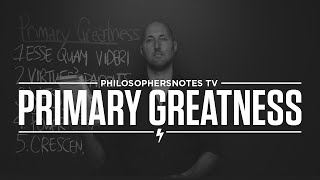
YouTube episode (Philosopher's Notes / PNTV) by Brian Johnson summarizing and riffing on Stephen Covey's book Primary Greatness: The 12 Levers of Success. The video contrasts primary greatness (character, 'to be' rather than 'to seem') with secondary greatness (resume/appearance), outlines key virtues (humility and courage), and presents five practical themes—humility & courage, a single deep 'yes' and saying no, 'sharpening the saw' (Quadrant II renewal), and living in crescendo—followed by a membership pitch.
Chapters
Hi, this is Brian.
Welcome back to another episode of Philosopher's Notes.
Tv.
Today we've got another great book, Primary Greatness by Stephen Covey. Primary greatness, subtitled the 12 Levers of Success. This book was published after Stephen Covey.
Passed away by his team at Franklin.
Covey, and it's extraordinary, as you know, if you've watched the stuff on 7 Habits of Highly Effective People. Stephen Covey is one of my favorite teachers. All about character, who we are when no one is looking. That's what this book is about. Primary greatness vis a vis secondary greatness. Our world, our society, rewards secondary greatness. The resume virtues is how David Brooks put it, right? In the road to character versus the Eulogy. Virtues. What's really important, the primary greatness, who we are. That's what this book is all about. 12 levers to success in the ultimate sense. We've got the Philosopher's Note with a handful of my favorite big ideas, five of them here. We will start with essequam videre. Essequam videre means to be rather than to seem, to be rather than to seem. That's the essence of primary greatness. We are what we aspire. We kind of have this orientation of wanting to look a certain way. And he says that's secondary greatness, where your attention is on the resume. Virtues of check me out, I look like I've got certain things going on. He says, we want to be that way. Not focus on seeming to be that way and all the marketing and self promotion, but actually being that way. Ryan Holiday in Ego Is the Enemy says, make it so you don't have to fake it. Be it, don't try to seem to be it. Right? Primary greatness versus secondary greatness. Another way that Stephen Covey described it in Seven Habits was private victory before public victory, Private victory before public victory. He says, algebra comes before calculus. You gotta master this stuff, you gotta master yourself before you're gonna have sustainable exterior success. Let that be a byproduct of your commitment to being that which you aspire to be rather than just seeming to be it. Total integrity is a phrase he uses. Total integrity. And he makes the point that he, Stephen Covey, was. Was never perfect. There were certain areas of his life where he fell short. He wasn't perfect in all senses at all the time.
Right?
And as we talk about all the time, there are no perfect human beings. We're never going to be totally in integrity, yet that's the value we aspire to, which leads us to our next big idea, which is virtues. Parents. We need to have two things. Virtues, parents, right? What are the parents of virtue? If you're going to guess, what would the mom virtue be? The ultimate meta virtue that drives all the others. And what would the dad virtue be? Mom virtue, dad virtue. What would your guess be? Well, he says that mom is humility and dad is courage. Those are the parents of all the other virtues, humility. Why? Because we need to have humility to say, you know what? I'm not in total integrity. There are things that are more seeming than being in my life, and I'm committed to working on that. This is what David Brooks talks about in the Road to Character. He says the number one vice that we have in modern society is pride.
Right?
We think that in terms of developing character, we think that we're awesome. It's the culture of the big me selfie. Check me out. I am awesome. And I'm constantly promoting how awesome I am in every single regard. We need to have the number one virtue, which is vice. I'm sorry, which is not a vice. The number one virtue is humility.
Right?
We need to have the number one virtue of humility to deal with. Number one vice of pride. Humility is stepping back and saying, yes, I am not totally in integrity. I have sinned. David Brooks talks about sin as a powerful thing. To be honest with ourselves when we're falling short. That's the mom of all the virtues. The second parent, the dad, is courage. Once you've had the humility to identify where you're falling short. There it is. Wow. I could do better in those areas, by the way. Think about it. Of course. What areas are you falling a little short in? Have the humility to say, wow, yeah, I can do a little work in that regard, or a lot. Then we need to have the courage to actually embody these ideas to do it when you least feel like it. Remember, the word courage comes from the Latin and French word for heart. Just as your heart pumps blood to your arms and legs and other organs, courage is the virtue that vitalizes all the other virtues. It's what gives all your other virtues energy. If you don't have the courage to do what you know you could do moment to moment to moment, then it doesn't matter, right? It's all just intellectual, theoretical stuff. We want to navigate toward total integrity via humility and courage. Third, big idea. We have a very big yes on the board and a very small no. We need to get our priorities in order. We need to Say yes to something that is wildly important in our lives. What's really, really, really important to you when you have that deep yes? Covey says there's actually like this psychological relief to be able to say no to the stuff that just isn't important. It's absolutely been that way for me. I mention it all the time, but I'm so clear on my one thing and what I'm going to do that it's made it really, really easy to say no to a ton of stuff. No to my iPhone again, I'm a bit of a nut about it, but I haven't turned it on in forever. No to email. I've been out of email and I'm excited about that because I have a deep, deep yes to the creative work I'm doing. So I can say no to the other stuff. So the question for you is what are you saying? A deep yes to what's truly important. Be willing to go all in on that stuff and make the trade offs and say no, I'm not going to do that. That, that and that. For me, it's my creative work and being a husband and father and I have a lot of room for anything else. So it's easy to say no to the other opportunities that come up because this is what I'm doing. Have a really clear big yes to the wildly important stuff and say a polite no, but thank you to the other opportunities. Easier said than done. What is your big yes?
What do you need to say no to?
Get on that fourth big idea, the power saw. So in the seven habits of highly effective people, the seventh habit was renewal was basically taking care of yourself. Right? Quadrant 2 activities is how Covey described it. Quadrant 2 activities are things that are important. They're important, but not urgent. Right, Quadrant two on my whiteboard in the studio we have, I have quadrant four. I have an X through it. Quadrant four is stuff that is. Actually, I've got this a little bit backwards but we'll get the basic idea. This is actually a negative, that's a positive. Right? So we got a negative here and then we've got a positive here, which means that it is. What is this dimension? Is it urgent? Nope, not urgent, not urgent. Is it important? Important? Yep, it's important and no, it's not important. So quadrant four would be neither urgent nor important. It's time wasting stuff. It's checking out email more than you need to. It's checking out social media more than you need to.
Right?
And then quadrant two is the stuff that's not urgent, but is important. That's stuff like meditation, exercise, time with your family, thinking, hiking, stepping back, getting a massage, whatever you're going to do to renew yourself. And the power saw idea here comes from Abraham Lincoln's supposed quip that if he had two hours to chop down a tree or saw down a tree, he would spend an hour of that time shooting, sharpening his saw. If Abraham Lincoln had two hours to saw down a tree, he would spend an hour sharpening the saw. What does that mean for our lives? It means that we are the saws. We need to manage our energy more than our time. We need to spend the requisite amount of time renewing ourselves and prioritizing the fundamentals of eating, moving, sleeping, meditating, etc. This morning I was doing my normal AM routine, which is get up early this morning, it was five something, right? And then meditate for 20 minutes. Every single morning I meditate for 20 minutes and then I do a very simple stretching, five minutes and kind of just leisurely get into it. It takes me 25, 30 minutes to do all that stuff. And I was thinking this morning, like, you know, in theory, I could be spending that time doing sawing down the tree, but that's what gives me the vitality to do it with the most energy I possibly can.
Right?
So again, if Lincoln had two hours, he'd spend an hour sharpening a saw. These days, he'd invest for sure in a power saw. He certainly wouldn't be going at it with a dull blade.
Right.
Power saw action. So how do you create as much vitality as you can? You do that by focusing here in quadrant two. And I started to mention my whiteboard. I've got this simple thing in my whiteboard, little quadrant. Boom, boom, X. And then there. I make it a game. Anytime I feel tempted to do a Quadrant 4 activity, which is a time waster that does nothing for me other than kind of grind. Can I flip that into a quadrant 2 activity? Can I do something productive with that time rather than kind of dissipative? It's a powerful idea. Create a power saw for yourself. And I'll draw this because I do it once a day, right? Get your foundations dialed in. That's quadrant two. That's how you have the energy to truly live at your highest potential. Primary greatness style.
Somewhat meandering idea.
Thanks for bearing with me. Fifth big idea is crescendo. Crescendo. Now, this was from the very end of the book. There was one of the last interviews that Stephen Covey did is part of the very end of this book. And in it he was asked a question about crescendo. And apparently toward the end of his life, talking about crescendo was one of his big themes. And the idea is that crescendo is a musical term which basically means that the energy is building and building. There's more strength and vibrancy to the playing and to the song than before, right? Versus something like disinuendo, which is the opposite, which is less and less and less and less bold. So the crescendo is moving up. And Covey said that the most important thing we can do is to live in crescendo, where the next thing we're working on is always the best thing. Isn't that exciting? Where we're giving more energy, more vitality to our lives and to our projects, to our families than ever before. We're not diminishing the energy, we're building on that energy. It reminded me of Mihaly Csikszentmihalyi's idea in Creativity, where he said that the great creators who truly created something is extraordinary that changed their domain. If you ask them what their best work was, they'll all say the next one. They're always looking forward. As Emerson says, genius appeals to the future. So get excited about what you're up to. Know with hope and that optimism that your future is going to be brighter than your present because you're going to put in the energy to do it. You're going to live with crescendo and you're going to have a power saw and prioritize Quadrant two activities. And in one of the recent episodes we just did on Sleeping Smarter, here's an example of how to move from Quadrant four to Quadrant two. If you're spending your time watching TV or surfing the web at night, that's a Quadrant four time wasting activity. It's not nourishing you. You could easily swap even just one hour of that time into Quadrant two. Getting a good night of sleep. That simple, simple shift is a powerful way to sharpen your saw so you can have a great day the next day and continue to build momentum wise. Say yes to something really important to yourself. Identify it. What are the 1, 2, 3 top things you're committed to in your life? Give yourself to them and say no to the other stuff. It takes courage, which is the father of our other virtues. And it takes humility to see where we're falling short in total integrity. Essay quam videre. We want to be virtuous rather than appear virtuous. We want to have primary greatness rather than constantly chase secondary greatness. Let that be a byproduct of our commitment to something bigger than ourselves and our commitment to being that which we aspire to be a little bit more day in and day out. That is a quick look. Primary Greatness. I hope you enjoyed what was your favorite big idea. How can you make it a bigger part of your embodied life? Get on that and have another awesome day. Look forward to sharing more soon. See you.
Hi, this is Brian. I hope you enjoyed that PNTV episode. A lot of people don't know all the stuff I do beyond these free videos I share on YouTube. So I thought I'd do a quick video to give you an overview of our membership program that you can get access to. Get a ton of other stuff. So here's a quick look. 10 bucks a month Join the Optimal Living Membership program. You get instant access to 250 philosopher's notes on some of the best Optimal Living books out there. Old school classics, Positive Psychology, Modern Stuff, Mindfulness, Peak Performance, purpose, neuroscience, wealth, etc.
And what you may not know is.
That in addition to the PNTV episodes, I create PDFs on all these great books. So six page PDFs take a look at one of them. Joseph Campbell, you want to figure out how to live your hero's journey? Well, this is a great place to start.
I basically pull out my favorite big.
Ideas, riff on them, connect them to other books and other ideas and help you apply this wisdom to your life today. That's what the PDF looks like again. We have 250 of these on all these different great books. And then I record those PDFs as an MP3 so you can listen to that MP3 while you're on a walk or working out or doing some errands or whatever that is. Philosopher's Notes. A lot going on there. And then in addition to Philosopher's Notes, you get access to optimal living classes. Optimal Living 101 idea here is that.
All those great teachers come back to.
The same big ideas again and again and again. I distill those ideas into classes. Super practical, fun, inspiring classes ranging from Habits 101, Confidence 101, Getting Stuff Done 101, Meditation 101, instant access to all those classes and then Future classes include Relationships 101, Energy 101, Purpose 101, Business Goals, etc. Those are our full length classes. And then I create micro classes 2 to 3 to 5 minute and little bursts of wisdom on my favorite great ideas from these great books across the domains that you want to optimize in your life. So we have dozens of these so far. I create 50 new micro classes every month and 10 new philosopher's notes every month for 10 bucks a month. So we're blessed to have thousands of members who are enjoying the program and sharing some incredibly kind words with us. And super simple 10 bucks a month. Cancel anytime. Would be honored to be a bigger part of your life, and I appreciate your support. And here's to optimizing and actualizing.
More from Brian

Heroic +1: What’s THE Most Creative Act in the Universe?: Turning Around Glitches (#2024)









