PNTV: Reinventing Yourself by Steve Chandler (#373)
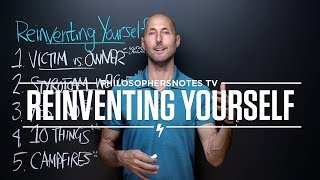
Brian Johnson summarizes and reflects on Steve Chandler’s Reinventing Yourself (revised edition). The episode presents five core ideas for personal reinvention: (1) the fundamental distinction of Victim vs Owner (owning the human spirit), (2) "Styrofoam weights" — avoid shallow challenges and embrace real problems, (3) "yes lives in the land of no" — accept rejection/failure on the path to success, (4) the "10 things" exercise to act before fear dissipates, and (5) the "campfire"/chair metaphor — rebuild purpose and positivity daily. Johnson ties these concepts to practical prompts (make a 10-item list, take action) and encourages adopting owner-language and behaviors.
Chapters
Hi, this is Brian. Welcome back to another episode of Philosopher's Notes. TV Today we've got another great book, Reinventing Yourself by Steve Chandler. Reinventing Yourself Subtitle how to become the person you've always wanted to be. This is the revised edition. Steve Chandler is awesome. As we've discussed in the other five books of his we've profiled, I love him. His down to earth style, grounded wisdom, former alcoholic who turned his life around. Super self deprecating and also super wise. He and I worked together one on one for a couple of years. I read this book years ago, reread it recently. Love it, Love Steve. Philosopher's Note. Bunch of big ideas, five of them here. Let's take a quick look. So our first big idea is victim versus Owner. Victim versus owner. This is really the whole point of the whole book. You want to reinvent yourself, you need to look at your language you're using in your own mind, right? Are you being a victim or are you being an owner? How are you approaching life? You want to be what Steve calls an owner of the human spirit. This is similar to what we described in prior episodes, like on David Emerald's Power of Ted of Victim versus Creator. The victim blames everything outside of themselves, right? The creator says, what do I want? How am I going to create the life that I want? Rather than spend all of my time and energy complaining. In the note, I jokingly say, you can speak one of two languages, you can speak Victamese or you can speak Onish. Which one are you speaking in your life? If you want to reinvent, get really good at speaking your new language. Being an owner. No longer complaining, no longer criticizing, no longer blaming anything outside of yourself for things that might be going on in your life that you don't want to be going on. Victim versus Owner. That's our first point here. Second one is a fun one. Styrofoam weights. One of the things that makes a victim a victim is that they're constantly avoiding challenges and problems. They're complaining about the things that aren't going perfectly in their lives. Steve says in the book. And I remember vividly the conversation we had in our one on one work where he says that victims are people. Kind of like people who go to the gym, right? And they're sitting there and they're acting like they're working out. But rather than pick up real weights, they're there picking up styrofoam weights, right? They're pumping weight, right? But it's Styrofoam. Weights, you're not going to get any results from working out with styrofoam weights, right? The true creator, the owner, as Steve says here, looks at problems, looks at challenges, like their weights in a gym. They know that those problems and those challenges literally make them stronger. Every single time they go toward their problem and challenge, they get better. They're spiraling up, as Ray Dalio says in principles, right? They're evolving and using those mistakes and those failures as fuel for their growth rather than avoiding all of their challenges and problems. Then what do you do when you're avoiding things? You go straight toward distraction. Again, this is what a victim does. An owner goes straight to the weights, the right weights. They're not being idiots about it, but they're also not looking for the easiest things in life. They're not going to Styrofoam weights. So again, check in. Are you approaching your challenges in life like you would if you were in a gym looking to get stronger? That's how we want to approach it. Why do we do what all the work we do, but to see how much better we can be and how we can deal with more and more challenges? Which leads us to the next big idea. Another good distinction, yes and no. I remember our one on one session where Steve and I chatted about this as well. So get this. Imagine this big circle. Then you got this little circle. That big circle is no. That little circle is yes. Basic idea here. As you may notice from the drawing, the yes lives within the no. Steve and I were chatting about this back in the day when I was raising money for the business I was running at the time. A little different version of what we're doing now. And he was coaching me to realize that you got to be willing to go through the no's if you want to get to a yes. In that context, it was raising money, right? Then you have to be willing to go through a bunch of no's. Yes. I lives in the land of no. Steve would say, right? So you got to be willing to have the courage to venture into this unknown. Get a lot of no's. Oh, no. In order to get to the yes. Another way that he framed this was an Alan Watts piece of wisdom. He says, some things go with one another so much that we should create a word that he called goes with no space. One word goes with right. So light goes with dark, right? Success goes with failure. Night goes with day. Yes goes with no. So again, the victim hates no's. They will do anything they possibly can to avoid Getting a no because they experience it as complete and utter rejection. The owner of the human spirit, the creator, knows that you have to be willing to navigate through, through the land of no to get to the yeses that we want. So we're willing to embrace the mistakes that are inevitable. We're willing to embrace the failures that are inevitable when we go for things we truly want. Yes lives in the land of no. Check in. Are you avoiding some no's? Well, know that if you're not willing to go into that land of no, you're never going to have a shot at getting your yeses. Which leads us to our next big idea. 10 things. Steve talks a lot about how a victim thinks they need to have courage and feel courageous before they do anything. Steve says no, actually, it often works the other way around. That the courage comes in the act of doing something, that it shows up midway or at the end. You realize, wow, I was courageous there. You got to wait. You can't wait until you feel like doing something in order to do it right. It's the whole idea that you need to have a clear identity which will drive your behavior, which will then drive your feelings. But if you're constantly checking in and saying, well, how do I feel about that? You may never take any action. So he has an exercise. 2 parts. 1. Imagine 10 things that you would do if you had absolutely no fear. 10 things that you would do if you had absolutely no fear. Think about it. It's worth busting out a good old piece of paper. 1, 2, 3 to 10. What are 10 things that you would do if you had absolutely no fear, Absolutely no fear? What would you do that is worth the exercise? Press pause, do it right now or do it when you have some quiet time. But what are 10 things that you would do if you had absolutely no fear? Now you can whoop it right? The wish, outcome, obstacle plan and be smart about it and ensure that it's actually within the realm of what you tried, truly want to do, etc. Etc. But Steve makes the point that too often we're just so confused and think that we have to know that we can do something or have the confidence that we can achieve something and no fear that it will not go the way we want in order to try anything. He says, look, make your list of 10 things and then start working on one of them. So part one was make your list of 10 things. Part two is take some action on it. What's the one thing you're going to start doing now? What you might find, as Seneca told us, it's not that things are difficult that we do not dare. It's because we do not dare that things are difficult. He says, perhaps your fear will become like salt in a river. If you had a handful of salt and you put it into a river, what would happen? It would dissolve. Right. He says, you need to be willing to jump off that cliff into the river below. And. And you feel that mixture of joy and fear simultaneously. And quit telling yourself that the fear needs to be completely gone before you take action. Right again. Ralph Waldo Emerson, as he references, do the thing and you'll get the power. Start taking action now and you'll find some power. 10 things, two parts. Fifth big idea is campfires. Steve tells us that life in the human spirit is kind of like a campfire. So imagine that you're out camping, you light a fire. It's cold at night, so you light a fire. It's awesome. You get all warm. You wake up the next morning, and of course the campfire is out. That's just how campfires work, right? Well, he says, you know what? And then what do you do the next night? You light another fire and you proceed. As long as you're camping and you want a fire, right? He says, the human spirit is very much like that campfire. But we have this naive idea that we should be able to light that fire and then get the warmth from it all day, every day in the specific context of happiness in our human spirit. He says, look, you think that you should be able to wake up every single morning with that campfire, that happiness burning every single morning, but that's not quite how it works. You need to recreate that internal, happy, purpose driven, meaningful campfire every single day. Victims don't like that. Victim. Victims, as my current coach, Phil Stutts, says, want to be exonerated from all future campfire building. I'm done with it. Why do I have to keep on doing this work? I've already built a thousand campfires. You're telling me I have to build another one? Yes, that's precisely what we're telling you. Phil, in our work together, one on one over the last couple of years says exactly the same thing. Rather than campfires that have to be rebuilt every day. He says it's kind of like a chair. He says, now, on a material plane, when you build a chair, it's there the next morning on a spiritual plane. You build a chair on a spiritual plane, it's not there the next morning. You have to rebuild it. Again the next day. Then you have to rebuild it again the day after that, just like that campfire. And again, victims don't like that. Owners own it and they realize that that's just how it is. And then they get excited about the fact that when they don't feel particularly motivated or happy, they now know what to do to build the fire, to put themselves into a state of positivity. And that gives them an extraordinary amount of confidence. And again, it's related to our 10 things. They know that they don't have to feel great every day in order to do things, that the feeling great often follows the doing the things. So keep that in mind with your campfires and your chairs. Get your ten things list going. Remember that yes lives in the land of no. Are you so afraid of getting rejection? So afraid of making mistakes or having failures and not taking any action? Well, again, whoop it. Get smart about it and then take action. Take more action. Take more action. He says that when you orient from action like an owner, success or failure is really just like left and right. It's like up and down. They're just signposts. They don't mean anything other than, oh, that didn't work. It's just neutral data. We take it in. We take more action as we get closer to our goal. Styrofoam weights. Remember that metaphor? Anytime you find yourself wanting to avoid problems and challenges, Imagine being the guy or girl who goes to a gym and kind of lifts Styrofoam weights. You would just never do that. Well, we don't want to do that in life. And you'll also notice that when you do tend to do that, you then run into distraction and you want to avoid. When you are avoiding those challenges, you tend to get sucked into meaningless stuff, whether it's obsessing about news or the latest ridiculous show that's going on, or whatever else that is indicative of you avoiding the things that really need to be done so you can get stronger, etc. Finally, victim versus owner, which is the ultimate distinction. We want to be owners of the human spirit as we reinvent ourselves, become the person we've always wanted to be. On that note, think about that. What is the best version of you look like? Optimize comes from the Latin word optimus, which literally means the best. All of our work together is based on that. What is the best version of you look like? Think about that. See where you are. Reinvent yourself into that next best version of yourself. Moment to moment to moment. Spiral up into that awesome version of you, become an owner of the human spirit, etc, etc. There you go reinventing yourself. Steve Chandler. What was the idea that jumped out and landed? How can you make it a more integrated, embodied part of your life today? Get on that. Make today another awesome day. See you.
More from Brian

Heroic +1: What’s THE Most Creative Act in the Universe?: Turning Around Glitches (#2024)









