PNTV: Resilience by Eric Greitens (#181)
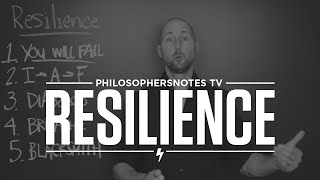
Eric Greitens wrote Resilience as letters to a struggling friend. The core idea: order your life as Identity, then Actions, then Feelings, so feelings follow practice rather than drive it. He teaches a 4-4-4 breathing routine to regulate your nervous system and names the self-imposed obstacles holding you back as diabolos to defeat.
Chapters
Hi, this is Brian. Welcome back to Philosopher's Notes tv. Today, another great book, Resilience by Eric Greiten's Resilience. Best book I've read in a long time. I've read some great books. This is right up there on the top of the list. Highly recommended. Eric Greitens is a borderline superhero, former Navy SEAL, boxing champion, who also happens to be a Rhodes Scholar, PhD from Oxford. Humanitarian. Time magazine recognizes him as one of the top 100Americans. Fortune magazine describes him as one of the 50 greatest leaders in the world. And the book is really, really well written. He admires Hemingway in the direct style with which he writes. He emulates that. And he also reminds me kind of of a modern Marcus Aurelius and Seneca. And both of those guys didn't intend to write books and neither did Eric with this one. So Marcus Aurelius, his Meditations, literally was notes to himself. He was just writing to himself, reminding himself of things that he wanted to live by, the truths he wanted to live by. And that became this book, Meditations. But he never intended to publish it. Seneca. His most famous book is Letters from a Stoic, which were letters to his friend. I'm not sure if he intended to publish them or not, but my hunch is he didn't. They were just letters he was writing to his friend. Now, Eric, Navy seal, a buddy of his, a former Navy seal, was struggling, got out of the military, was struggling with alcohol and finding his purpose. They had a conversation. Eric got home late at night, wrote his buddy a letter. His buddy wrote back. They wound up going back and forth with a bunch of letters on how to create resilience, how to live with virtue, how to flourish in your life. And those letters became this book. Super cool philosopher's note, bunch of big ideas. Five of my favorite ones here. First, what is resilience? So resilience, Eric tells us, is not about bouncing back. You can't bounce back once you've experienced a loss, whether that's a parent losing a child or, or a young 19 year old Marine going to war. You can't bounce back to where you were before. You can only move through the challenge. You're never going to go back and be who you were before. Can't bounce back, but you can move through. That's the basic idea of resilience. And the book is obviously all about how we cultivate that through consistent practices and habits, et cetera. So our first big idea is to realize the fact that you will fail, period. That's not a Negative thing to say, that's just a reality. The problem is when you think you won't or shouldn't fail, then when you do, which you inevitably will do, particularly in the beginning of anything worthwhile, you're going to think you are a failure. You're going to have a fixed mindset. But when you start with the reality and the understanding of reality that you will fail inevitably, then you have a greater shot at being resilient because you know, it's just part of the process. You don't beat yourself up. And Eric goes so far as to say, look, if you're consistently taking risks, you will consistently fail. And by definition, if you aren't consistently falling short, at least occasionally, and not about being reckless, but if you aren't making mistakes and falling short of your goals and you're not trying hard enough, the best among us, those who really go for excellence, fail more often than those who are mediocre. Because the mediocre people are so afraid of failing, they never put themselves out there. So embrace the fact that you will fail. Huge distinction, especially as recovering perfectionists. If you're like me, it's a good thing to embrace. Second big idea is a really, really good one. Iaf, what does that stand for? Stands for identity, actions and feelings. So there's two ways to order those three words. Identity, actions, feelings. That's one way to do it. The other way to do it is feelings, Actions and identity. Alright, two different ways, two very different approaches. Most of the time we check in, we say, well, how do I feel right now? I want to check in, how am I feeling? Everyone's always asking us, how you feeling? As if how you feel in any given moment. What should drives what you actually do, what your actions are. Oh, I'm feeling a little scared, I'm feeling a little depressed. Therefore I'm going to crawl up into a ball in my bed where I'm going to drink another beer or I'm going to zone out online some more. I don't feel good. So I'm going to take these actions and I'm going to solidify an identity that I'm not proud of. That's one way to do it. Not a particularly effective way to do it. Eric says what we want to do is, is start with our identity. Who do you want to be? Don't start with how do you feel? Start with who do you want to be? What does the highest version of yourself look like? Perhaps you want to be more courageous. Okay, then what do you do? Then you take Actions consistent with that identity. If you want to be courageous, act courageous. It's the only way you're going to cultivate any virtue is through practice. Eric goes off on this in the book Practice, Practice, Practice. We are what we repeatedly do. Excellence then is a habit. It's not one act. It's what we do again and again and again. Now, when you have a clear sense of what your idea was, you take actions consistent with that. Guess what? That feels great. But feelings followed behavior, not the other way around. It's a huge distinction we talk about again and again. David Reynolds, Constructive Living says the same exact thing, mixing Zen Buddhism with therapy. But we need to get clear on what we aspire and who we aspire to be. Take actions consistent with that and let the feelings follow. That's I to A to F. Big idea. Third one here is diabolos. Diabolos is the Greek word for the devil. Do you know what the word the devil directly translates as? I didn't until I read this book. Basically, it's one who puts obstacles in your way. That's what diabolos means. One who puts obstacles in your path in your way. That's the devil. And he says, look, don't think about the devil as some guy with horns and a pitchfork. We are our own worst enemies. We are the devil within. And if we want to master the devil, we need to see how often we put obstacles in our own way. Our addictive behaviors that we have that don't serve us, the other things that we're doing that are making it harder for us to live in integrity with that identity that we aspire to have. I just love that. If you want to beat the devil, master yourself. Big idea. Fourth big idea. If you want to develop resilience, which is essentially moving through our fear, right? And seeing what's in front of us, confronting reality and becoming stronger as we face challenges. One of the best ways to do that, one of the best ways to manage our psychology is to manage our physiology. The best way to do that is to breathe. I keep on coming back to this because it's important. And Eric says, look, you breathe thousands of times a day. And if you're not willing to put in a little discipline to master how you breathe just a once in a while kind of thing, don't you do it every single moment of every single day? But if you're not willing to practice that a little bit on a daily basis and practice that little discipline, you're not going to have the discipline to master your life. So when things are out of our control, we need to identify what's within our control. And there are a few things more within our control than how we're breathing. So practice control over your breath, and you'll gain more control over the rest of your life. It's a huge idea. His method of breathing that he recommends in the book is to inhale to a slow count of four through. Through your nose, hold it, and then to exhale through your mouth for a count of four. Inhaling through your nose to a slow count of four. Holding. Exhaling through your mouth to a slow count of four. Doing that for four minutes. That's his recommendation. Four. Hold for four minutes. We can do one right now. Breathe in through our nose for a slow count of four. Hold it and exhale through our mouth for a slow count of four. Deep breaths are just pure gold. Practice that fourth big idea. The fifth big idea. A blacksmith. A blacksmith? Yes. A blacksmith forges things with high heat and a lot of hammering, which is what I thought of as Eric was describing, the fact that we want to discover our purpose. But you don't find your purpose. You create your purpose. Purpose is not found. It's forged. He says. Forged. Your purpose isn't found. It's not some thing that's going to come float onto your desk, dropped by an angel. You're going to need to go forge your purpose, which you can only do through a ton of hard work, a ton of experimentation, a willingness to endure failure and to show up again and again and again to get more clarity on who you are, what you most love to do, what you're really good at doing, and how you can make that work in service to the world you're going to discover through the process of forging. So think of when you think of your purpose, think of a blacksmith, high heat, hammering away to forge whatever it is that he's creating. That's how we want to approach our purpose as we cultivate our resilience. Knowing we're going to fail, getting this equation right. It's not, how do I feel? Okay, I'll take those actions and I'll have a certain identity. It's, this is who I aspire to be. That's me at my best. I'm going to take actions to be in integrity with that, and my feelings are going to be a byproduct of those actions. Huge distinction. Remember, the devil's the one who puts obstacles in the way. Quit putting obstacles in your own way. Master yourself. Breathing is a great way to do it and forge your purpose. Create a life of meaning as you cultivate your resilience. Hope you enjoyed. Eric Greitens is a remarkable guy. Again, I think you'll enjoy the book and I look forward to sharing more with you soon. Have another awesome day. See you next time.
More from Brian

Heroic +1: What’s THE Most Creative Act in the Universe?: Turning Around Glitches (#2024)









