PNTV: Rethinking Depression by Eric Maisel (#212)
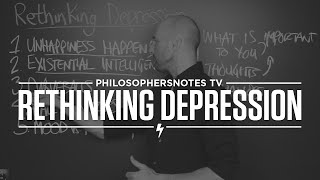
Eric Maisel argues that unhappiness has been over-medicalized as depression. Instead of treating sadness as a disorder, he suggests cultivating existential intelligence by identifying what matters to you, questioning unhelpful thoughts, and asking how you can make yourself proud rather than chasing mood alone.
Chapters
Hi, this is Brian. Welcome back to Philosopher's Nodes. Tv. Today, another great book, Rethinking Depression. Read it on Kindle. Eric Maisel is our author. We recently profiled his the Creativity Book. Eric Maisel, as I mentioned in that episode, is one of the world's leading creativity coaches. He's also a passionate advocate of rethinking depression. Basic idea here is we've over medicalized unhappiness and that's not helping us, it's creating more unhappiness. Philosopher's note. Bunch of big ideas. Love Eric's direct style. And I'm excited to jump into five of my favorite big ideas. Now we're going to start with the first big idea, happiness. Rather, unhappiness happens. So does happiness. But unhappiness happens. Labeling it as depression, Maisel tells us, just isn't necessary and isn't helpful. Unhappiness happens. We don't need to make it wrong or somehow abhorrent. Something is wrong with us if we experience, as Eric says, a day or a week or a month or a year or even a decade of unhappiness. It is what it is. When we bring a medical label to it, we have a pharmacological influenced approach to dealing with it that involves all the medication, all these different things. Again, over diagnosed, over medicalized is what Eric says. I completely agree. And it's exciting to be able to say, look, unhappiness happens. Now, it doesn't need to be enjoyable just because it happens. Of course it's not. But we can develop the skills in order to deal with it, independent of turning to the medical industry and their diagnoses on all the things that are abhorrently wrong or abnormal in our experience of life, et cetera. Now, how do we do that? How do we optimize? He says we need to cultivate our existential intelligence. Our existential intelligence. Essentially, we need to get better at the meaning that we ascribe to things that are happening in our life, starting with our experience of unhappiness, and choose to create meaning in more constructive ways. He asks a very important question. What's important to you? Write that one down. What is important to you? That's the next essential question. What's important to you? Fact is, when we're most unhappy, we're probably divorced from that question. We're going through life feeling helpless, out of control, and we're not contemplating this. We're focusing on all the things that are wrong in our lives. So first step, what's important to you, identify that number one. Then he says, number two, are your thoughts aligned with that? Do they support that? Important thing to consider? Number three, how about your behaviors? Do your behaviors put you on track to live in integrity with what's important to you? This is the essence of what Maisel describes as existential intelligence and creating an existential ideal. You know it's important to you. You're aligning your thoughts to it. If your thoughts are not helpful, which we're going to talk about here, you let them go and you choose meaningful, constructive, helpful thoughts. And of course, you engage in behaviors. If you're engaging in behaviors that are not consistent with what's important to you, guess what? You're going to feel a lot of unhappiness. That's exciting because then you can see, wow, if I change these behaviors, if I change these thoughts, I can change the mood that I'm in, the state that I'm in, etc, etc. That's our second big idea. Third one is curve balls. He's got a great section in the book where he talks about the fact that life throws us curveballs, period. We want to get to a point where life just settles down, where there's no longer any challenges. No more curveballs. Just throw us some nice, easy to hit softballs that we can knock out of the park, right? As the tools guys say, we want to be exonerated from future work. We want to do enough work that we're just kind of done. We don't need to be stressed out anymore. We don't need to have any more anxiety or any more pressure, etc. No more curveballs, right? But the reality is that's fighting against reality. Life happens just when you get comfortable, you think you've achieved a new level of well being. You may set goals for yourself that challenge you in, bring in a new level of anxiety and stress, etc. Or a loved one, whether it's a parent or a child, may pass away. Life continues to challenge us to create meaning in a meaningful life. I'm going to be sharing some ideas on Kelly McGonigal's new book, the Upside of Stress. The reality is, research shows that the higher the level of stress, the higher the level of meaning. The lower the level of stress, the lower the level of meaning. They go together. You can't separate them by trying to get rid of all curve balls. Joseph Campbell talks about the fact that the good life is one hero's journey after another. You go out and you do your thing. You battle your Dragons, you come back and you give it to the world. Ah, you feel good for a moment. And then what happens? Then you spiral up and you go on your next hero's journey. By definition, the hero's journey is entering the forest of the unknown at the darkest spot. Well, guess what? It's. That's the darkest spot the first time around, the second time around, the third time around, the fifth time around. And ideally, you navigate it with a bit more grace and poise, existential intelligence, but you aren't trying to avoid that stress and that potential anxiety, etc, etc, etc. And as Campbell says, when you follow your bliss and you're willing to engage in the hero's journey, there's a chance of experiencing rapture and all these things. There's also the chance of a fiasco. Things can go wrong or even very wrong. That's part of the deal. We want to embrace that. We want to get good at hitting curveballs and not try to get into a situation where we no longer have that stress. That's our fourth big idea. The fifth one, hall monitors. So a big part of rethinking depression, obviously, is looking at our thoughts. So this little second bucket here, what's important to you are your thoughts aligned with it. And I'm trying to create all these different metaphors for us. We can think about how we can become more aware of our thoughts. That's the first step. Most of the time when we're super unhappy, we're also super unaware, unconscious. We just have these thoughts going. You know, the little crazy drunk monkey swinging from vine to vine to vine to vine to vine. We're not even aware of it. We just feel horrible. So I've talked about the idea that we want to have bouncers. Alan Cohen describes it as a bouncer in your head who's got that velvet rope. And he only lets in good thoughts. The thoughts and the people that you really want to have in your party are the ones who get to hang out in your head. Cohen and others also talk about attorneys battling in your head. Good thoughts, bad thoughts. Which one's going to win? The one you give the most attention to. Well, hall monitors is another one, Mazel says. Imagine these rowdy kids just running around the hall. They need a monitor. Those are your little negative, unhelpful thoughts. You need to be able to observe them and then say, no, no, no, no, you need to go settle down. Rambunctious thoughts. You're not welcome to go run around here anymore. And his question is, does this thought serve me Slow down long enough to observe the thoughts that are going on. And anytime you have a feeling, nearly every single time, it's preceded by a thought that's eliciting this feeling. It's the heart of cognitive behavior therapy. Identify the thought, as Byron Katie says, that kicks you out of heaven. What is the thought? Write it down. And then ask yourself, is that thought serving me? Is it helping me achieve what's most important to me? If not, let it go. Choose a more empowered thought that takes the place of this negative thought. Easier said than done, but with practice, you can cultivate that ability, and it's huge. So remember hall monitors. Does this thought serve me? We've got attorneys, We've got bouncers. We're bringing more awareness to what's going on in our mind. Fifth, big idea. Mood versus meaning. If we want to rethink depression, deal with unhappiness, and develop our existential intelligence, we've got to make a distinction between mood and meaning. Eric describes the fact that it's one of those jokes of the universe that we pretty much only check in on how we're feeling when we feel worst. When we feel the worst, right? We're not sitting here going, how do I feel? When you're crushing it, you're having a great day, and you're super elated, etc. You just kind of let that go. You know how you're feeling, you're feeling great. But when you're not feeling great is when you ask the probing questions, wow, how am I feeling? Why am I feeling this way? Something must be wrong with me. Well, something was right with you when you were feeling great. Celebrate that. Feast on that. Then when you're feeling funky, notice that. That's fine. We don't need to try to get rid of it artificially. But don't dwell on it, and don't let that dictate what you do with your life. Instead, find ways to create meaning. The essence of Eric's work in this context is to create meaning, make meaning throughout your life. And one of the most powerful questions he asks. It's one of the most powerful questions I've ever heard, which is, how can I make myself proud? How can I make myself proud? That's a way to make meaning, not, do I feel like doing this or not. We talked about identity, actions, and feelings, right? Not being driven by your feelings before in our work on Eric Greiten's resilience. Well, try this question on how can I make myself proud? When you have a pretty good sense of what's important to you even if you don't and you just ask the question how can I make myself proud in any given moment? If that's the question that's going through your mind, that's amazing. Imagine that. So as you're going through a challenging time, whether it's later today or tomorrow or next week or the week after that or whatever, see if you can bring the hall monitor out and see if you can hit the curve ball as well as you can by exercising your existential intelligence and asking yourself the question, okay, I'm challenged right now, but how can I make myself proud? What would the best version of me do in this moment? And then go do that and then do that again and again and again and sooner than you may think, you're going to become more and more of an expression of that highest version of yourself. That's the basic idea. I hope you enjoyed and I look forward to sharing more with you soon. Have another awesome day. See you.
More from Brian

Heroic +1: What’s THE Most Creative Act in the Universe?: Turning Around Glitches (#2024)









