PNTV: Sea Stories by Admiral William H. McRaven (#407)
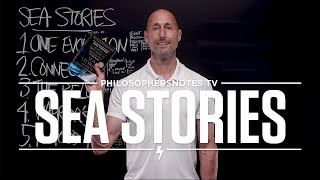
Brian Johnson reviews Admiral William H. McRaven’s autobiography Sea Stories: My Life in Special Operations, extracting practical lessons about resilience, focus, service, and connection. The episode highlights five core ideas—take challenges one evolution at a time; the power of connection; don't 'ring the bell' (don't quit) and the role of encouragement; 'warrior's love' and exacting justice as service; and playing your role well/being a good person. Johnson weaves personal anecdotes, references to other thinkers (e.g., Byron Katie, Pema Chödrön, Viktor Frankl), and ends with a brief promo for his Optimize/Optimized Coach offerings.
Chapters
Hi, this is Brian. Welcome back to Philosopher's Notes tv. Today we've got another great book by Admiral William H. McRaven. In our last episode, we spent some time with the good admiral four star admiral talking about his wisdom from make youe 10 Ideas He Learned in His Navy SEAL training. Well, now he has an autobiography we're going to talk about called Sea My Life in Special Operations. It's phenomenal. Highly recommend both make youe Bed and this book in general, and particularly if you're interested in learning about American military history through the lens of a man who is truly an American hero, who led some of the most extraordinary missions that the U.S. special Forces Operations have been engaged in over the last X decade. So great book, Sea Stories, Philosopher's Notes 6 page PDF, 20 minute MP3. Adding to the collection in general and particularly our Navy SEAL wisdom. We've got a ton of notes. I am an absolute fan of Navy SEALS in general and their wisdom shared via books. I can do notes on in particular. So we have a growing collection. Everyone from Admiral McRaven to Jocko Willink and Leif Babin to Mark Devine, David Goggins, Alden Mills, etc. So let's jump in five ideas. Again, I'm going to pull out the practical wisdom we can get from these extraordinary stories. The first one is one evolution. Now make youe Bed was all about Ensign McRaven going through buds Navy SEAL training right now, chapter four in the book, we revisit his Navy SEAL training just for one chapter, right? And the chapter is called the Only Easy Day Was Yesterday. The seals have some great aphorisms. That's one of them. The Only easy day was yesterday. And McRaven talks about the fact that as he was going through it, one of the leaders on his crew and in the overall group told the guys, don't quit, don't quit, don't quit, don't ring the bell. Make it through this evolution. And he said, just one evolution at a time. Evolution is like the training challenge they have to face, which is finite, right? It's one evolution. You got to go do this. It's going to be really hard, but.
You can get through that.
That one evolution, take it one evolution at a time. One evolution at a time. And he said, I remembered that for the rest of my career now, the guys that weren't able to focus on what's important right now and just focus on the task at hand, he says they had too long of an event horizon. They were sitting there thinking about all the hell and the torment that was going to come down the line. And they said to themselves, I can't handle all that. That's too much. It's overwhelming. Then they'd go, ring the bell, which we're going to talk about again. We don't want to do that. Don't quit. I'm going to talk about a time later in McRaven's life where he went through some extraordinary challenges and one of his mentors came back to him and said, remember, don't ring the bell, don't quit, you're a Navy SEAL, etc. Now, if you have too long of an event horizon, you're going to get overwhelmed. What we want to do is simplify the battlefield. As Navy SEAL Commander Mark Devine puts it, have front side focus. Just know what's important right now. What's your target that needs to get done right now? And this isn't just Navy SEAL wisdom. You can go spiritual on it. Byron. Katie, the great spiritual teacher, she says, look, God never gives you more than you can handle. She calls it doing the dishes. All you have to do right now is one thing. What's the important thing for you right now? Might be doing the dishes. Might be getting through one evolution in seals Buds training. It might be writing an email to a prospective investor for your business. It might be drafting an email to share with your community about something you're excited about. Might be a coaching session you have with one of your clients. We only always have one thing to do, and we need to focus our best attention on that and not have our event horizon get so strung out that we either give up or don't give our best to this moment. And then another favorite line of mine is the Zen therapist David Reynolds in Constructive Living, the best book you've never heard of, Constructive Living, he tells us again, same thing. Now what needs to be done? That's the question we want to ask. Okay, I don't feel great. Life isn't going my way. Fantastic. Now what needs to be done? Now what needs to get done? Now what needs to get done? Moment to moment to moment. We just need to make the decision, take it one evolution at a time. We call that winning. What's important now? W I n get clarity on that. Go give your best to that. Second idea is from a chapter called Airborne. Which one is it? Yeah, Airborne. Froggy. So fast forward. McRaven is no longer an ensign. He's moving up rapidly throughout the ranks. I'm not sure what his status was at this point, but he's advanced in his career and he's jumping out of an airplane, doing a parachute jump. Things go disastrously wrong, right? The guy below him does something that I don't think he's supposed to do. His parachute opens up. It hits McRaven in the face. He's spinning. Not good. Crash, crash landing. Wince. Even thinking about it, his pelvis split, separated 5 inches. Lucky he was alive. But he's hospitalized. Life isn't quite going the way he wants it to go. Life's not fair. If you remember in our last note, pntv we're going to talk about this in a moment. Ouch. Sugar cookie. He's sitting there in pain in the hospital and his wife Georgianne comes in. And this book is in many ways a love story of his love for his wife, Georgianne, of 40 years and for his service and his country and his craft of being a warrior, which we'll talk about in a moment. Just the deep passion that he had for his life, has for his life and demonstrated in his military service that comes through in the autobiography is deeply inspiring. But he's sitting there in the hospital in excruciating pain. His wife comes in and holds his hand, and he talks about how her fingers just always fit. His hand gives me tears in my eyes perfectly. She says, how you feeling? Are you in pain? He says, no, I lied. No, I'm okay. He lied, right? But he was talking about the power of that connection and her presence was healing for him. And it's amazing because shortly before I read this book, I read a book called the Upward Spiral, which we recently covered on the neuroscience of reducing depression. One little thing at a time. And in that book and in the note, we talk about one of the eight tools to reverse your depression. One of them is called the power of connection. And they've done fascinating research in labs, basically taking what McRaven experienced and putting it into a lab and testing it. And what they found is that if you put someone into a lab and you ask them to do something that's painful, like dip their hand into an ice bucket of water or get shocks on their body with an FMRI machine hooked up to them, what they found is that if the person's alone, basically they'll suffer more, they'll have less pain resistance, and they'll. Their worry centers will be more activated in their FMRI than if they're in the presence of someone. A loved one and even a stranger can help reduce the activation in our worry centers, our anxiety centers, our pain centers, and there's a tremendous power in connection and just having people in your life with whom you can connect. And as I read this and thought about that hand fitting perfectly, I thought about one of the most powerful moments of my life, which is when our son was born. We have two kids, our son, Emerson. Nearly eight years ago, we were blessed to have a home birth and wonderful midwife named Mary Jackson. Love you, Mary. And I was blessed to kind of catch, receive Emerson, right? And he's born. And the very first thing that he does, literally, our eyes connect. Like right when he was born, it was amazing. We looked at one another. And then I stuck out my finger for him, my little pinky. And he wrapped his tiny, little, unbelievably small hand around my pinky. And we eyes connected. And he and I revisit that scene often. And I say we said I love you to one another right when we. Right when you came into the world. He said, I love you, buddy. And he said, I love you, daddy right back, right? And these days, we recreate that. I love holding Alexander's hand and Eleanor's hand and Emerson's hand, perhaps in particular, he and I hold hands. Now we recall that moment, and then we'll squeeze each other's hands just a few times. We've got a plus one on this, too. How to say I love you in squeezy ease. We just squeeze it a couple times. We don't even say anything. And we know that means I love you. I love you, buddy. And every single night. We're now kind of sleeping in a family bed. We've got the four of us on our California king huge bed. Right? Goes Eleanor, Mommy, Emerson, me. We do our thing at night, put on our tape so we can breathe through our nose. Yes, that's like us. And say I love you right before we put the tape on. And then I reach for his little leg and he reaches for mine, and we squeeze each other. I love you. The power of connection, it's real. We want to literally reach out and to the extent we can connect with our loved ones and experience that power today. And then let's go to the bell. So, same chapter. Airborne Froggy. We're still in the hospital. Georgeanne has left the room for a moment. And now Moki Martin comes into the room in his wheelchair. And if you remember Moki Martin from Make youe Bed, he makes an appearance in both books. In make youe Bed, he's this tough drill sergeant guy. I don't know what his official title was. But the guy who's just beaten on McRaven while he's going through the Navy SEAL training, giving him the sugar cookie, teaching him, life's not fair. You can do everything perfectly. And boom, life isn't fair. You need to stand strong and drive on, right? So Moki cruises in in his wheelchair while McRaven's sitting in the hospital not knowing what his future has in store for him, right? Is he going to be able to go back to the Navy? He's on his way to doing some even more extraordinary things and he doesn't want to have to leave the seals. Is he going to be physically incapable of doing what he needs to do to be a Navy seal? Imagine how heartbreaking that would be. Moki Martin cruises in, an exemplar of heroic anti fragility. And he reminds him, never quit. You're a seal, you're tough. You've been through tough things. You're going to get through this. Don't ring the bell. Seals don't ring the bell, right? And McRaven, you know, is there. They started the conversation with Moki Martin coming and saying, apparently, I need to teach you some how to jump out of an airplane. What's going on here? And they laugh together. Then he gives him that encouragement and I want to pause for a moment, make sure we get something on this board up here today and talk about the word encourage. So encourage in make youe Bed, we talked about the science of hope. And McRaven said that hope is the most powerful force in the universe, right? To give people hope. To sing when you're neck deep in mud is one of the greatest gifts we can give. Don't be the one complaining about everything. Be the one standing up, rising up heroically, and being a radiant exemplar of what's possible. Give them hope and also encourage them. So Aristotle, if you go back to the day, would tell us that the summum bonum, the highest good, is to express the best version of ourselves. We do that by living with are a te or virtue. And his number one virtue was courage. The number one virtue that vitalizes all the other virtues is courage comes from the old, ancient word, for it is from the word that meant heart. It's an awkward statement there, but cor, right means heart. So your heart pumps blood to your other vital organs, your arms, your legs. Courage vitalizes all the other virtues. Without it, you're not going to be able to show up powerfully. When we encourage people, literally, etymologically, it means to inject with courage to give them heart and hope in a sense that they're capable of doing what they need to do. And I talk in our mastery series for our coaches, we have a whole month we spend on what we call hero ology, becoming a hero, operationalizing the wisdom from Joseph Campbell's Heroes, Myth, etc. But I talk about the power of encouraging others. And compassion is a virtue. I juxtapose with this. Often. Compassion is important. We want to be able to have concern for others and their suffering. The word compassion literally means compassio to suffer with. Now, it's important to have the capacity to suffer with others, but it's also very important and I would offer the not as often discussed and as discussed as often as it needs to be to encourage others. Don't just suffer with them. Have courage with people. Especially in times like this and especially in times like when McRaven was sitting on a hospital bed and needed the encouragement from someone he really admired to remind him of what he was capable of and to move forward with hope. That's the bell. Don't ring. It never quit. And then by extension, give others encouragement. And again, there's a whole science to confidence and self efficacy. One of the most powerful things we can do is to be a demonstration of what's possible. If I can see that someone else has done the thing that I want to do, my self efficacy, my belief in my ability to do it goes up. If I've done it in the past, it goes up. And if someone coaches me and encourages me and tells me I can do it, my self efficacy goes up. And finally, if my physiology is right, my self efficacy goes up. There's a plus one on that too. The science of self confidence. We'll link to it, check it out. Four different things. Someone else has done it. I can do it. I've done it in the past, I can do it again. Someone's coaching me and encouraging me. Awesome. Thank you. And then your physiology, holding yourself with a powerful presence, etc. The fourth idea you is warrior's love. So this is a book about a warrior's series of missions in his fierce training and mastery of his craft. And he says, look after rescuing a woman who was held hostage, I think in the Philippines while serving at the White House, she wrote a book and she talked about how she had mercy for her captors. And it was very quote, loving take on it. And McRaven's very honest. He says, you know what? As I was serving our country and protecting our country and the world, in many ways, from the tyrants and the despots that needed to be dealt with with justice. I didn't have a sense of mercy per se. I had a sense of exacting justice. And he talks about the warriors ethos and the warriors running to the battle. They want to be challenged and faced with those challenges. And he has a beautiful description with a level of humility and clarity of this is who he is and who he was. A fierceness of showing up. Now, he said in that context that he didn't feel loving. And I kind of step back a little bit and briefly talk about the broader sense of love, of showing up with a fierce love in exacting justice in service to the world is in fact one of the most loving things we can do. Of course. And then I quoted Pema Chodron, who shares an ancient Buddhist Buddha story about a guy named Compassionate Heart who's on a ship with a bunch of people and then angry pirate or someone of some such name comes on and Compassionate Heart knows that Angry pirate is going to harm other people. So Compassionate Heart kills him compassionately in service to the others on the boat. It's a complex conversation, but there's something that Pema Chodrun calls idiot compassion. When we ignore things that need to be addressed with a sense of fierce masculine, you could say love. And then I was also thinking of the fact that he played his role really well. He went all in. He loved what he did as a warrior. He. He was absolutely committed to being the best in the world at what he did with those who were also committed to it. And the world needed his service. What he did over the course of his career is astounding. So he played his role well. He met Jim Collins, hedgehog concept, right, the three circles. And we can talk about that for a while, but moving on, he also talks about in the beginning the fact that his father, in his father's cohort served in World War II. So when I thought about playing your role well, I thought of Viktor Frankl, who in World War II played his role well. He was a psychiatrist in a concentration camp, not where he chose to be, but he chose to play his role well and serve those in need as a. Basically a psychiatrist in these concentration camps, helping people find meaning. And thank God we had people like Admiral William McRaven's father playing their roles well as warriors to go free Frankel from the despotism that was running the world at that time. So again, we all need to step back and say, what role am I being called to Play am I playing it as well as I possibly can? And this leads us to the final idea of why I loved this book so much. Gives me tears in my eyes. McRaven ends the book with his final speech, or near the end, anyway, his final speech as he retired as the highest ranking Navy Seal running U.S. special Forces Command, etc. For all U.S. special Forces. And he references Saving Private Ryan, the movie where Ryan goes to Normandy at the end of his life to honor the man who gave his life so that he could live. It's a very emotional scene. And he says to his wife, basically, was I worthy of the sacrifice that this person made for me? Was I a good man? And McRaven connects that to the only thing that he's ever really wanted to be in his life was a good man. That was his commitment. He was surrounded by other good men and women, and he wanted to serve as profoundly as he could. That was his commitment. And again, when I read a great book by a great man or woman like this, it just inspires me to be a good man. And that, ultimately is what I'm most grateful for. To Admiral McRaven and all these other heroes that we talk about, whether they're teachers or luminaries in different contexts, they're all showing us what's possible. And hopefully we can go out and be that radiant exemplar in our families and communities and world. And again, this is how we change the world. We need to be the change we want to see. And keep this Albert Einstein wisdom in mind today if you feel so inspired to do so. Einstein once said, every day I remind myself that my inner and outer life are based on the labors of other men, living and dead, and that I must exert myself in order to give in the same measure. And as I have received and am still receiving, takes a humble posture to say, look, my life is not possible without you, without all the other human beings on this planet who are committed to playing their roles well. How can I give back in equal measure? How can I be a good man? How can we show up with our own version of fierce love, playing our roles? Well, let's not ring the bell. Don't quit. Life's not fair. Rise to the occasion when you feel the worst. Give your best. Remember connection, the power of connection. Holding hands, being together as we take it one evolution at a time. Don't let your time horizon get too far out. As Joe decenna, the founder of Spartan Race, puts it, if he's doing an ultra whatever crazy endurance event he's doing. He's not thinking about the hundred miles he has left to run. He's thinking about getting to the next telephone pole. Get to the next telephone poll, the next telephone pole. Front side focus. Don't overwhelm yourself. One evolution at a time. Marcus Luttrell, Lone Survivor, one of the renowned heroes of Navy SEAL lore and modern American history, talks about his story in Lone Survivor. His buddies are killed, every single part of his body's broken. He's broken his back, his knees are blown out, his pelvis is broken, his nose is broken, he bit off part of his tongue, can barely move, and he's surrounded and he has seven miles to go before he can find safety. And we talk about this in It Takes what It Takes by Trevor Moad. And what he said was, I'm not going to overwhelm myself with all the complexity. I'm going to get a rock, I'm going to draw a line in the dirt and I'm going to get to that line. And when I get to that line, I'm going to draw another line in the dirt and I'm going to get to that line. Seven miles later of crawling to safety, he was able to tell his story, honor those who fell, and serve as a radiant exemplar of exactly this wisdom. So sea stories Admiral William H. McRaven highly recommend it. Thank you again, Admiral for your services and thank you all for being here and allowing me to share this. What is the number one thing that jumps out for you today? We always want to get clear, moving from theory to practice to mastery as we operationalize this wisdom and give the world all we've got. Let's do it today. Look forward to sharing more with you tomorrow. See you.
Hey guys, this is Bry. Hope you enjoyed that video. We have a lot of people ask us what Optymyze is all about. So I just wanted to give you a super quick tour of our site, tell you what we do. We do two primary things. We have an optimized core membership and we have an optimized coach certification program for people that want to go from theory to practice to mastery. So the core membership is basically 10 bucks a month to depending on whether you do monthly or annual. And you get instant access to over 500 philosopher's notes, the six page PDF, you know, 25 minute or so MP3 recordings of these great books. And then you get over 1000 optimized plus ones, 50 optimal living 101 masterclasses, et cetera. And we have a Free trial the team set up, get it, you know, free for 14 days and then go from there if you like it. So we're blessed to have a lot of people who subscribe to this, including some of my friends who happen to be some world class peak performance gurus like Tal Ben Shahar, who taught the two of the largest classes in Harvard's history. Starts every day with Optimize. Ben Greenfield, friend and coach Optimizes, bar none. My go to source for taking a deep, efficient dive into some of the world's best books via the Philosopher's Notes. It's an indispensable resource. Thank you Ben. Marcy Shimoff loves philosopher's notes. Mark Devine, retired US Navy SEAL Commander, Dear friend who starts his days with Optimized plus one with winning win in the mind routine to charge him up for the day's battle. If you're serious about leading heroically, I recommend you use them too.
Huya. Thank you.
And 10,000 plus other awesome humans around the world. That's the core membership. Then we have, and I should say we have apps. Excuse me, you can get apps, iOS and Android. You know, we feel pretty proud and blessed to have basically a 4.9 ranking and people saying some great things. You can check that at Optimize Me Apps. And then our coach program is all about helping you master yourself so you can serve heroically so you can empower others to do the same. We have trained over a thousand optimized coaches from over 50 countries and yeah, really excited about this. This is one of the core levers for us to fulfill our mission to change the world one person at a time together starting with you and us today. We've been told that here's one little thought and we have hundreds of testimonials you can check out about how it's transformed people's lives. And if you want to be a coach, your coaching practice now. Half the people who do this want to be coaches. The other half just want to master their lives. But Barb, a coach of ours, says I already had two coaching certifications but Optimized Coach was indisputably the most valuable I have taken.
Thank you Barb.
Honored to be part of your life. You can learn more about what we're doing with Optimize Coach at Optimize Me Coach. There you go. Hope you're doing great. Look forward to sharing more with you soon. Have an awesome day. See you.
More from Brian

Heroic +1: What’s THE Most Creative Act in the Universe?: Turning Around Glitches (#2024)









