PNTV: Smartcuts by Shane Snow (#266)
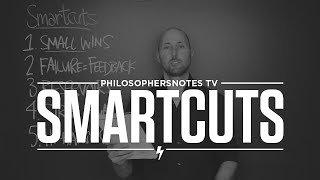
Shane Snow's Smartcuts separates real shortcuts from integrity-driven ones. Build momentum through small wins, treat failure as feedback, create value reserves before your breakthrough hits, strip away distractions, and aim for 10x goals that attract bigger resources. Michelle Phan and Sal Khan made thousands of pieces before they broke through.
Chapters
Hi, this is Brian.
Welcome back to Philosopher's Notes TV Today, another great book, Smart Cuts by Shane Snow. Smart Cuts Subtitle How Hackers, Innovators and Icons Accelerate Success Fascinating read. Shane Snow is part journalist and author and part entrepreneur. And in this book he profiles individuals who have achieved an extraordinary level of success in a rather shorter time frame or short time frame. Guys like Elon Musk, Jimmy Fallon, young presidents, and a number of other extraordinary humans. Philosopher's Note, Bunch of my favorite big ideas. We're going to look at five of my favorites now. But first, let's differentiate smart cuts and shortcuts. So shortcuts by definition, Shane tells us, are amoral, right? And he shares a story of the guy who was featured in Steven Spielberg's Catch Me if youf can, who took a lot of shortcuts and he wound up in federal prison.
Right?
What we want to do is add integrity to shortcuts and we get smart cuts where we're working smart, right? Taking some shortcuts with integrity and creating value in the process. Benjamin Franklin is the guy he uses as an example in that juxtaposition. So smart cuts are shortcuts plus integrity. You're creating value. You're working smart while you're working hard and doing the right thing throughout the process. You're breaking rules, but you're doing so with integrity. That's the basic idea of a smart cut. Now, the first big idea starts small wins. So Shane walks us through nine different hacks in three different sections in the book. He starts by talking about the fact that we need to learn how to hack the ladder. And then most people who achieve extraordinary success don't climb a traditional ladder. Whether it's young presidents or comedians or entrepreneurs, they're willing to break some rules, but one of the things that they do is they create small wins in the process. And he shares an amazing story about these students at BYU who do this thing called Bigger or Better, a game called Bigger or Better where they start the night with a toothpick. And they'll go to somebody's house and say, hey, do you have anything bigger or better than a toothpick? Some random person's house, right? And often they'll get someone to say, oh, yeah, okay, no problem. They go and they find like a stick of gum and they take that stick of gum, they go to the next house and they get rejected and rejected and rejected. But then the next person says, okay, I'll give you some post it notes in exchange for that stick of gum. Then they keep on going through the process, and the post it notes become a magazine, which becomes something bigger. And he shares a story about how oftentimes, after 12 to 14 of those transactions of small wins, they wind up with like a TV set or a set of golf clubs. And the moral of the story is we, as we aspire to great things, need to make sure we create momentum. We create progress via small wins. So the practical application for our purposes. What's your big goal? We're going to talk about that in our fifth big idea here. And what's the tiniest thing you could do right now to make progress in the direction of that goal? In the note, I talk a little bit about research that he talks about out of Harvard Business School, where they found that people feel best, they're more likely to succeed more when they are making progress. It doesn't matter how big the progress is. It matters that they're making some progress. So create momentum in your life. Another metaphor he uses which is really helpful is the Olympic rings at the playground, right? So if you want to get across the Olympic rings at a playground, you need momentum. You need to keep on going small win to small win to small win. It's a huge aspect and a key smart cut, second big idea is the fact that these individuals who use smart cuts see failure as feedback. Again, he's a great storyteller and shares the Second City, kind of the school for comedians. Stephen Colbert, Steve Carroll, Tina Fey, all these great comedians came out of the Second City. And he talks about how they train their comedians to see failure as feedback. And they put him into an environment where, where they turn off the part of their brain that takes feedback, negative feedback, that is an audience not laughing as just neutral data, rather than thinking it's a sign that something's wrong with them, they step back and look at it and go, okay, well, that didn't work. It's just neutral feedback. It doesn't mean I'm a horrible comedian. It means I need to work on that particular joke some more. Very, very powerful idea. If we want to do smart cuts, we need to be willing to get rapid feedback that we can interpret impersonally and then churn and get better and iterate, Right? In the note, I talk about the fact that there's research that we talk about. In the note on Daniel Amen's change your brain, change your life. You can actually put people into a lab and watch how some people respond to failure, right? And how others respond. Some people, when they experience a mistake or something Stressful. Their brains light up in the area of their brain that is associated with pain. But not everybody. Other people, their motivation centers light up when they experience mistakes. They want to lean into it and get better. They take it as data. We need to train ourselves and rewire our brains such that our default is leaning into the feedback. It's not a personal assault on our ultimate worthiness, fixed mindset style.
It's.
It's a opportunity for us to get better. Feedback is how we want to perceive the little mini failures when we're willing to do that, he says, the small failures, we run the risk of ultimate failure being a lot lower. The ultimate risk of ultimate failure is a lot lower. To state it more coherently when you're willing to embrace tiny failures in the process, that's our second big idea. Also funny, I was chatting with Christine Lai, who runs Zappos, Tony Hsieh's organization, Delivering Happiness. She calls this Feed Forward with her team Feed Forward. It's just information to help her team improve Feed Forward, not feedback. I love that. Third big idea here is reservoirs. This is another smart cut. He juxtaposes a couple of online entrepreneurs and individuals who achieved a level of fame. One was able to sustain it and the other wasn't. You might have seen the video of the guy who saw a double rainbow and then went nuts. And he had, I don't know how many millions of views. He was on some late night show, but he wasn't able to sustain the little traction that he got, the momentum he got. Whereas a woman named Michelle Phan had a similar catalyzing hit when Lady Gaga shared something that she did with her community. But the difference was, whereas this guy didn't have a reservoir of other meaningful content. He had nothing else really going on that was creating value. He just had a big hit and then it dissipated. Whereas Michelle Phan had a ton of amazing content she'd been working on for years, she had a reservoir of content such that when she got a hit, she got lucky, if you will, and got this big surge of attention. She was able to sustain it and create further small wins. Or parlay it is another phrase or term that Shane uses in the book, right? Parlay it into something bigger and sustain that momentum because she had built a huge reservoir. In the note, I talk about the fact that's essentially what I'm doing. This is me creating a ton of content such that I can build a foundation and continue to grow going forward. He talks about the fact that Sal Khan, who created the Khan Academy. How many videos would you guess? How many math lessons do you think Saul Khan created before Bill Gates found him and then catalyzed him into, you know, the stratosphere of success with the Khan Academy? How many videos of Saul Khan create? How deep was his reservoir? Shane tells us he had created a thousand videos before Bill Gates found him. Now that's amazing. A thousand math lessons. That is an extraordinary number of videos to create. It's a deep, deep, deep reservoir that showed the world, and in this case, Bill Gates, that he was in it for the long run. He was totally committed to creating as much value as he could.
And.
And then he was catalyzed into a deeper level of extraordinary success. So look at what you're doing and know that a smart cut is to create a really deep reservoir. In the note too, I talk about Nassim Taleb in his book Antifragile. He talks about a barbell strategy, right? So you have a barbell, and I'm going to go off on this in a business class that I teach, but he says you need to have a barbell strategy where you're simultaneously super conservative and super aggressive, right? So you're going for the big win, but you're also making sure you're doing the most mundane, basic nuts and bolts, right? So someone like Michelle Fan who achieved this huge opportunity, she had big dreams from the beginning, I'm sure, but she was showing up conservatively day in and day out and digging and filling a huge reservoir of content. Think about what you're doing, and if you want to smart cut it, create that reservoir. Fourth big idea is stripping away. So we've been coming back to this theme a lot as well. When we talk about creativity, it's all about stripping away the things that are not essential. Constraints create more creativity, not less. I've shared the Alan Watts idea that tennis is more fun with a court. Create constraints for yourself and paradoxically, perhaps you're going to be more creative. He talks about the fact that Barack Obama 2012 Vanity Fair said, Look, I only wear two shades of suits. I'm either going to be in a gray suit or a blue suit. I have too many other things going on in my life to think about what I'm going to wear today. Steve Jobs apparently had a closet full of dozens of black turtlenecks and 501 jeans. He had other more important things to do than figure out what he's going to wear. And I referenced the fact that when I talked to Scott Adams, who created Dilbert, he was Wearing, we were on video, he was wearing a little athletic shirt, right? And I was wearing a white T shirt. While I'm interviewing him and in his book he talked about the fact that he routine eyes is his life. He doesn't think about what he's going to do. And in that context he said, look, I wear, I have three different colors or something of this one particular shirt. One style, three colors. That's just all he wears. He doesn't think about it, right? He's working out, whatever. And I jokingly told him look, I have one style in one color. White. When I do these black, I don't need to think about what I'm going to wear. Why would I think about that? I got more important things to think about. Strip away the unessential. Simplify your life. Create routines, rituals, patterns such that true creativity can flourish. That's our fourth big idea and fourth smart cut. The fifth one in the last smart cut in the book is high hanging fruit 10x vision. Elon Musk is the guy that Shane profiles in this chapter. Elon Musk has done so many extraordinary things, it's mind boggling. PayPal, SolarCity, Tesla, then of course SpaceX. And he talks about SpaceX. And Elon wants to colonize Mars. Pause and think about that for a moment. Colonize Mars, that's like 1 million X thinking. And he knows that in order to do that he needs to create some small wins. So his next 10x or 100x thinking is to be the first private company to send a spaceship into orbit right out of gravitational pull. Right? First private business to do that. Failed again and again and again. But that's his 10x vision and he succeeded and he was able to do so at a fraction of NASA's cost and is now doing his extraordinary things. Basic idea here is that high hanging fruit 10x thinking is paradoxically, although it's technically more difficult to achieve, in some ways it's paradoxically easier than 10% improvement. Everyone's trying to do 10% improvement. Low hanging fruit. When you 10x, you're thinking yeah, you got to stretch and get technically more competent. But you also invite bigger support, bigger advisors, bigger capital, all these things. When you have this big dream that's catalyzing. So think about your big goal, think about how you can 10x that inspire yourself and those around you and of course connect it with your small wins. It's not enough to have this huge hundred x goal and not tether it to reality. We've got to bring it back and Then chunk it down such that we have small wins in the progress and the momentum that gives us a shot at achieving.
That 10x goal.
And then keep in mind this barbell strategy. Make sure you're in the game.
That's the thing.
Babe Ruth hit the most home runs in his era, but he also struck out the most, right? So we need to know that when you go for 10x, that's a really aggressive strategy, comes with a lot of risk. But what are you doing to mitigate that risk and be antifragile by making sure that you have whatever you need to have, whether it's deep resources or a profitable business or whatever. So there you go. High hanging fruit, stripping away the inessential. Perhaps you'll simplify your wardrobe. Or perhaps not. Reservoirs Create it such that you can sustain momentum when and if the big hit occurs and failure as feedback. Don't take it personally. Don't light up the part of your brain that wants to avoid feedback. Lean into it. Turn off that part of your brain that takes it personally and create the small wins. Get across the Olympic rings with momentum. Remember toothpick to tv? They didn't show up at the first door and say hey, can we have a tv? They started off really small. Toothpick for gum, for post it notes for magazine, for whatever sequence over extended periods of time. The compound effect was extraordinary. How can you frame your life a little more like that and tap into some smart cuts?
If you enjoyed this, I think you'll enjoy the book. Super fun.
I look forward to sharing more. Have another awesome day.
See you. Hi, this is Brian. I hope you enjoyed that PNTV episode. A lot of people don't know all the stuff I do beyond these free videos I share on YouTube. So I thought I'd do a quick video to give you an overview of our membership program that you can get access to and get a ton of other stuff. So here's a quick look. Ten bucks a month. Join the Optimal Living Membership program. You get Instant Access to 250 Philosopher's Notes on some of the best Optimal Living books out there. Old school classics, positive psychology, modern stuff, Mindfulness, Peak performance, purpose, neuroscience, wealth, etc. What you may not know is that in addition to the PNTV episodes, I create PDFs on all these great books. So six page PDFs. Let's take a look at one of them. Joseph Campbell, you want to figure out how to live your hero's journey? Well, this is a great place to start.
I basically pull out my favorite Big.
Ideas, riff on them, connect them to other books and other ideas and help you apply this wisdom to your life today. That's what the PDF looks like again. We have 250 of these on all these different great books. And then I record those PDFs as.
An MP3 so you can listen to.
That MP3 while you're on a walk or working out or doing some errands or whatever that is. Philosopher's Notes. A lot going on there. And then in addition to Philosopher's Notes, you get access to optimal living classes. Optim101 idea here is that all those great teachers come back to the same big ideas again and again and again. I distill those ideas into classes. Super practical, fun, inspiring classes ranging from habits 101, confidence 101, getting stuff done 101, meditation 101, instant access to all those classes, and then Future classes include Relationships 101, Energy 101, Purpose 101, Business Goals, etc. Those are our full length classes. And then I create micro classes. Two to three to five minute little bursts of wisdom on my favorite great ideas from these great books across the domain that you want to optimize in your life. So we have dozens of these so far. I create 50 new micro classes every month and 10 new philosopher's notes every month for 10 bucks a month. So we're blessed to have thousands of members who are enjoying the program and sharing some incredibly kind words with us. And super simple. 10 bucks a month. Cancel anytime. Would be honored to be a bigger part of your life and I appreciate your support. And here's to optimizing and actualizing.
More from Brian

Heroic +1: What’s THE Most Creative Act in the Universe?: Turning Around Glitches (#2024)









