PNTV: Smarter Faster Better by Charles Duhigg (#365)
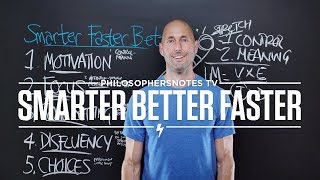
Brian Johnson summarizes Charles Duhigg's Smarter, Faster, Better in this Philosopher's Notes TV episode, highlighting practical strategies to increase productive output rather than mere busyness. Key takeaways: motivation arises from control (internal locus) plus meaning; focus is trained via mental models and implementation intentions; effective goal-setting combines stretch goals with SMART planning and proximal (domino) steps; disfluency (desirable difficulty) enhances learning and retention; and consistent small choice improvements (marginal gains) compound into higher productivity. The episode closes with a brief promotion for Johnson's Philosopher's Notes membership and Optimal Living classes.
Chapters
Hi, this is Brian. Welcome back to another episode of Philosopher's Notes. TV Today, another great book, Smarter, Faster, Better by Charles Duhigg. Smarter, Faster, Better Subtitle the Secrets of Being Productive in Life and Business. Charles Duhigg, as you may know, wrote the great book the Power of Habit. He's an award winning writer and this book is fantastic. If you want to increase your productivity, not just your busyness, but to get things done, Smarter, faster, better, I think you will enjoy it. Eight basic ideas on how to go about doing that. Blending science with super practical application across a range of facets of optimizing our productivity. And as always, Philosopher's note. Bunch of my favorite big ideas. And as always, we have five of them here today. So the first thing, the first chapter in getting smarter, faster and better, what do we talk about? We talk about motivation. You are not going to produce at your highest possible levels in the most smart, fast and best ways unless you're motivated, right? Obviously. Now how do you get motivated? Charles talks about two different ways we want to think about it. Number one is control and number two is meaning. So let's write those down. Control plus meaning. When we think about control, he talks about the locus of control, right? And walks us through the science of that. You can either have an internal locus of control or an external locus of control. People with an internal locus of control, in short, assume responsibility for their lives. They see themselves as the causal agent of creating that which they want to do, whereas those with an external locus of control feel kind of like victims are constantly reacting and responding to things thrown at them. So we want to come from that creative orientation with an internal locus of control, create that high level of autonomy which is so important to getting ourselves to do the things we want to do. And we want to connect that with a deep sense of meaning. Why are we doing what we're doing? Right? This is a big idea. What motivates you? Another way to think about motivation that we've talked about a lot is the motivation equation by Piers Steele, right? He did a meta analysis of hundreds or thousands of papers on motivation. What he found was a good way to jack up your motivation is to get a high sense of value. Value. You really, really want to achieve something and expectancy, you really think you can do it. Then you want to make sure your denominator is small. You need to control your impulsivity and you need to control the delay you have in your goals in other ways. You need to reduce, in other words, you need to reduce your distractions. And you need to set up micro goals. So control and meaning finding motivation. Our first step, the second step in the second chapter in the book, is on focus. So let's say you have motivation. Fantastic. Now you need to focus that motivated energy in the right direction and shine what Charles talks about and scientists refer to as the spotlight of your attention on what matters. If you're constantly distracted by things in your life, this variable is going to be very high. You're going to be impulsive. You're going to go from this to this to this to this to this. You won't be able to sustain your attention and focus your mind on that which is most important. And then you will not be smarter, faster and better. So one of the ways that Charles tells us we can develop and cultivate our spotlight of attention and be able to shine it where we want, when we want, for how long we want is, is to create what he calls mental models. Mental models are basically your conception of what's happening in your world, and you want to be aware of that and you want to create it throughout your day. He basically says, we want to have a running narrative of our lives. We want to bring intentionality to what we're doing. So, for example, if you're entering a meeting, right, you're thinking about the different variables at play and what you're going to do. You're setting an intention for that meeting. He talks about another researcher who wrote a great book on procrastination, Tim Pischel, who refers to that as implementation intentions. If, then planning, if this happens, then I'm going to do that. You're thinking ahead and focusing your energy. Sounds obvious, and it is pretty straightforward, but we want to create this ongoing, consistent narrative of what's going to go on in our lives. We want to have an intentionality present and focus our minds. We can talk about that longer, but we'll move on to the next one. Goal setting. This is. I'm not sure which chapter it is, but it's one of the eight principles. Goal setting. We want to get really good at setting goals if we want to maintain our motivation. Charles walks us through a really cool model of how to combine super ambitious goals, right? So you've got this big goal that you want to achieve, right? You want to have that, that's important. You need to have that for meaning. You need to have that ambitious, audacious view of what you can achieve in your life. But if that's all you have, you can crash and kind of burn out because you don't have you get the kind of sense of overwhelm because you don't have a concrete plan in terms of how you're going to achieve that. So he says you want to have stretch goals, but then you need to combine them with smart goals, right? So your specific, measurable, actionable, reasonable and time oriented goals need to go with your stretch goals. When you combine a stretch goal with a very concrete plan to actually make it happen, then you have power. Then you add a third variable which he calls proximal goals. So proximal goals, that's the scientific frame for the dominoes that we talk about. A lot of you want to look at. You want to achieve this big, big goal, this huge domino you want to knock over. We'll start with the micro goal. Knock that over. Then you can knock over the next goal, the next goal, the next goal. You build this momentum up via proximal goals. So it's kind of the scientific way of breaking down this huge goal into proximally smaller goals. Hit the next one via your smart. Very practical. This is what I'm going to do. Next goal and, and line it up such that that big goal becomes an inevitable byproduct of you hammering your next micro goal. I love the way he talks about that. And again, we talk about that in a ton of different contexts. Another aspect of the book to get smarter, faster, better was disfluency. So he talks about a theme that we talked about in our Learning 101 series, where there's that paradox of difficulty. Disfluency basically means that if you want to really master something, you need to paradoxically make it harder. So a lot of times we do things that feel easy. A mundane example is when you're at a lecture taking notes. You can type your notes on your computer. That's easier than writing it down. But the research shows, interestingly, that when you have that bit of disfluency, that bit of, of challenge of writing it down, you actually learn the material much better. Therefore, if you're a student ever taking notes, you'd be wise to write your notes rather than just type them out. If you want to have a deeper level of understanding. That's an example of disfluency. He says that we have so much information coming in, so much data coming in, we need to make it useful by doing something to embed it deeper into our consciousness. There's a lot of different ways you can do that. One of the ways in our context here, when you're watching something like this, whether it's a episode like this or someone else's content, you want to move from the intellectualization of the theory into the practice. You got to do something a little hard with it. Whether that's write it down in your own words, explain it to someone like they're five Reddit style, right? Barbara Oakley stuff style in her book A Mind for Numbers. Great practice. And most importantly is how do you figure out how to apply it? How do you take this theory and make it practice? That's an example of using information to make it viable. That's disfluency. Smarter, faster, better. We want to deliberately lean into making things a little harder, desirable. Difficulty, style. Our fifth big idea, the most important one. And this is kind of how Charles wraps up the book, which is ultimately, if we want to be smarter, faster, better, it's all about choices. The people who are the most productive are making little choices a little more wisely throughout the day that most people ignore. Most people just set things on autopilot and just go through the rhythms of their life. Nothing wrong with that per se. But if you want to optimize, you got to step back and start looking at those choices more deliberately. How are you focusing your attention? How are you motivating yourself consistently? How are you structuring your days? How are you moving from one thing in your day to the next? What does your masterpiece day look like? Finding those marginal gains that allow you to step up and into your highest potential. So there you go. Super quick look at this great book. Think about what choices you're making in your life and think about what experiment you can run. What's one little thing you know you could do in your life to get a little smarter, faster, better? Is today a good day to step into that? Good answer. Let's do this. Make today another awesome day. See ya. Isn't it a bit odd that we went from math to science to history, but somehow missed the class on how to live? For some wacky reason, optimal living 101 never made the schedule. Of course, it's too late to go back and change that and you're too busy to read full time to catch up. But if you're like us, you're all about optimizing your life so you can actualize your potential. So imagine this. Imagine having someone read the best books on how to optimize your life and pull out the big ideas that can really change your life. You know those sections. You underline an asterisk and mark all up. Then imagine that guy me, connecting those awesome ideas. To other great books and helping you actually apply the wisdom to your life today. Well, that's what I do with something we call Philosopher's Notes, where I've distilled hundreds of great books into 20 minute super practical summaries. Then imagine me taking the absolute best big ideas from those great books and sharing them with you in hour long Optimal Living 101 classes on everything from productivity, purpose and confidence to nutrition, goal setting and conquering procrastination. Helping you optimize every facet of your life so you can actualize your potential. You've got a personal trainer. I'm kind of like your personal philosopher. Ancient wisdom, modern science, and practical tools. That's what our optimized membership program is all about. If you're feeling it, we'd love to have you join us.
More from Brian

Heroic +1: What’s THE Most Creative Act in the Universe?: Turning Around Glitches (#2024)









