PNTV: The 10X Rule by Grant Cardone (#230)
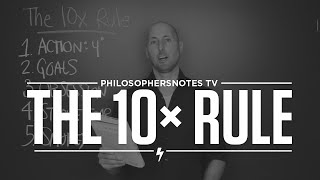
Brian Johnson breaks down Grant Cardone's 10X Rule: aim for goals equal to your potential, treat obsession as a gift, starve fear by running toward it, and combine intense effort with persistent fundamentals like exercise and sleep. Massive action beats normal action.
Questions this video answers
July 4, 2015
Ten bucks a month
250 Philosopher's Notes
Chapters
Hi, this is Brian. Welcome back to Philosopher's Notes TV. Today, another great book, the 10x Rule. The 10x Rule by Grant Cardone. Subtitle the only difference between Success and Failure Grant Cardone is fantastically intense and this book is all about the 10Xing, your vision of what's possible in your life and very importantly, 10xing, the actions you're going to take in order to bring that vision to life. The 10x rule. It's fantastic. Philosopher's Note Bunch of my favorite big ideas. Let's look at a handful of my favorite. Now start with the first one. Action. The four degrees of action. Grant tells us there are four ways we can approach life. We can do nothing, basically just kind of hang out. We can retreat and actively avoid doing things need to get done. We can take normal levels of action, which is what most people do. Just enough to live a reasonably comfortable life, right? Or the fourth degree of action. You can take massive action. Massive action. I'm going to write that down. I don't know how many times Grant used this phrase in the book, but suffice to say it was a lot. Disciplined, consistent, persistent, massive action followed by more disciplined, consistent, persistent, massive action followed by more disciplined, consistent, persistent, massive action. That's the essence of this book, the action side of it anyway. So quick inventory. Where do you show up? Are you doing nothing? Are you kind of retreating from life? Are you doing just enough to get by normal activity levels right? Or just enough to get a little bit better? Or are you taking massive action? If you want to create extraordinary things in your life, you need to take massive action. Not particularly complicated. That's our four degrees of action. We want to 10x by taking massive. Second one is goals. Grant tells us how often do you write down your goals? He asks how often do you write down your goals? For most people, if they write them down at all, it's once a year, New Year's resolutions.
I'm going to write down my goals.
Grant says anything that's important in your life, you need to ask the goal.
More than once a year.
He says you need to ask daily what's important to me. Write down your goals daily and stretch yourself. Go beyond what you think you can currently do and push yourself. Those are the goals you're going to want to come back to on a day in and day out basis. They it really fire you up. He asked a great question.
He says, are.
Your goals? When you do your inventory of your goals right, the note, I've got a space for you to write down, okay, these are my goals, right? This is what I'm excited about in my life. And he says, okay, are your goals equal to your potential? Are your goals equal to your potential? That's a really, really, really powerful question. Are your goals equal to your potential? If that doesn't increase your pulse rate a little bit, when you think about, wow, what am I really capable of? What can I do? What can I achieve? That's how we want to operate in our lives, right? And find the baby steps and the massive action that helps us connect from that big, big vision to where we are today and enjoying the process and all that good stuff we're going to. But keep that in mind. Reflect on your goals. Stretch yourself. Do your goals match your potential? Third big idea here, obsession. Obsession being super focused on something. Do you think that that is a disease? Is that a disease or is it a gift? Important distinction.
How do you view obsession?
Do you view it as a disease? Something's wrong with that guy. He's obsessed about whatever optimizing his life or building a business he's proud of or having a family that really resonates and helps him serve and actualize. Do you see obsession as a disease or as a gift? Are you willing to turn up the energy in your life and move out of the first three degrees of action here and be abnormal? Most people. To be normal is to do what most people do. To be abnormal is to say, look, I'm going to go all in on this. And it's not just Grant Cardone and his intensity who tells us we need to be willing to go all in and be willing to obsess on things. Joseph Campbell, the mythology guru who talks about the hero's journey in one of his books, A Joseph Campbell Companion, he quotes Ramakrishna, who says, do not approach enlightenment unless you approach it like a man whose hair is on fire seeks a pond. Well, if your hair is on fire, how are you approaching a pond with some intensity, with some obsession? To get from where you are to that point, you're going to do whatever it takes to get to the pond to put out the fire on your head. We need to approach life with the same level of intensity. We want to ground it in our fundamentals so we're sustainable. We need to have that intensity. In the note, I talk about another idea. We talk a lot about activation, energy, the difference between 400 degrees and 451 degrees Fahrenheit. You probably know that at 451 degrees you can create fire. Paper will Catch on fire. A guy named Michael Lardon who wrote a book about being in the zone. One of the world's leading sports psychologists, peak performance experts. He says the difference between good and great is tiny. It's tiny. But that 1 degree between 450 degrees and 451, nothing happens at 450 degrees. You can be freezing, lost in the forest. And if you rub sticks hard enough together to try to catch fire, to set paper on fire, and you get it all the way up to 450 degrees, that won't do the trick. You've got to be willing to get it all the way up to 451. And that requires a focus, one could say an obsession of on the results that you're passionate about. Obsession. Is it disease or is it a gift? 10x'ers see this as a gift. Cardone makes the great point, too. The only people who criticize him for how hard he works are people who haven't achieved his level of success. They criticize him because they're operating from one of these lower degrees. People who have achieved more success than him never criticize the amount of effort he puts in because they know what it takes. Very powerful distinction. Fourth big idea. This is another good one. It's packed with big ideas.
This book is Yoda speak.
Starve fear. You need to starve fear. Guess what fear's favorite food is? Fear's favorite food.
What is it?
Grant tells us it's time. If you have something that you need to do, you need to make a phone call to someone. And just the thought of making the phone call creates a level of anxiety within you. Apprehension. And then rather than pick up the phone and dial the numbers and call them, you go get a cup of coffee and you think about it and you're like, okay, let me prepare. Let me see what I need to do here to make sure that call goes well. But you're really just imagining all the things that can go wrong in avoiding what needs to get done. And in the process, you're feeding your fear. You're making it bigger and bigger and bigger. Grant tells us we need to starve fear. Cut the time out of the equation. You're just avoiding doing what needs to get done. What if you could reverse that whole process? And rather than go out and distract yourself and waste a ton of time and create anxiety in your life unnecessarily, you just did it. You just took the action. And he says, anytime we find ourselves wanting to run away from something, feeling fear, condition, Ourselves to go right at it. It's what the tools guys talk about, that I talk about all the time. You need to reverse your desire. We have this relationship to fear where we say, ah, I want to go away from it, but our potential exists on the other side of fear. Outside of our comfort zone is where our potential is. So fear can become a signal for our potential. We need to run right at it rather than run away from it. So starve fear by removing time from the equation.
Huge idea.
And then the fifth one is another great idea. Smokey. So Grant tells us about the fable the Tortoise and the Hare. Tortoise and the hare.
Right.
So the tortoise wins the race. And the fable's message is that slow and steady wins the race. Right. The hare. The rabbit runs ahead, goes nuts, super intense. Then he kind of burns himself out. Whereas the tortoise started slow, but just kind of plods along and eventually he wins. He says, okay, well, whatever. But there's a third alternative. What if you could create this creature that can both start strong and sustain itself over the long run? He says if that creature existed, it would smoke both of those other two competitors and the fable would not be called the Tortoise and the hare. It would be called Smoked.
So good.
So let's say the creature's name is Smokey. The creature that has both the speed of the hare and the diligence and the persistence of the tortoise. That's what we want to be. And the way to do that, to create the engine where you can be both intense sustainably, is our fundamentals very simple. Your exercise, your nutrition, your rest. Are you honoring those? Your digital sunsets, getting aligned with the circadian rhythms? You're not the hare that gets excited about an idea and then stays up two nights straight and then crashes. You're the individual who says, look, I'm fired up about this idea. I've done that in the past. I want to be smoky, I want to be intense, but I also want to be thinking long term so I can consistently show up with this level of intensity. You turn off your electronics when the sun goes down, or whenever you get a good night of sleep, you leave a little bit in the tank for the next day and. And you show up and you have another great day. That's the basic idea of how we can integrate speed and intensity with long term endurance. Think Smokey. Smoking the tortoise and the hare. Starve your fear. Take action. Do what needs to get done. Reverse your desire. Move straight at that which freaks you out. Be obsessed about what's important to you. Be obsessed about having a great relationship with your spouse and with your kids and with your colleagues and creating a life you're proud of. And as you set goals that are equal to your potential, are the goals you're setting for yourself in every domain of your life equal to your potential? That's a really, really, really powerful question. And remember our four degrees of action. Don't stand still and do nothing. Don't retreat and don't take normal action. Take massive action. All caps, exclamation point and in the process, 10x. There you go. What was the idea that jumped out at you? Think about that. Think about how you can apply it to your life. This isn't about theory. This is about taking ideas and actually living them consistently, day in and day out.
I hope you enjoyed.
I look forward to sharing more soon. And if you haven't checked out the membership program yet, get on it. If you like these videos, I do a ton. More like way more than what you see here. I'll put a link where you can click on that and and would love to welcome you there and honored to be a part of your life. Let's optimize, let's actualize. Have another awesome day.
See you. Hi, this is Brian. I hope you enjoyed that PNTV episode. A lot of people don't know all the stuff I do beyond these free videos I share on YouTube. So I thought I'd do a quick video to give you an overview of our membership program that you can get access to and get a ton of other stuff. So here's a quick look. Ten bucks a month. Join the Optimal Living Membership program. You get Instant Access to 250 Philosopher's Notes on some of the best Optimal Living books out there. Old school classics, positive psychology, modern stuff, mindfulness, peak performance, purpose, neuroscience, wealth, etc.
And what you may not know is.
That in addition to the PNTV episodes, I create PDFs on all these great books. So six page PDFs. Let's take a look at one of them. Joseph Campbell. You want to figure out how to live your hero's journey? Well, this is a great place to start. I basically pull out my favorite big ideas, riff on them, connect them to other books and other ideas, and help you apply this wisdom to your life today. That's what the PDF looks like again, we have 250 of these on all these different great books and then I record those PDFs as an MP3 so you can listen to that MP3 while you're on a walk or working out or doing some errands or whatever that is. Philosopher's Notes. A lot going on there. And then in addition to Philosopher's Notes, you get access to optimal living classes. Optimal Living 101 idea here is that all those great teachers come back to the same big ideas again and again and again. I distill those ideas into classes. Super practical, fun, inspiring classes ranging from habits101, confidence101, getting stuff done one on one, meditation one on one, instant access to all those classes. And then future classes include relationships one on one, energy 101, purpose one on one, business goals, etc. Those are our full length classes. And then I create micro classes. Two to three to five minute little bursts of wisdom on my favorite great ideas from these great books across the domain that you want to optimize in your life. So we have dozens of these so far. I create 50 new micro classes every month and 10 new philosopher's notes every month for 10 bucks a month. So we're blessed to have thousands of members who are enjoying the program and sharing some incredibly kind words with us. And super simple 10 bucks a month. Cancel anytime. We'd be honored to be a bigger part of your life and and I appreciate your support. And here's to optimizing and actualizing.
More from Brian

Heroic +1: What’s THE Most Creative Act in the Universe?: Turning Around Glitches (#2024)









