PNTV: The Art and Science of Low-Carbohydrate Performance by Jeff Volek and Stephen Phinney (#380)
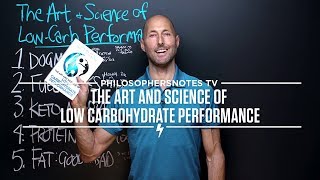
Brian Johnson summarizes and comments on The Art and Science of Low-Carbohydrate Performance by Jeff Volek and Stephen Phinney. He outlines five main ideas: (1) challenge nutritional dogma that links fatigue only to glycogen depletion; (2) two fuel tanks — burning carbs gives 'hours' of fuel, burning fat gives 'days' of fuel (citing glycogen ~2000 kcal vs fat ~40,000 kcal for a lean athlete); (3) keto adaptation requires an adaptation period (~2 weeks) and dropping carbs to <50 g/day while managing electrolytes; (4) moderate protein: 0.6–1.0 g per lb lean body mass; (5) prioritize fat quality — reduce omega-6 vegetable oils and favor olive/avocado/algae oils and increase omega-3s. Emphasis on experimentation and personal context.
Questions this video answers
Stephen Phinney (credited in the video) in 1980.
Less than 50 grams per day.
Around two weeks.
0.6 to 1.0 grams of protein per pound of lean body mass.
Glycogen ~2,000 kilocalories; fat stores ~40,000 kilocalories (example cited for a 6'0", 150 lb lean athlete).
Chapters
Hi, this is Brian. Welcome back to another episode of Philosopher's Notes. TV Today, another great book, the Art and Science of Low Carbohydrate Performance by Jeff Volek and Stephen Finney. The Art and Science of Low Carb Performance. No subtitle necessary. Jeff Volek and Steve Phinney are two of the leading thinkers in the low carbohydrate nutritional performance movement. They're academic researchers. They've been at this for decades. In fact, Finney, whose pedigree is ridiculous, he got his MD from Stanford, a PhD in nutritional science or something like that from MIT, and he also spent some time at Harvard. In 1980, he actually coined the phrase keto adaptation or keto adapted. So these are the guys to go to if you want to learn more about low carb performance. I think I picked it up after reading Mark Sisson's the Keto Reset Diet. We've also got an episode coming up on that and on Ketotarian. If you come from a vegan or vegetarian orientation, Ketotarian is a great book on how to go keto while still being vegan or vegetarian. And whenever I create a nutrition episode, I'm tempted to turn off the comments because they get a little bit ridiculous at times. There's a lot of dogma, there's a lot of emotional energy around nutritional conversations. I get it. I used to be vegangelical. I was 100% right. Everybody else was 100% wrong. At this stage, I think it's about experimentation. I think it's about respect and opening our minds. And in the note I talk about the fact that these guys say, look, if what you're doing on a high carbohydrate diet is working, then keep on doing it. If it's not broken, don't fix it. If your energy levels fluctuate, if your health isn't where you want it, if your performance isn't where you want it, then you may want to consider experimenting with an approach like what they talk about. Again, whatever you're going to do, have fun with it, rock it, etc. Personally, I've gotten a lot of benefits out of experimenting with a low carb approach, both energy wise in general and performance wise to put it in perspective. Got into Spartan races, right? That's kind of my thing now. So a year ago I did my first Spartan race and I was kind of sorta following a fat adapted approach. Actually I was pretty good on it, but took it to a different level over the last year. Anyway, I was 1270 out of 4500 people that did it. Right? So fine, but not anywhere near great, right? I didn't even know I could do it, but I did it. I just did one last weekend and I raced in the competitive division with my age group top 10 in that, which I was pretty happy about. But my time in that race, had I done the open race, I would have gone from 1270 to number 10. My time would have been the 10th fastest out of 4500 people. And before I did it, I had a coach who's a friend of a friend tell me now, you can't do that. You can't do Spartan fat burning. Well, you know, it's all an experiment. I do a lot of different things, but I was fat adapted for it. And again, a lot of work to do to get where I want to be performing at a really elite level athletically, but it's working for me. So anyway, very long introduction. The art and science of Low Carbohydrate performance. We've got a philosopher's note with a bunch of my favorite big ideas. We've got five of them we're going to look at now. First big idea is dogma. So again, they're very clear on the accepted dogma. The accepted dogma is in what's been researched over the last 40 years and they praise all the progress that's been made. But the dogma is basically that when glycogen reserves are depleted, fatigue goes up, right? That's what we've observed. That is in one scenario, true, right? Glycogen levels go down, fatigue goes up. So if you want to reduce fatigue, you got to find a way to keep your glycogen levels up. Enter a multi billion dollar industry that gives us all the sugary fuels we need to keep the glycogen levels up, from sugary drinks to sugary gels, etc. Now the presupposition in that is that glycogen is actually the preferred. I guess I had it over here. Glycogen is actually the preferred fuel in the first place. They challenge that dogma and they say, okay, but what if you actually had a fuel source that wasn't dependent on primarily using glycogen as your fuel source, Then all the carb loading and all the making sure your glycogen reserves are capped off becomes a different conversation. And this is what they've spent their decades of life force and energy researching academically and publishing papers on it, et cetera, et cetera, et cetera. But the accepted Dogma is, again, glycogen fatigue. So let's deal with the glycogen and we'll deal with the fatigue. They say, step back, look at it iconoclastically, think about it from a different perspective. And in the note, I talk about Yuval, Noah Hararis in a different context. We have TV episodes, PNTV episodes coming up on Sapiens Homo Deus and on 21 Lessons for the 21st Century. But the great historian Harari tells us that there are imagined orders in our culture, right? There's this accepted dogma. Well, that's just how it is. You know, boom, boom, you have a lawn in front of your house. You're supposed to wear shoes that have high heels on it. But he says, step back, look at it, and realize those are just imagined orders. Those are things we take for granted, but they're not necessarily natural or true. So again, it requires us to step out of the dogma, be willing to experiment, but only if we want to and what we're doing isn't working perfectly. Right? But dogma, that's the first idea. We want to take a look at it. The second big idea is to think about that a little bit more deeply. So we talked about glycogen, right? They talk about the fact that you basically have two potential fuel tanks. You can fuel your body in one of two different ways, right? And they say, and I say in the note, imagine a blank slate. Imagine you didn't know anything about nutritional philosophy. You didn't have any imagined orders. You bought into no dogma, no kind of evangelical approach to one thing or the other. And you were presented with two options. One option was, let's get your body. I will give you a body that is adapted to have fuel that lasts for hours. I'll give you a body that can use fuel that will go for hours. That's one option. Or I'll give you a body that's adapted to use fuel for days, hours or days. Which one would you take? Now, obviously, you're gonna go for the days. If you didn't have any dogma or any kind of filter through your lens, you'd say, well, of course I'm gonna go for the days. Why would I choose an engine or a machine or a body that can only go for hours when I can go for days, right? Well, they say that when you break it down and you look at our alternate fuel sources, you can either go for hours if you primarily burn sugar for fuel or carbohydrates for fuel, or you can Go for days if you burn fat for fuel. Now again, that may sound absurd to you if you have a belief system that it's all about high carbohydrate and this and that. But when you look at it, fat is a much more efficient fuel source than glycogen. And we're going to talk about Filmathetone a lot as well. Filmathetone is one of the greatest endurance coaches ever. He coached Mark Allen, who's the greatest triathlete ever, who followed Maffetone's approach. Maffetone's approach was all fat burning, both training in an aerobic zone and in what you're eating. And MAF wasn't necessarily get into ketosis, but he was understand your carbohydrate tolerance levels and eliminate sugar and flour. Right. But anyway, when we look at our sources of fuel, Maffetone makes the point that someone like me and Maffetone actually says a 6 foot tall, super lean, 6 foot tall, 150 pound endurance athlete, which happens to be exactly what I am, 6ft tall, 150 pounds, single digit body fat. Right. I have very little body fat. Yet Maffetone says that athlete, when adapted, important distinction, when adapted to burn fat for fuel, has enough fat stores to run for 100 hours. Now, biomechanically, I'm not fit enough to run 100 hours. But from a fuel perspective, your glycogen reserves can only only has 2000 calories of energy. Right? That's how much your glycogen stores have. But your fat stores 40,000. Six foot tall, 150 pound lean athlete has 40. I still have 40,000 calories of energy waiting for me. I could run 100 hours. Maffetone tells us on that store of fuel. So again, you want to think about the fact that you have two different potential sources for fuel, sugar or fat. One will give you hours of energy, the other will give you days of energy. Fascinating stuff. Third big idea here is keto adaptation. So again in 1980, Finney, Stephen Phinney, thank you for your life's work, came up with the phrase the idea of keto adaptation. The basic idea is you need to shift if you're going to make the switch from being primarily sugar burning to primarily fat burning and going from the high carb to the low carb approach, there is an adaptation period. They say it takes around two weeks, right? At least two weeks. Now in that process you're adapting and you can kind of wind up in no man's land, they say. So check out all the Online resources. Check out the book for more details. But their approach is drop your carbohydrates down to less than 50 grams per day. Now, a lot of people are eating 500 grams per day. That's a huge drop. They say, well, okay, you're going to find your calories primarily through fat and moderate protein, which we'll talk about in a moment. But you don't want to wind up in a no man's land. Your brain requires 500 calories or so of energy a day. It's currently burning glucose for fuel, and you need to make that switch such that the ketones become free. And that can fuel your brain's energy, right? But if you wind up somewhere between your 500 and your 50, you're going to be in kind of a weird no man's land. So they say, just do it. Take the Nike approach, go less than 50, and again, check out the details to do it. Well, the adaptation process, if you want to experiment, but you want to make sure that you take care of your sodium and magnesium levels, right, Deal with the keto flu and all this stuff, but give yourself that time to become keto adapted. Flip the switch from the sugar to the fat burning. Go through the little process here. Yeah, there you go. And then the fourth idea here is protein. They recommend that we take a moderate approach to protein, right? So some people, when they're dropping their carbs, can go nuts on protein. They don't. They don't recommend that at all. Their recommendation is 0.6 grams of protein to 1.0 grams of protein per lean body mass. So again, to use me as an example, 150 pounds, call it 9%, but call it 10% to be even numbers, right? So 150 pounds, my lean body mass is 150. Minus those 10% body fat is what, 15 pounds? So 135 pounds of lean body mass. So on their math, the upper threshold would be 135. The lower threshold would be whatever it is, right? 70ish grams of protein. You want to play in that range. You don't want to go nuts and you don't want to have too little. Now, on the protein front, as I mentioned, we've got an episode coming up for vegans and vegetarians called ketotarian, where you can do this on a vegan or vegetarian approach, right? And in that book, he emphasizes that when a lot of people talk about keto approaches, they're too focused on the macro breakdown of fats, carbs, protein, and they forget about the Quality. So he makes a really important point that the quality of your proteins, if you're going vegan and vegetarian, do that. If you're doing it from a non vegan or vegetarian approach, get the highest quality proteins. Obviously no factory farm stuff for a million reasons. No processed meats and all that stuff. Get the grass fed, wild caught, conscious, clean proteins and moderate it. Too much of a good thing is not a good thing. That's the quick take on the protein side of things. And again check out all the online stuff for more on it. But that's what they recommend. Our fifth and final idea here is fat. When you're reducing your carbohydrates, again for them it's less than 50 grams. They say it will vary but for most people it's that you're not going crazy on your protein. And that's a pretty easy to punch in number, right? You got your lean total weight minus your body fat. You got your lean body mass. Your timing it by their equation. So the bulk of your calories are coming from fat. They say you need to be really, really aware of what type of fat you're consuming. There are omega 3 fats and omega 6 fats, primarily omega 3s and omega 6s. Long story short, omega 6s are over consumed in our modern society. They say something like we eat 10 times more omega 6 fatty acids than we need, right? And the primary source of those fats that we want to eliminate are vegetable oils. So things like sunflower oil, safflower oil, corn oil, canola oil, soybean oil. These vegetable oils are ubiquitous in our nutritional supply now even in the healthiest places. Go to whole foods, pick up a salad dressing off the shelf, look at the first ingredient, it will be one of those soybean oil, canola oil, something like that. Mark Sisson's got his Primal brand which is fantastic. No vegetable oils in his, but most of them are going to have vegetable oils. And why we should care about that is it's going to jack up our inflammation. Omega 6s are important to create a level of healthy inflammation, to fight different things in our body and to help heal our body. But the way that Chris McDougall puts it in Natural Born Heroes is brilliant. He says, look, you need a fire in your house to keep yourself warm, to keep your house warm. But you don't want such a big fire that it burns your house down. We need to moderate our Omega 6 intake and calibrate it so it's closer to one to one rather than some crazy number to one. And the easiest way to do that is to reduce, eliminate your vegetable oils. This may not seem like a big deal, but it is. I'm so sensitive to it that if I have vegetable oils years ago I discovered this. Even at a healthy place, I'll feel like inflammation in my nose. It will immediately trigger an inflammatory response. So look at that. Pay attention to it. Substitute it with the good stuff, which are things like olive oil, avocado oil. We use a lot of algae oil and perilla oil in our salad dressings. Actually, we share a recipe in our class for optimized members cooking 101. It's basically the extent of my cooking in the kitchen is I can make a decent salad dressing. But anyway, tons of fat, healthy fats, reducing the unhealthy fats, and a ton of greens, which we'll talk more about in keto Terrian. Lots of plants, lots of healthy fats, moderate protein, reduced carbs. That's the basic idea. There you go. Fats, good versus bad protein, we want to be moderate, 0.6 to 1. Think about that. Think about where you are on that level. Keto adaptation, it takes a little time. Get your sodium, your magnesium levels all dialed in. And remember your fuel tanks. If you were offered options, do you want fuel for hours or fuel for days, which would you take? Options. Obviously you take the longer one. You may or may not agree philosophically with what we're talking about here, but no one's going to say, oh, give me the few hours. And historical fun fact. There are no or factoid as they said, there are no essential carbohydrates. So there are essential fatty acids that are part of the macronutrient fat. There are essential amino acids which are part of the macronutrient of protein, that there are no essential carb acids. There are no essential molecules within carbohydrates that your body absolutely needs to function. Literally. Your body does not have a requirement for any carbohydrates. Your body can take care of the glycogen production through intake of fats and proteins. It doesn't need the carbohydrates, which is a fascinating thing to consider. And again, the historical point I was going to make is if our ancient, ancient super ancient ancestors had to have carbs available to them every few hours or they couldn't perform at a peak level, we wouldn't be here today. Old school. Back in the day we all burned fat as our primary source of fuel. And I'm talking pre agricultural revolution. We went through inevitable famines during which we had to perform at a high level. So two fuel tanks. Choose wisely. And then dogma Again, the accepted dogma is what we discussed. Low glycogen equals high fatigue. But what if you stepped back and didn't have glycogen as your primary source of fuel? Opens up an interesting conversation. Hope you enjoyed. And here's to experimenting, finding our optimal self and continuing to spiral up. Letting go of the dogma. Being open to that experiment of one seeing what works for you and for your family. And again, whenever I talk about nutrition, I like to bring it back to things we can all agree on. Sugar, flour, vegetable oils. No one's going to say, yeah, increase your sugar consumption, that makes sense. Or increase your refined flour consumption, that makes a lot of sense. Or increase your vegetable oils. I didn't mention it, but those were only invented 100 years ago. Those don't belong in our bodies, period, let alone in the percentage of our total caloric intake as a culture that those three things, no matter your nutritional philosophy, need to be paid attention to if we're going to optimize and actualize and have the energy to give ourselves most fully to the world. There you go. Thank you, Jeff and Steven, for your hard work and make today another awesome day. See you.
More from Brian

Heroic +1: What’s THE Most Creative Act in the Universe?: Turning Around Glitches (#2024)









