PNTV: The As If Principle by Richard Wiseman (#367)
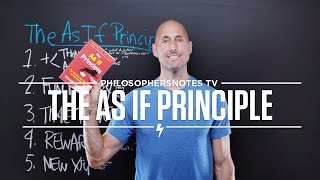
Brian Johnson breaks down Richard Wiseman's "The As If Principle," which argues you can reshape your personality by changing how you act. The core idea: pretend to be confident, happy, or outgoing and you'll actually become those things. Wiseman shows personality isn't fixed.
Chapters
Hi, this is Brian. Welcome back to another episode of Philosopher's Notes tv. Today, another great book, the as if Principle by Richard Wiseman. The as if Principle, subtitled the radically new approach to changing your life. Richard Wiseman, in addition to having the best possible last name for a professor focused on the science of well being, also has the best possible title. He is Britain's professor for the understanding, the public understanding of psychology. Richard Wiseman, super funny guy, super practical guy who brings the science of well being to life. In this great book we we get to talk about William James and his adage that if you want equality, the fastest way to get it is to act as if you already have it. The as if principle is what Richard Wiseman describes it as. And he walks us through the scientific research that proves that unequivocally. We'll talk about that more today. As always, we've got a philosopher's note. A bunch of my favorite big ideas. In this six page PDF, its accompanying 20 minute MP3, we have hundreds of those. You haven't checked them out yet. Get on it if you are feeling it. For now we have five of my favorite big ideas from the book. The first one is positive thinking vis a vis positive acting. So a lot of self help is about positive thinking. If you can get yourself to change your thinking, the thinking goes, you can change your behaviors. Now there's a certain amount of truth to that, of course, but what Richard tells us is a far more effective way to change your thinking and feeling is to change your acting. Positive acting is what research shows to be the most effective way to change your feelings. And they make the. He makes the point. Behaviors drive feelings. So we talk a lot about identity drives behavior, which drives feelings. Or they also describe it as emotion. Behaviors drive emotions. And the book is all about basically proving that that if you can get yourself to act as if you were the fill in the blank version of you, the best version of you, you will see dramatic changes in your sense of feeling and in your performance levels, et cetera. So positive thinking versus positive acting versus focus on the acting. And again, remember William James thought, he said if you want a quality, act as if you already possess that quality. So think about a quality that you may want to have more of in your life. What is it? Can you think of one or two or three qualities? I can think of one or two or three qualities. So for me examples I committed myself to my new sport hobby of racing spartan races. Now the identity that's fun for me is a world class Age group, world class, Spartan racer. That's an identity. Well, guess what? I want to act as if I were that now. Well, how would I eat? How would I move, how would I sleep, how would I train? How would I show up and do the different things that I'm doing throughout the day? Powerful identity. I want to be a great husband and father. Well, guess what? I can act like that now. I can be more present, I can be more kind, I can be more patient, right right now. I can act as if I already had those qualities right now. And sure enough, I'm more likely to have those qualities again. What quality do you want to have? Fill in the blank and then act as if you already had that quality and we will see more of that little fun. Philosophical historical Aside, William James, 18th century, early 19th, early 20th century, was a contemporary of Freud. So they had very different philosophical vantage points. Freud was all about psychotherapy, which involved looking into your past. I like to describe it as an archaeological dig into all the reasons why you are currently neurotic. William James liked to look at your behaviors right now and said, look, change the way you're acting right now. We don't need to know what happened to get you to the point you're at. And in fact, wrestling with all that stuff actually strengthens its hold on you, was his philosophical take on it. Let's change your behaviors right now. And if we can do that, we will change how you're feeling and you will experience a better state of well being, functioning, etc. Wiseman says, guess who won that debate? William James. The academic research is unequivocal in its support. Focus on your behaviors and your feelings will follow. Research wise. He talks about something called the Fun Factory. And all the different research that's been done to prove the points that we just talked about, they've proven everything from getting yourself to smile induces higher levels of happiness. And again, we always think that, well, when I'm happy, I smile. That's how it works. It goes in that direction. I'm happy, I smile. But what Richard says is, yeah, and when you smile, you feel happier. So a direct route if you don't feel happy is smile. And they bring people into a lab and do things like have them pronounce e right. When you pronounce E, it makes you kind of smile, right? Or you can pronounce ew. What does oo make your face do? Makes you kind of grimace, right? E OO something as simple as that can elicit a higher level of happiness in the E group which kind of sort of emulated or produced a smile than the other group, the Ooh. Group that did the opposite. A little bit of a grimace. That alone can boost your emotional experience in that short period of a study. That's kind of crazy. Other things they've seen. Singing. Listening to music won't boost your mood as much as singing. What do you do when you're happy? Well, a lot of times you smile and you sing. Another thing that Richard comes back to again and again and again is dancing. Apparently, dancing has been one of the most powerful ways to induce happiness. When you're happy, you tend to dance, and when you dance, you tend to feel happier. Huh. Good idea. You're not feeling great. Dance. I went down and shared this with Alexandra as I was reading the book. She is our official house dj, all into dancing. So I said, this is great. We got to do this more often and more consistently. Dance if you want to boost your mood. And then another simple thing from the Fun Factory is hold your head up high, stand and act and breathe like you do when you're feeling great, when you're feeling confident and energized, how do you stand and how do you talk and how do you breathe and all that good stuff? Well, guess what? Act like that right now. This again is a corollary to Amy Cuddy's research presence. Simply assuming a posture of openness and strength increases your physiological markers of power and confidence and happiness, etc. Whereas wilting into a little shriveled little flower does the opposite. Be strong, sing, dance, smile, etc. Come out of the Fun Factory even happier. The third big idea here is time travel. This is a powerful demonstration of the as if principle that we've talked about before. And you might already have heard of time travel. Ellen Langer, renowned research scientist out of Harvard, who studies what she calls this psychology of possibility. Right. And basically, she says, you don't know what you're capable of, so let's just move toward the possibility of what you could do. And we've profiled her a number of times. The reference that he makes in the book is to one of her studies that she wrote a book on called Counterclockwise. And the basic idea here was, let's test this as if principle. She did so in 1979. She brought in men who were 70, 80 years old, in their 70s or 80s, and she had them for a week, act as if it was 20 years earlier, 1959. So they had to act as if they were 20 years younger. Right. And she created this environment where all of the posters on the wall and the movies they watched were from 1959. And she told them, don't talk about 1959. Act as if it is 1959. Talk politics like you're talking about it in 1959. We're going to talk about and watch movies that were the best hits in 1959. She had them act as if they were 20 years younger. And. And over the span of a week, what she saw was some of these men were not using their canes as much. Their eyesight measurably improved from when they came in. And vis a vis a control group that didn't go through the same experience. Right. They talked as if it was 1959, but they didn't act as if it was 1959. These elderly men, their blood pressure went down, their finger length actually extended. They actually were able to extend their fingers a little bit more as they literally. She says, that's as if they got younger over this period of time as they acted as if they were living in 1959. Incredibly powerful thing. Their eyesight got better, et cetera, et cetera, et cetera. Sounds crazy, and it is a bit crazy. And it's also a powerful set of data that establishes this acting as if principle even more powerfully. The fourth big idea, it's a little different take on a little different angle on it. The Paradox of rewards is an interesting topic that Richard explores in the book the Paradox of Rewards. So he talks about research done by Teresa Amabile. We have featured Theresa Amabile. She is Harvard Business School's head research. So Amy Cuddy's at Harvard as well. Theresa Amabile has been doing this for decades. We talked about her work in Micro Wins, small wins, in her book the Progress Principle. Well, she did some other research on creativity, and she wanted to understand what led to higher levels of creativity. So she brought people into her lab and she split them up into two groups, and they did some poetry or something like that. Right. So they each created a piece of poetry. Then before they created their second piece of poetry, she had them, one group thought about all the fame and the wealth they could get by being a writer. She had the other group think about all the reasons they intrinsically enjoy writing. Right. Just the joy they get out of it, intrinsically. So you have this fame, wealth group, and then you have the intrinsically rewarded group. Then she had them write a second piece of writing poetry, and then she had that piece analyzed by an independent panel of Judges. And what she found was the group that was focused on the intrinsic stuff produced higher quality creative work than the group that was focused on the extrinsic material wealth and fame types of things. Simple study, simple intervention, change in creativity. It's a fascinating thing. Well, what happens if you thought about fame and wealth all day, every day, Fame and wealth all day, every day, vis a vis your intrinsic reason and motivation for doing something right? Logic holds that if you extend that out, you're going to find more creativity among the people that are doing what they truly love to do and are focusing on that rather than on all the material rewards. That's the paradox of rewards. When you focus on them, paradoxically, you produce lower quality work and you're less likely to get the rewards you want. In the note, I talk about Carol Dweck and her whole fixed mindset growth mindset. She has a great quote. She says, the fixed mindset people tend to want to be at the top. They want all the prestige and the wealth and the fame that comes from being the best. But the intrinsically motivated, growth oriented people just do what they love to do. Yeah, that's cool. They don't focus on that side of things. They do what they love to do and the byproduct of their enthusiasm is reaching the top. Whereas the fixed mindset people tend to burn themselves out en route to it. Another little mention I have in the note is Stephen King, who wrote, obviously great writer, right? He wrote on writing and one of the ideas in that book was people ask him, did you do it for the money, right? And he's like, no, I didn't write one word for the money. I got a buzz out of doing it. He was super lit up and intrinsically to write and he happened to make a ton of money. He said, yeah, I made a lot of money and it paid the mortgage, sent the kids to college. But I didn't write for that. I wrote for the intrinsic reasons. So for you, check in on how you're thinking about things, how you're orienting when you journal in the morning. What are you focusing on? The extrinsic or the intrinsic? Focus on how awesome it is to get to do what you get to do. For me, I can focus on the extrinsic or I can focus on the intrinsic. I get paid to read, to study, and to help you optimize your life. That is unbelievably cool. I love doing that. Focusing on that allows that enthusiasm to come through. The rewards are there and they're Nice. But we want to keep that balance on the intrinsic side of things if we want to enjoy both higher levels of flow and happiness and higher levels of creativity and ultimately success. Next and final big idea is the new you. So the whole point of this book is the fact that your personality is not fixed. Right? It's malleable. You can act as if you are that best version of you in different ways and you do that consistently and you aggregate and you compound all those little opportunities to act as if you are that version of you. And guess what? You're going to become that version of you. It's an exciting thing. And he suggests that we take a two week vacation from our current selves and imagine who we are at our absolute ideal, optimal, best or even just at a little bit best version of ourselves. Right? But what would you look like if you were living with the qualities you aspire to live with. And he Sundays take a two week vacation from the current version of you. And and act as if you are this version of you. Two weeks. And do it even when you're alone. Act as if you are already that version of you. William James says that's the fastest way to become that version of you. Positive actions versus positive thinking. Don't just sit there and vision board and journal about it. Act like you're that version of yourself right now. Behavior's gonna drive those feelings and drive the actual experience of being that version of you. Remember the Fun Factory? E oo going to generate different levels of happiness. Kind of stunning smile leads to happiness as much as the other way around. Sing, dance, hold yourself up, head up high, strong, etc. Time travel. Remember that? 1979 and 1959 these 70 to 80 year old men actually experienced. Almost as if they got younger over that period of time. Truly astonishing. The rewards focus on the intrinsic. What fires you up about what you do focus on that. Let the external rewards be a byproduct of your enthusiasm for your life as you create the new, most awesome you. The as if. Principal Richard Wiseman. Awesome stuff. Hope you enjoyed and I hope you have an awesome day. The new you, of course. See you. Isn't it a bit odd that we went from math to science to history, but somehow missed the class on how to live? For some wacky reason, optimal living 101 never made the schedule. Of course it's too late to go back and change that and you're too busy to read full time to catch up. But if you're like us, you're all about optimizing your life so you can actualize your potential. So imagine this. Imagine having someone read the best books on how to optimize your life and pull out the big ideas that can really change your life. You know those sections? You underline an asterisk and mark all up. Then imagine that guy me connecting those awesome ideas to other great books and helping you actually apply the wisdom to your life today. Well, that's what I do with something we call Philosopher's Notes where I've distilled hundreds of great books into 20 minute super practical summaries. Then imagine me taking the absolute best big ideas from those great books and sharing them with you in hour long Optimal Living 101 classes on everything from productivity, purpose and confidence to nutrition, goal setting and conquering procrastination. Helping you optimize every facet of your life so you can actualize your potential. You've got a personal trainer. I'm kind of like your personal philosopher. Ancient wisdom, modern science and practical tools. That's what our optimized membership program is all about. If you're feeling it, we'd love to have you join us.
More from Brian

Heroic +1: What’s THE Most Creative Act in the Universe?: Turning Around Glitches (#2024)









