PNTV: The Checklist Manifesto by Atul Gawande (#348)
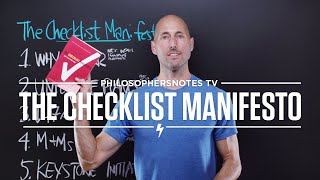
Atul Gawande argues that checklists turn complex tasks into reliable routines. A surgical checklist reduced mortality by 47%. Brian Johnson shows how to build daily checklists with pause points, 50-90 minute work blocks, and keystone habits like a digital sunset.
Questions this video answers
47% reduction in mortality.
103 ft.
December 1, 2017.
Article 126 — no brown M&Ms clause (bowl must have no brown M&Ms).
50–90 minutes on, then 7–20 minutes off.
Chapters
Hi, this is Brian. Welcome back to another episode of Philosopher's Notes. TV Today, another great book, the Checklist Manifesto by Atul Gawande. The Checklist Manifesto Subtitle how to Get Things Right the Checklist Manifesto we ended our last PNTV on this book. Theresa Amabile's the Progress Principle. She quoted Atul. I finished that PDF immediately. Read this book. It's absolutely extraordinary. Really well written, compelling story. If you like Malcolm Gladwell and his storytelling as it relates to some complex issues, you'll love Atul Gawande. Fantastic writer who Harvard surgeon, public health researcher and multiple best selling author. Compelling book. Philosopher's Note with a bunch of my big ideas. Favorite big ideas, five of them here. Let's jump in. The Checklist Manifesto how to Get Things Right well, let's start with why do we err? Why do we make mistakes? Atul talks about when he was in med school he read an article or a paper by some philosophers who said there are basically three reasons why we make mistakes. The first is what he calls necessary or what they call necessary infallibility. We're human beings, we're going to make mistakes. That's just in our nature, period. We can't get everything perfectly right. So some things are just out of our control. Then there's a second class of situations where things are actually within our control, yet we either do or do not do what we're capable of doing, right? So in those situations there are two reasons we err. So necessary fallibility. It's just going to happen sometimes. Then there's the set of things where it's actually within our control. We can do it well and if we don't, it's either because we're ignorant, right? We don't know what it takes to do it well, but it could be done well. Or we had ineptitude, ignorance or ineptitude. So ignorance, you don't know what you need to do in order to perform the task at an excellent level. Ineptitude is you actually do know, but you didn't do it. And that's the area where we want to shine a bright light. It's basically moving from theory to practice. In the case of this book, Atul tells us it's taking the complex that's doable and making it so you can get it right every single time more and more consistently. And his answer to those complex solutions is something very, very simple. And he uses a ton of synonyms to describe it. From silly, like almost ridiculous, mundane basics, things that we need to Master if we want to master the complex. And it all boils down to a checklist. And this is a Harvard trained surgeon. And he says, really? I spent my career mastering very, very intricate things. And what's going to save me is a checklist on things as mundane as checking in and making sure everyone knows their first name. Check on the checklist, confirming that we all know what side of the body we're going to perform surgery on. Check. Really, I've got to do that? That's so obvious. Yes. If you want to avoid avoidable errors, checklists are extraordinarily helpful. We'll talk about that more in a moment. But that's a quick look at why we err. Necessary infallibility, ignorance and ineptitude. Second big idea is unflyable planes. So one of the stories that Atul tells very well is about the B17 bomber. Before they recall that 1935 Boeing is out to give a demonstration of their new bomber. The army has asked for certain specifications. They've beat them all. It can fly faster, it can fly farther than any plane before. It has four engines instead of two. Its wingspan is 103ft. It's a flying fortress. And it's supposed to win the bid easily. So they're just going out as a kind of a necessary next step in the bidding process. And the major gets in the pilot who's the best test pilot in the army or the Air Corps, takes it up 300ft off the ground, comes down and crashes, killing the pilot and almost bankrupting Boeing. So they looked at it and they said, what's going on? Is this plane unfly? Right? And they realized the answer wasn't more training. The guy who flew it was the most well trained individual in the entire Air Corps. If he can't fly it, it's not an issue of training. And what they realized was what they needed was a simple checklist. So the aviation industry created this idea of a checklist. And Atula walks us through all the other scenarios where they've mastered the art of boiling it down the complex into the most simple and making sure these basic things are done to reduce the likelihood of avoidable air. So unflyable planes are solved by what? A very, very, very simple checklist. We are going to talk more about how to create them as we move down. But think about that. The unfiable plane that is flyable, and by the way, they went on to fly it over a million miles, and the fact that they were able to figure out how to make the B17 work is one of the reasons why the Allied forces won World War II. So checklists matter. Now let's apply it to surgery, which is a tools focus. And his public health research is on this. How do we reduce mortality across all these different domains in which and contexts in which surgeries are performed? And they did this amazing study going to a ton of different, a number of different hospitals in a really broad, diverse array of environments. Some super sophisticated with all the cutting edge technology, some the exact opposite. None of those benefits. And he wanted to know, how do we improve performance across all of those different contexts? And again, what they found was checklists worked. They worked to the tune of reducing mortality by 47%. The surgical teams that used the checklists had a mortality rate that was 47% lower than those who did not use the checklist or than themselves before they implemented the checklist. And again, mundane, silly, almost ridiculous things that are on this checklist that we want to think about as we want to create a reduced mortality rate in our masterpiece days. So again, well, how do we apply this to our lives? Well, our lives from my vantage point, our game that we're playing together is how do we optimize our lives so we can actualize our potential and give our greatest gifts to the world? So you may be performing surgery, you may be leading an Olympic sports team, or you might be leading a team at your office, or you might be leading your family at home, whatever it is. We have our different things going on, but we all have the idea of creating masterpiece days in common. You want to create a great life. It's one simple day at a time. So for me, the most direct application of this idea is to our masterpiece days. You want to reduce the mortality rate of your masterpiece days by 47%. How? Checklist. We will get to that in one moment with specific details on how to do it. First though, we're going to make one more stop and talk about M&M's and the fact that Van Halen does not like brown M&Ms. You might have heard this story before. It's epic. So rewind time. Van Halen is the first band to go into smaller markets with 918 wheelers. Usually it was like 318 wheelers that would go into major markets, right? They'd come in with nine super high production value, ton of stuff going on and, and they'd go into smaller markets and these smaller markets, there's, you know, less sophistication in these markets, right? So they had this set of document their contract had a Ton of different things that the individual who was putting on the event where they would perform had to execute in order for them to go on stage and perform, right? So there's literally over 100 different clauses that they had to get right when Van Halen showed up to perform. Now in that super thick contract they had Article 126. Article 126 was the no Brown MMS clause. So Van halen rolls up 9:18 wheelers, the team does their thing, they're getting ready to take the stage to do their rehearsal. And what they would do is they would look at the, the bowl of M&Ms. And if the bowl of M and Ms. Had a Brown M in it, they would cancel their show. Or more specifically, they would do a walkthrough to make sure everything was done right. Because if the group that was putting on the event couldn't get the Brown M and Ms. Clause correct, they probably messed something else up, right? So Atul tells this story and he's listening to a radio show about this and he screams to himself this. Van Halen used a checklist. They had a checklist to make sure that the surgeons confirmed what side of the body the surgery was on. You'd be surprised, but that you can make that mistake when you're in the going for it, right? Oh wait, was it on this side or this side? Right. Very rare. But it's those rare opportunities for Van Halen where if someone couldn't get the Brown M and M out, they did a walkthrough and they didn't get the weight right on the support for the stage. And, and had they gone on stage, they might have literally been killed. So the brown MMs are simultaneously super mundane and irrelevant and absolutely essential. So we want to have clauses in our lives where we have the Brown M and Ms. Clause. In the last PNTV, I talked about my 1 +10 +100 +1000 +10000. That's my article 126. I do my sun citation, my pull ups, my burpees, my rowing, my, my steps. Do I really need to do that? No, I don't really need to do that. But if I can't get those basic fundamentals right, I probably didn't get other basic things right that are really important for me to create a great day. Therefore I have a checklist and I crush those things on a consistent basis to make sure I do everything at a high level of excellence and I don't fall into the ineptitude of why we err so Remember Van Halen's Brown M&Ms? You need to create a bowl and, and take out the Brown M and Ms. In your life. And let's look at how to do that. So, Keystone Initiative. One of the studies that Atul references was called the Keystone Initiative that was involved in this type of checklist for surgeons. And I read it, and I absolutely loved it. As we know, a keystone is the stone that locks in an arch. Without that keystone, that arch does not maintain its stability. So researchers on habit building and the science of building and effective habits talk about keystone habits. It's the things that you do that most benefit you. And we want to know what those are, and then we want to throw them on our checklist. And so when we think about our Keystone Initiative, I would like to encourage us to think about it on this masterpiece day. And the way Atul describes it in the book is good. Checklists often are created at what he calls pause points. So in the aviation industry, they have pause points like before takeoff, when taxiing, and before landing, right? Those would be three pause points that you want to have a checklist that you bust out and you get it, right. Oh, I got to make sure the wheels are up or I got to make sure this is going on or whatever it is. Same thing with surgeons. They have pre incision, they have this, and they have that, right? Three different pause points. We have three different pause points in our masterpiece days, right. That we can look at pretty easily, that we talk about a lot in this context. We have our AM1 time block. We have our PM1 time block, and we have the cycles within our day. So we can create keystone checklists for each of those pause points. So, for example, what do you do when you have a great morning? Right? And you can create a checklist for that. And you want it to be super simple. So he talks about the fact that these are not multiple page things. These are like index cards with a few words. Yep, that. A few more words. Yep, that. A few more words. Yep, that. So what is on your list? Right? Maybe it's three things, right? Boom, boom, boom. What's the one thing you do when you have a great morning? Make it simple. What do you do when you have great mornings? For? For me, it's very, very simple. First of all, I go to bed early the night before, right? That's how I have a great morning. But we'll talk about that in a moment. But once I'm up, I have my am1 deep work time block. I'm creative before I'm reactive. I never, ever, ever, ever, ever, ever, ever turn on the Internet and go do something. Reactive before I've been creative, whether that's reading or writing or strategizing or whatever, I'm creative before I'm reactive. And I do a few other things in the morning, but that's my big thing. And then the PM time block, same thing. What do you do when you have a great end of your day? There are things that you do when you have your best days that Josh Waitzkin says we want to make our baseline. What are your basic keystone fundamentals? Obvious things. They're not complicated. They don't take rocket science, but they're really important. So for me, it's things like digital sunset. That's my number one. So my number one, when I boil that down, Digital sunset, when the sun goes down, all my electronics go off, shut down complete. It's family time. That both slows down my mind so I can get a good night of sleep, which catalyzes the next great day. And it also allows me to invest in my family. So I'm done with work. I can do my next most important thing, which is connect with my family, period, undistracted. I'm not coming back upstairs and checking in again. Phone's off, computer's off. Done. So what do you do in your pm? Bookend. And then we have during our day, I'm playfully calling these in Productivity 101. And some of my other stuff, I'm calling these super cycles now. So you have your intense on phase and then your intense recovery phase. Right. Peak performance. PNTV. We talked about it. 50 to 90 minutes on and then 7 to 20 minutes off. So what do you do to get on and what do you do to recover? Right. 1, 2, 3. What's your number one thing? So my number one thing to get on is my iPhone is stored away in the closet. We know that just having your smartphone in sight diminishes performance. My WI fi is turned off unless I really need to use it. Right. And then I'm training my recovery, so I'm taking the time to really deeply recover via my trail run, my nap in the middle of the day, and the sauna I do at the end of the day. Right. So. So we've got a checklist for our am, our pm, and then these super cycles throughout the day. And you can identify the one thing you do to optimize your am, the one thing you do to optimize your pm, and the one thing you do to Optimize your super cycles and boom. Make that your checklist. Those three things are your checklist. You do those three things, you will reduce the mortality rate on your masterpiece days by at least 47%. It's impossible for me to have a bad day when I do my basic core fundamentals. Those things are so mundane, they're so obvious, they're so ridiculous, but yet essential to me staying plugged in and having a great day. It's exhilarating when we see that the sublime, as David Allen Getting Things Done says, comes through the mundane. It's the most basic things and a checklist is the best way to do it. But Atul Gawande tells us it's not just aviation and surgery, it's finance and restaurants. All the industries and building. All industries can benefit from checklists, but very, very few people actually use checklists. For whatever reason, we are allergic to applying some discipline and some rigor to our lives, thinking it will diminish freedom, but it doesn't. It's the freedom gained by, through structure that we want to have. Be boring in your life so you can be interesting in some of your life, so you can be interesting in what really matters. Get your checklist in order, figure out your three things and there's a few other ways we can break that down that I do in Productivity 101 and come back to another context, but we'll leave it at that for now. Have your bowl of brown MMs. Right, so bowl of M&Ms. Without the brown M&Ms. The basic thing that you just make yourself do on a daily basis just because. Just because you want to demonstrate mastery of yourself and that you're paying attention to the details. Reduce your mortality rate of your masterpiece by 47%. Remember the unfly plane? It wasn't about more training. We don't need more knowledge. You don't need more information. Why I'm always constantly saying, how do you go from theory to practice, is we need to move. We're not in ignorance most of the time. We know what we need to do. The question is, are we doing it? Are we stuck in ineptitude? Which is related to why we err. Let's get things right. Think about the Checklist Manifesto. If you enjoyed this, I think you'll love the book and of course the note. There you go. So what was the idea that jumped out and landed? How will you make it a more integrated, applied, practical part of your life? Get on that and make today another awesome day. See you. Isn't it a bit odd that we went from math to science to history, but somehow missed the class on how to live. For some wacky reason, optimal living 101 never made the schedule. Of course it's too late to go back and change that and you're too busy to read full time to catch up. But if you're like us, you're all about optimizing your life so you can actualize your potential. So imagine this. Imagine having someone read the best books on how to optimize your life and and pull out the big ideas that can really change your life. You know those sections you underline and asterisks and mark all up. Then imagine that guy me connecting those awesome ideas to other great books and helping you actually apply the wisdom to your life today. Well, that's what I do with something we call Philosopher's Notes where I've distilled hundreds of great books into 20 minute super practical summaries. Then imagine me taking the absolute best big ideas from those great books and sharing them with you in hour long Optimal Living 101 classes on everything from productivity, purpose and confidence to nutrition, goal setting and conquering procrastination. Helping you optimize every facet of your life so you can actualize your potential. You've got a personal trainer. I'm kind of like your personal philosopher. Ancient wisdom, modern science and practical tools. That's what our Optimize membership program is all about. If you're feeling it, we'd love to have you join us.
More from Brian

Heroic +1: What’s THE Most Creative Act in the Universe?: Turning Around Glitches (#2024)









