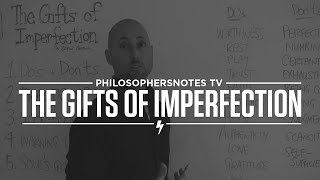
Brian Johnson summarizes Brené Brown’s The Gifts of Imperfection in this PNTV episode. The video presents Brown’s do’s (worthiness; rest; play; trust; faith; intuition; hope; authenticity; love; gratitude; joy) and don’ts (perfectionism; numbing; certainty; exhaustion; trying to be cool; fitting in; judgment; scarcity; self-sufficiency). Central themes include practicing wholehearted living (courage, compassion, connection), starting from worthiness (“I am enough now”), moving from perfectionism to ‘good-enough’ striving, the risks of sacrificing authenticity for safety (linked to anxiety, depression, addiction, rage, blame, resentment, inexplicable grief), and the distinction between happiness and cultivated joy (the “soul’s good mood”).
Chapters
Hi, this is Brian. Welcome back to another episode of Philosopher's Notes tv. Another great book today, the Gifts of Imperfection by Brene Brown. We've got a handful of my favorite big ideas pulled from this note, which pulled my favorite ideas from the book. We've also have a long list of do's and don'ts of wholehearted living that we're going to talk about today. Excited about that, Brene Brown. Yesterday we worked on and talked about her other great book, Daring Greatly. Hope you enjoyed that. Daring Greatly. Wholehearted Living. This book, the Gifts from Perfection, came out before that one, and she talks about the aspects of wholehearted living in more detail. So we're gonna talk about that a little bit more today. I'll put the links to her TED talks below. Hope you enjoy. So do's and Don'ts. Brene, as I mentioned yesterday, is one of the world's leading shame and vulnerability researchers. When she was studying shame and resilience, etc. She discovered a group of people who had qualities that she admired and they lived wholeheartedly. Wholeheartedly. Not half heartedly, wholeheartedly. And she started documenting their do's and don'ts. This is her first pass at it. She came up with this do's and don'ts. You want to live wholeheartedly? Well then these are the words that come to mind and came to her, came through in her research ideas like worthiness, rest, play, trust, faith, intuition, hope, authenticity, love, gratitude, and joy. The do's of wholehearted living. What about the don'ts? The don'ts of not well, the dots of wholehearted living which are not going to help you achieve wholehearted living include perfectionism, numbing certainty, exhaustion, being cool, fitting in judgment, scarcity, and self sufficiency. Now the book is basically all about what she calls her guideposts that help us apply and practice these ideas. We obviously don't have time to go into all of them right now, but the basic starting point is worthiness. Worthiness. I am enough now, Period. Not when I get to some point in the future which is never going to arrive, but right now, no matter what I get done today, some of which I'll be proud of, some of which I won't be proud of. I am enough right now. Worthiness. It's a hallmark of living wholeheartedly, which is juxtaposed with perfectionism, which we'll talk about a little bit later when we talk about this. Good enough. We rest. We notice when we're tired and we rest. We don't Numb ourselves with continued work and activity or jumping around and flitting around online or watching tv. That just numbs us. We rest, we recognize, wow, it's not that I work too hard, it's that I don't recover enough. So I'm going to rest actively. Which we've spent a lot of time talking about in recent notes. Wholehearted people play. They trust, they have faith, they trust their intuition, they have hope, which we talked about yesterday. They're authentic, which we're going to talk about today in warning labels. The risk of not living authentically. And of course love and connection is a huge part of a wholehearted person's life. Vis a vis self sufficiency. The half hearted or less than happy optimal individual isn't connected. They think they need to be self sufficient all the time. They're disconnected, they're alienated again. The three ideas we come back to again and again in Brene's work are courage, compassion and connection. We have the courage to express ourselves fully. We're compassionate. We realize that everyone is struggling. We can share in their pain and that allows us to connect. There you go. Quick, super quick. Look, the do's and don'ts. Wholehearted living now. How do you cultivate the do's? If I want more of this in my life, what do I need to do? How do I do that? Well, you need to practice again theme that comes up again and again and again. If you want anything in your life that you don't have at the level you'd like, what do you need to do? You need to cultivate and practice developing it. Not complicated. She's got a beautiful way of describing that. Practice, practice, practice, practice, practice. You want to be more courageous or you want to rest more, you want to play more, you want to feel more worthy? Practice those things. It's just like a muscle you go to the gym to work out. You need to practice and then practice some more. One of the things you want to practice, I would suggest is becoming a good enough ist. I am a recovering perfectionist, if you like me, used to think and still at times think that everything needs to be perfect. You need to be perfect. That to remind you, falls up on the don't side of the column. And I should also say that Brene, in her awesome, courageous authenticity and vulnerability says that when she created these lists, she didn't even want to look at it because she fell here. She was not in the do's part, she was in the don'ts part. And this is what led to her Breakdown that she talks about spiritual awakening. But she realized that her research showed her that she was kind of doing it all backwards and she needed to go do the work so that she could practice, so she can move from here to here. Anyway, if you are a perfectionist, you want to think about becoming a good enough ist. We want to start with worthiness, realize we're never going to be perfect, and become a good enoughist. Talbin Shahar wrote a whole book on this called the Pursuit of Perfect. We've got a note and a PNTV episode on that. He says that it's really healthy to strive for excellence, to go for it. But there are actually two forms of perfectionism. There's a less healthy expression of it and there's a more healthy expression of it. So when you're going after excellence, you can be what he calls an optimalist. If you're going after perfection, which is impossible, you are a perfectionist. Perfectionism is tied to everything we don't want in our lives. Anxiety, depression, etc. Tal says the key difference between an optimalist and a perfectionist is the optimalist knows they're never going to be perfect. They're able to deal with what he calls the constraints of reality. They know they're never going to be perfect. They see their ideals as guiding stars, not distant shores. When you have that attitude, you can start from worthiness because you know you're never going to be perfect, yet you have these high aspirational ideals you're going for. But they're guiding stars, not guiding stars, not distant shores. Huge, huge idea. Check out those notes, that note in that TV episode. If you're feeling it good enough, that's what we want to be. And we want to look at some warning labels that Brene suggests we should be born with. I'm going to share this warning label with you. She says this again. She says that we should be born with warning labels. Kind of like what goes on cigarettes, right? She says caution. If you trade in your authenticity for safety, you may experience the anxiety, depression, eating disorders, addiction, rage, blame, resentment, and inexplicable grief. I'll repeat that caution. If you trade in your authenticity for safety, you may experience the anxiety, depression, eating disorders, addiction, rage, blame, resentment, and inexplicable grief. The trade there was authenticity for safety. We need to dare greatly. We need to embrace the gifts of imperfection. And as she says, the subtitle is let go of who you think you're supposed to be and embrace who you are. Be authentic, which comes from the root of the same word that author comes from. So to be authentic is literally to be the author of your own life, to write your own story. You're authentic. You're authoring, you're writing your own story. That's a huge idea. Warning labels. When we're not being authentic, we are putting ourselves at great risk. Alright? And the final big idea here is soul's good mood. Soul's good mood. So Brene talks about the difference between happiness and joy. And she talks about the classic Greek roots of the word, which I'm not going to go into the details on right now. But happiness basically came from a Greek word that symbolized or represented kind of a state. So you might be independently wealthy and you can afford luxuries and stuff. That was happiness. Or you might come into good fortune and you're just stoked you can do whatever you want. That's happiness. Joy, on the other hand, was cultivated. Joy, they said, was the good mood of the soul. The good mood of the soul. And it wasn't a beginner's virtue. It was something that you had to work on. You had to practice day in and day out, month in and month out, year in and year out, decade in and decade out. And you learned how to experience joy. The good mood of the soul. I just love that concept. And they also say that the opposite of joy was not sadness, it was. It was fear. When we truly cultivate this perspective, there's a fearlessness that comes in. We get the bigger game we're playing. We're able to live in this do category. We start from a place of worthiness. We know that it's only through daring greatly, which involves falling down again and again and again, that we can ever actualize our potential. So we embrace the things we used to be afraid of. We embrace mistakes. We know we're going to fall down and we know we have the ability to get back up. So there you go, the gifts of imperfection. Super quick look. Do's and don'ts. Practicing is what it's all about. Mastery. Moving from theory to practice. Good enough is much better than a perfectionist. Warning labels. Being inauthentic is dangerous for your health and the soul's good mood. Joy is happiness. Oh yeah, I got something going on in the particular moment. Then there's joy. I cultivated this ability, this presence, to live wholeheartedly and to love my life. A soul's good mood. Well, there you go. That was fun. Covered a lot in a short period of time. What was the one big idea that jumped out of you. Did something jump out and land? Think about that and think about how you can apply that particular idea more in your life. Starting today. Alright. Hope you dug it. Look forward to sharing more with you soon. Have another awesome day. See you.