PNTV: The Happiness Track by Emma Seppälä (#369)
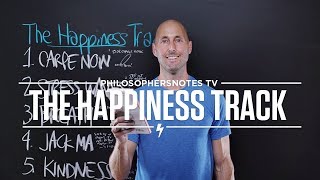
Brian Johnson (Philosopher's Notes / PNTV) summarizes Emma Seppälä's The Happiness Track (video published Jan 31, 2018), extracting five practical "big ideas": 1) Stop chasing the future — cultivate present-moment focus ("carpe now"); 2) Step out of overdrive — alternate activation and recovery and build resilience to "ride stress waves"; 3) Use diaphragmatic breathing (emphasize longer exhales) to shift from sympathetic to parasympathetic arousal; 4) Reinterpret failures as learning (Jack Ma, J.K. Rowling examples) to support grit; 5) Kindness and compassion are wired to increase well-being (charity/giving studies). The episode combines book takeaways with actionable practices (breath counts, recovery routines) and links the science of happiness to accelerated success.
Questions this video answers
January 31, 2018.
About $25 billion.
Approximately 400 million copies.
Inhale for 6, hold for 1, exhale for 8 (repeat).
Chapters
Hi, this is Brian. Welcome back to another episode of Philosopher's Notes. TV Today, another great book, the Happiness Track by Emma Seppala. The Happiness Track Subtitle how to apply the science of happiness to accelerate your success. Emma Seppala is the head of Stanford's center for Compassion and Altruism Research, which is extraordinarily cool in its own right. And she basically tells us there's a science to happiness that leads to our success. Unpacks it in this great little book, which I very much enjoyed. I'm a huge fan of the Science of well being, as you know, if you follow much of my work. We have dozens of the best books on the science of well being profiled in our Positive Psychology section. We've got a class on positive psychology 101 you might enjoy. Check that out at Optimize Me Psychology. I think it's the URL. If not, I'll make sure it is. Anyway, we got a philosopher's note with a bunch of my favorite big ideas and five of them here. Let's jump in. First big idea is from the first chapter of the book, which is called Stop Chasing the Future. Stop chasing the future. What should you do? You should carpe. Now we talk about carpe diem, carpe punctum, carpe momentum, all these different ways to get into the moment. And Emma starts her book off with the fact that, look, if you're constantly chasing the future, now, of course, we want to have ambitious goals that really fire us up. Here's our awesome, big, hairy, audacious goal that inspires us. Fantastic. We want to have that, and then we want to bring ourselves into the moment. And she says there's a science that demonstrates unequivocally the truth of carpe diem, of seizing the day, seizing the moment, carpe punctum, carpe momentum. However, we want to describe in style, being 100% right here, right now, in pursuit of goals that have meaning for us, but not always living in the future and never enjoying the moment that then we're not here. We're neither going to be happy or inflow and productive and creative and experience the outcomes we want to see. So hold your big goals, get fired up about them, run them through the whoop analysis that we talk about all the time, right? Make sure they're challenging, meaningful and doable, and then put yourself in this moment and remember, carpe diem, seize the day really means in its Latin translation, it's more accurately translated as pluck the day. You don't need to grab it like it's going to be taken from you. Pluck it like a piece of ripe fruit from a tree and then enjoy it. Be here right now in this moment. That's our number one idea from the first chapter. Carpe now. Second big idea is from the second chapter. So if we want to stop chasing the future, which was the subject of the title of the first chapter, the second chapter was called Step out of Overdrive. So too many of us in pursuit of success, we're living at that red line, right? So two aspects here of stepping out of overdrive. We've talked about the need to oscillate many, many times, right? We want to go like this. We don't want to live at this constant state of on. That is not going to work for us. We want to ride the. The stress waves is how Emma Seppala describes it, right? And it's in two functions. We want to step out of overdrive as it relates to always being on and not baking in enough recovery. And then she says we want to get really good at cultivating our resilience. So the scientific definition of resilience is essentially our ability to bounce back. How quickly can we recover from a stress. Kind of like Marcus Aurelius equanimity game, right when he got knocked off center, which will happen. We don't need to be stressed about that. See how fast you can get back. See how fast you can get back. That's the essence of resilience and literally making it a game. And the only way you can do that is if you're able to step back outside of that and see what's going on and then choose our wisest response as we cultivate that and learn to ride those stress waves as mindfully as we can. And again, you can't do that if you're constantly on. And remember, you want to be on, you want to be off. And off is not checking your email or checking the latest push notification or reading news. Off is going for a walk, hanging out with your family, and quiet, no smartphone time, going for a hike, meditating, petting your dog, whatever you can do to really, really recover so you can ride those stress waves as well and optimally as you can. We're not trying to get rid of them. We're trying to ride them as gracefully as we can. The third big idea is one of the most powerful ways we can do that, which is our breath. Now, again, at Emma's research center at Stanford, they do a lot of work on compassion and altruism and mindfulness and One of the key ways that we can handle the barrage of stress that's coming at us that puts us into these stress waves of the sympathetic system being turned on. Our fight or flight system is basically always on. We've used the metaphor of the fact that we evolved to deal with one lion in a jungle at a time. But these days, it's as if the entire jungle is roaring at us all day, every day. We experience more stimuli in the span of something like a week than our ancestors did in our entire lifetime. We simply didn't evolve to manage the onslaught of information. And a huge percentage of that information is not positive. We just didn't evolve to handle that as well as we could. How do you deal with that? A lot of different ways, but you need to get out of the sympathetic into the parasympathetic you. And the fastest way to do that is via your breath. So Emma talks about the same thing we talked about with Barbara Fredrickson in Love 2.0. Your breath stimulates your vagus nerve, right? The wandering nerve that connects your mind, your brain, and your heart and your gut. And simply training yourself to breathe properly, which is deeply into your diaphragm. Inhaling slowly, exhaling slowly, rhythmically. And Emma stresses emphasizing the exhale. Exhaling longer than your inhale is one of the most direct ways to flip the switch from your sympathetic to your parasympathetic. To calm your brain and your body and have that sense of energized calm, calm energy. That's what we want to have. And our breath, again, is our strongest vehicle to that point. It's literally like flipping a switch, decreasing your heart rate and increasing your calm. So, again, we've talked about different breath counts. Find one that works for you. My favorite is inhaling for six, holding for one, exhaling for eight. In for six, holding for one, exhaling for eight. That works for me. Find a rhythm that works for you, and then walk it in. It's my practice. It's what I do in all my meditations. It's what I do whenever I'm taking a nap. Start that. Do five repetitions. It's before I go to sleep. I have this almost like an anchor slash security blanket, if you will. Trigger cue to relaxation. That's both a psychological trigger and also a very powerful physiological trigger for me now to really slow down, shut my mind off, and to drop out of an intense mode into a relaxed mode. Become really good friends with your breath. Ride these stress waves. Well, our fourth big idea is Jack Ma. You might have heard of Jack Ma. He is, at least at one point was the wealthiest person in China. But before he became this uber 25 billion dollar plus worth entrepreneur, he experienced a ton of failure in his life. And Emma kind of puts him up as an exemplar, finding success in failure. And she has a great passage from him where he describes the fact that with all the failures that he experienced, he had the experience be a success. And that might sound, you know, nice and intellectually satisfying. Yeah, you want to find success in all experiences, even failures. But get this, Jack Ma, again, we look at him and we think, wow, this guy's super successful. He's worth $25 billion. Wealthiest person in China. Amazing. But get this. He failed his entrance exams to university twice. Then he finally got into the university, graduated, applied for dozens of jobs, got rejected, finally got a job as a translator, being paid next to nothing. And then he wound up getting assigned to some project in the States. He came up with an idea for a startup. He failed twice, drove two companies into the ground, but he didn't give up. Throughout all of this, he saw the experience whether it was a failure or not. A lot of his experiences as a young man were failures. He saw that as success. He was learning, right? That win or learn attitude, again, very easy to intellectually get. Much, much harder to put yourself out there and to fail again and again and again. But to find the experience that allows you to get a little bit better the next time around and continue to pursue it growth, mindset, style. We want to train that. In the note, I quote J.K. rowling. She was rejected I don't know how many times for the Harry Potter series, but it was a lot, a lot more times than most people would endure. And guess what? She's now sold 400 million copies or something absurd like that. I'm rereading her books now with my son, Emerson. Unbelievable. And to imagine that that almost didn't come to fruition. A crazy number of publishers rejected her, yet she kept on persevering. We want to find that as we move forward. Which leads us to our next big idea. One of the sources of grit is kindness. Emma makes the point. And again, her lab is all about compassion and altruism, that we are wired for kindness. And she shares a number of really inspiring research studies on this. Here's a couple of them. So one of them is bring people into a lab, put them into an FMRI or whatever, and measure their brains, right? What you'll see is you can light up their pleasure Centers by basically giving them money and watch their brain. Boom. Pleasure center. Awesome. Thank you. And you can have them watch a charity getting money. Boom. Same pleasure center lights up for someone else. A charity receiving money. That's amazing. We are wired for compassion. To experience someone else's gain in the same way we experience our gain. And she shares another study. Bring people back into a lab. This time, give them some cash and give them two options. One group spends the money on themselves. The other group gives the money or spends the money on someone else. Guess what? This group that spent the money on someone else is happier than the group that spent it on themselves. Again, we are wired for compassion. So as we strive to optimize and actualize our potential, let's remember why we're doing so. Such that we can give our gifts in greatest service to the world. Enjoying the process but knowing that our ultimate success is tied to this level of kindness. And you go back to the grit that Jack Ma demonstrated. And you go to Angela Duckworth. Her four ideas of how to scientifically build grit. We had the passion, we had the practice. And then we had purpose. The purpose is something bigger than you connect to something bigger than you. Especially in the times where you're feeling stressed. Think about the individual or group of people for whom you are committed to to actualizing. That's what it's all about. Remember, we are wired for kindness. Find a way to give yourself to the world a little bit more today. Or maybe just go give a hug to someone you love right now. Remember Jack Ma? Literally. The guy went from failure to failure to failure to failure to failure. Winds up this extraordinary success. Failed his entrance exams to university twice, was rejected from dozens of jobs, drove two startups into the ground and created $25 billion of wealth afterwards. That requires a growth mindset and truly finding the lessons in each experience, whether they're a success or failure. We talked about the stress waves and your breath. The best way to navigate stress is to connect to your breath. Literally. Flip the switch off your sympathetic into your recovery parasympathetic mode. One deep diaphragmatic breath through your nose at a time as you carpe. When? Now. Quit manically going after the future, stressing yourself out. Have your big goals bring yourself back to this moment. Carpe now. Pluck that wonderful, delicious fruit that is the present moment today. And make today another awesome day. I hope you enjoyed. Look forward to sharing more soon. See ya. Isn't it a bit odd that we went from math to science to history but somehow missed the class on how to live. For some wacky reason, optimal living 101 never made the schedule. Of course it's too late to go back and change that and you're too busy to read full time to catch up. But if you're like us, you're all about optimizing your life so you can actualize your potential. So imagine this. Imagine having someone read the best books on how to optimize your life and pull out the big ideas that can really change your life. You know those sections? You underline an asterisk and mark all up. Then imagine that guy me connecting those awesome ideas to other great books and helping you actually apply the wisdom to your life today. Well, that's what I do with something we call Philosopher's Notes where I've distilled hundreds of great books into 20 minute super practical summaries. Then imagine me taking the absolute best big ideas from those great books and sharing them with you in hour long Optimal Living 101 classes on everything from productivity, purpose and confidence to nutrition, goal setting and conquering procrastination. Helping you optimize every facet of your life so you can actualize your potential. You've got a personal trainer. I'm kind of like your personal philosopher. Ancient wisdom, modern science and practical tools. That's what our Optimized membership program is all about. If you're feeling it, we'd love to have you join us.
More from Brian

Heroic +1: What’s THE Most Creative Act in the Universe?: Turning Around Glitches (#2024)









