PNTV: The Little Book of Talent by Daniel Coyle (#254)
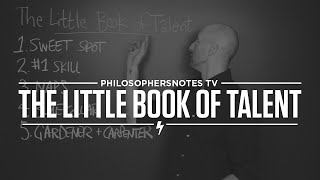
Brian Johnson summarizes and reflects on Daniel Coyle’s The Little Book of Talent (52 tips). He presents five core ideas for improving skill: staying in the ‘sweet spot’ of stretch, daily short practice (‘snacks’), deliberate recovery (naps), a blue-collar ‘show up’ work ethic, and the gardener/carpenter metaphor for patient planning plus disciplined action. The video ends with a short promotion of Johnson’s Optimal Living membership (PDFs, audio, and classes).
Chapters
Hi, this is Brian. Welcome back to Philosopher's Notes TV Today, another great little book, the Little Book of Talent by Daniel Coyle. The Little Book of Talent Daniel Coyle Subtitle 52 Tips for Improving your skills So I love Dan Coyle's the Talent Code where he describes the power of myelin, which is kind of like the insulation for our neural superhighways that helps our messages go faster, which is the key component to our talent level, our skill being cultivated. He wrote a whole book on that where he studied the different hotbeds that create just extraordinary world class performers and, and this book is a compliment to that book. So I reached out to Dan and said, hey, I'd love to interview you for our podcast. He said, that sounds great. We were setting up an interview and I realized I hadn't read this book. So I set it on my desk Saturday evening, went partying Saturday evening, which for me is going to bed at 8pm, woke up at 4am and I read this book before the family woke up and loved it. So 52 tips, really concise, practical stuff that we can apply right now on how to cultivate our talent, our skill, etc. Philosopher's note, bunch of big ideas. I've got a prop today, very excited about it. I'll share that in a moment. Five big ideas here. Let's jump straight in. The first big idea is the sweet spot. So most of us know at this stage if we've studied much of the work on the research and cultivating talent, and that we need to put in a ton of practice. The phrase is deliberate practice, not just any practice. You've got to put in deliberate practice. And Dan helps us understand how to discover what it means to deliberately practice. We can't just be going through the same motions, right? If we do that, we're hanging out in our comfort zone. We're just doing what we're really good at, right? He says when we're hanging out there, you succeed like 80% plus of the time. You're not going to cultivate your skills if all you're doing is doing what you're already good at. You've got to stretch yourself. He says you want to move out of your comfort zone and into what he calls your sweet spot. Your sweet spot is right at the edge of your current ability. You're stretching, you're reaching and you're succeeding about 50 to 80% of the time. Now beyond that, if you go too far, you're going to go into what Dan calls our survival zone. Right at the survival zone. You're succeeding less than 50% of the time. You're just kind of reaching too far. You're guessing, right. And you're kind of getting lucky once in a while. That's your survival zone. You don't want to play there, and you don't want to play in your comfort zone. You want to stretch to the edge of your abilities and hang out in your sweet spot, intensely focused, right? 50 to 80% of the time you're succeeding, etc. That's your sweet spot. Another way to think about it, I like to use the metaphor of a rubber band, right? So if we have a rubber band that we're stretching between our fingers, if you don't stretch it at all, it's just kind of sitting there, no tension at all. That's your comfort zone. You stretch it into your stretch zone or your sweet spot, in Dan's phrase, right? And then if you stretch it too far, it will snap. Talmon Chihar describes goal setting the same way. He says you need to get out of your comfort zone into your stretch zone. He says the area beyond your stretch zone where you pull too hard is your panic zone. Right? Panic zone, snap zone, survival zone. We don't want to go too far right at the edge of our abilities. 5% further is one way. We described it in a recent episode on Steve Chandler's Crazy Good sweet Spot. It's the essence of deliberate practice. That's our first big idea. Second big idea. He says that when you are practicing, it's better to practice intensely for five minutes a day than one hour a week. You want to snack. That's better than binging. Your brain develops incrementally, and it's much better to feed it a little bit every single day than it is a lot. Once a week. Then it's always playing catch up. Oh, I forgot that was important to you. You told me again, but I forgot. You want to consistently nurture whatever skill that you want to develop is part one of this idea. The other part is getting good at practicing in and of itself is a skill. And he says that's perhaps the most important skill, right? Is actually showing up and creating time in your day to. To practice and then to practice appropriately. Hanging out in your sweet spot, getting good at being able to do that is possibly, and I would argue is the most important skill. It's what I'm most focused on right now, creating masterpiece days. How do I figure out when my energy is best, how I can put myself in the position to stretch myself and operate from my sweet spot as often as possible. Right? So remember that a top skill is, is getting good at how to practice and doing so consistently. And remember too, snacks are better than binges. Third, big idea. Assuming that you're stretching yourself right, you're not just hanging out in your comfort zone. We also need to recover well. He says one of his favorite ideas is the fact that if you look at professional athletes and professional teams, you'll see that they're also professional nappers. We've talked about this in a ton of our sports books, from Michael Phelps, who takes a nap, to gsp, who takes a nap making waves. I'm going to keep on drawing this making waves. We go on hard and then we recover. We go on and then we recover. Naps are a great way to do that. I support or cite some research that supports this. Some great human beings across history have napped from Einstein, da Vinci, et cetera. And the science proves that even six minutes. Research out of Harvard has shown that that even a six minute nap significantly improves your memory and other cognitive performances. It's pretty good reason. And I keep on bringing this up because I got to remind myself to do it. I feel great when I do it, but sometimes days just get by and I forget to do it. So there we go. Note to self nap more often. Fourth big idea is to go blue collar. Dan quotes an artist. I think it was Chuck Close who says, inspiration is for amateurs. Inspiration is for amateurs. Professionals show up. This is Steven Pressfield's turning pro idea. We need to approach our work of creating talent, cultivating our talent like we're blue collar workers and just show up. Doesn't matter whether we're inspired or not. Show up what needs to get done today. That's what you're going to go do. Here's our prop. Now, you probably can't see this. I'm not sure if you can see this little Lego piece. If you're listening to the podcast, you definitely can't see it. But I am holding in my fingers here a tiny little Lego piece that came with my son Emerson's construction Lego set, right? And it's a lunch pail. Now this for me represents perfectly what the blue collar mindset is all about. I have this perched in my office on the windowsill so I can stare at it all day long and remind myself, this is it. Page. Pack your lunch, get to work. Inspiration is for amateurs. Today, what needs to get done and show up diligently, patiently, persistently. My father worked in A grocery store for my child. He worked in a grocery store for 39 years. Fifteen of those maybe he spent in a supervisorial role. But for the majority of his life, he showed up six days a week blue collar and ran a produce department and taught me the value of an incredible work ethic. So I just love the idea of, of showing up with a blue collar mentality. That's our fourth big idea. Fifth one is to think like a gardener, but to act like a carpenter. Think like a gardener, act like a carpenter. Dan says he picked this up at a hotbed called Spartik. Not sure if that's how you pronounce it, but a Russian hotbed. Now I don't remember the exact stats, but this place in Russia, tiny little place, has produced more top 20 female tennis players than basically all of the US in a certain period or whatever. But suffice to say they've created a ton of elite performers. And it's kind of a ramshackle place where they just crush it. And one of their mantras is think like a gardener, act like a carpenter. What does that mean? A gardener thinks with a long term perspective. Patient, non judgmental. They're measuring things on horticultural time, not clock time. They're not looking for instant results. They know that things take time. Certain things are out of your control. They're thinking like a gardener as they're cultivating their skills, but they're acting like a carpenter. How does a carpenter act? A carpenter acts like our last big idea, like a blue collar work ethic. They show up every day. They steadily, consistently do what needs to get done as precisely as they can, strategically creating something where they see how the individual components fit into the whole. That's what we want to do. Think like a gardener, think on horticultural time with patience and non judgment on how we're doing, and then act like a carpenter. Showing up diligently, patiently, persistently, day in and day out, seeing how each little thing that we're building is leading to us architecting a much grander whole. So there you go. Gardener, carpenter, blue collar, Lego piece, lunch pail. This is also what's on Steven Pressfield's Turning Pro. On the COVID of that is a lunch pail and a coffee mug representing exactly this idea. Naps. They're huge. Get on that. Six minutes can boost performance. Number one skill is getting good at practicing both showing up consistently and building that habit and doing so properly, playing out in your sweet spot, which is right in between your comfort zone, your survival zone. Stretch yourself at the edge of your abilities, but don't go so far that you're grasping and snapping and panicking. That's a really quick look at the Little Book of Talent. I'm looking forward to interviewing Dan and sharing that as well. I hope you enjoyed what was the idea that jumped out at you? Lean into that and this book is awesome. If you're looking for some really cool inspiration, both to improve your skills and also as a teacher or a coach or someone who's interested in helping others cultivate their talent, I think you'll love it. I look forward to sharing more soon. Have another awesome day. See you. Hi, this is Brian. I hope you enjoyed that PNTV episode. A lot of people don't know all the stuff I do beyond these free videos I share on YouTube, so I thought I'd do a quick video to give you an overview of our membership program that you can get access to and get a ton of other stuff. So here's a quick look. 10 bucks a month Join the Optimal Living Membership Program. You get instant access to 250 philosopher's notes on some of the best Optimal Living books out there. Old school classics, Positive Psychology, Modern Stuff, Mindfulness, Peak Performance, Purpose, Neuroscience, wealth, et cetera. And what you may not know is that in addition to the PNTV episodes, I create PDFs on all these great books. So six page PDFs. Let's take a look at one of them. Joseph Campbell, you want to figure out how to live your hero's journey? Well, this is a great place to start. I basically pull out my favorite big ideas, riff on them, connect them to other books and other ideas and help you apply this wisdom to your life today. That's what the PDF looks like. Again. We have 250 of these on all these different great books and then I record those PDFs as an MP3 so you can listen to that MP3 while you're on a walk or working out or doing some errands or whatever that is. Philosopher's Notes. A lot going on there and then in addition to Philosopher's Notes you get access to Optimal Living classes. Optimal Living 101 idea here is that all those great teachers come back to the same big ideas again and again and again. I distill those ideas into classes. Super practical, fun, inspiring classes ranging from Habits101, Confidence101, Getting Stuff Done101, Meditation101, instant access to all those classes and then Future classes include Relationships 101 Energy 101 Purpose 101 Business Goals etc. Those are our full length classes. And then I create micro classes. Two to three to five minute little bursts of wisdom on my favorite great ideas from these great books across the domain that you want to optimize in your life. So we have dozens of these so far. I create 50 new micro classes every month and 10 new philosopher's notes every month for 10 bucks a month. So we're blessed to have thousands of members who are enjoying the program and sharing some incredibly kind words with us. And super simple. 10 bucks a month. Cancel anytime. Would be honored to be a bigger part of your life and I appreciate your support. And here's to optimizing and actualizing.
More from Brian

Heroic +1: What’s THE Most Creative Act in the Universe?: Turning Around Glitches (#2024)









