PNTV: The Mindful Athlete by George T. Mumford (#232)
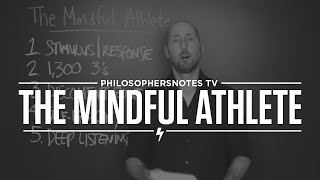
George T. Mumford teaches mindfulness for peak performance through five core ideas: the gap between stimulus and response, intention, deliberate practice, the discomfort zone, and self-efficacy. Kobe Bryant made 1,303 shots a day through deliberate practice. Mumford worked with elite athletes to turn mindfulness into concrete performance gains.
Chapters
Hi, this is Brian. Welcome back to Philosopher's Notes tv. Today, another great book, the Mindful Athlete. The Mindful Athlete by George Mumford. Subtitle Secrets to Pure Performance. So, the Mindful Athlete. Now we all know that, that Phil Jackson is the Zen master coach. But do you know who Phil called on when he wanted to get his players minds right? George Mumford. George Mumford is extraordinary. He's got a great personal story. Super inspiring. He played basketball back in the day with Dr. J. He was a roommate of his at the University of Massachusetts. Got injured, got addicted to drugs, hit rock bottom and then he came out of that through a practice in mindfulness. Jon Kabat, Zinn and a number of other leading meditation teachers became his teachers. And when Phil Jackson needed some support, George Mumford is the one who came in, worked with Phil and Jordan and the Bulls and then with Phil and Kobe and the Lakers and with thousands of athletes. In the book he distills his top big ideas on how to integrate what he calls the five superpowers. So he integrates Buddha's eight fold or eight noble truths rather into what he calls the five superpowers. Awesome book. Philosopher's note, bunch of big ideas, five of them here, plus a prop, pretty exciting rubber band. But this is a great introduction to mindfulness in general. It's way bigger than sports. So if you've been looking for a great intro, this might be it. Particularly if you're into sports or if you have a significant other who might be very into sports and not so into mindfulness, this might be a good avenue for, for them to engage in the subject. So let's jump into our five big ideas. We're going to start with stimulus and response. So the whole idea behind mindfulness is the ability to choose our response. So Viktor Frankl says that between a stimulus and a response, between the stimulus and response. So you've got your stimulus, you've got your response. Right here is a speed and it's in that space where our freedom and our growth exists. And what we want to do is stretch that space so we can actually step inside and choose the most empowered response. George tells us that if we're mindless, we just react, right? So stimulus, response, there's no gap, we just knee jerk react to whatever happens to us. But when we become more mindful, we respond and we're able to stretch the space between stimulus and response. That's one of the primary benefits of sitting in meditation. You observe your thoughts arising and you bring your attention back to your anchor you do that enough times, you do that thousands and tens of thousands of times. When you sit for 10, 15, 20 minutes for months and years, you get really good at stretching out this space. And then you have response ability. You can choose your response rather than mindlessly reacting all the time. It's a huge idea. He talks about it too metaphorically, as if you're in the eye of a hurricane or a cyclone. A hurricane can be blowing everything around with gale force winds, but in the center there's an eye that's clear and still that's where we want to be. That's the difference between reacting, being thrown around by the hurricane and responding, being centered and ground in the middle of life's storms. Huge idea. Second big idea. Here is another big one. 1303 pointers. 1303 pointers a day is what Kobe Bryant shot. No, it's what Kobe Bryant made every single day in the off season when he wanted to become a better three point shooter. So George talks about the power of intention and how important it is for us to have an idea of what we want to see come to fruition in our lives. Elite performers, mindful athletes, know what they want and they know that they can have pretty much anything that they want. They believe that, which is self efficacy that we're going to talk about in a second. But they also know that they have to be willing to pay the price. They can have whatever they want if big, if they're willing to pay the price. So for example, Kobe Bryant wanted to be a better three point shooter. He wanted to be the best three point shooter he could be. So what did he do? He got a clear intention. He knew he could do it if he was willing to pay the price. He decided that the price he'd pay is he would make 1300 three pointers every day during the off season. George says when he was working with him, that's what he was doing. Think about that for a moment. 1303 pointers made in one day. You can do the math on that and figure out how many you have to make per minute in order to do that. That's a lot of time. But he was committed. He wanted to be the best he could be and he was willing to pay the price. So the question is pretty obvious. We talked about it a little bit in the note. What do you want? What do you want in your life? Do you believe you can have it if you pay the price, what's the price you're going to need to pay? And are you willing to pay that price and then get to work. That's our second big idea. Third big idea is related to that, which is your discomfort zone. So your discomfort zone. Here's your comfort zone. Here's your discomfort zone. Comfort zone. Discomfort zone. George tells us if we want to grow, we need to play here in the gap between our comfort zone and our discomfort zone. We don't need to go nuts. We don't need to blow through our discomfort zone and try to get here. We just need to take a little step outside of our comfort zone. And the way that we talk about it in the note is imagine a rubber band. I've got a rubber band between my fingers that you should be able to see. Now, if I just leave it like this, there's nothing going on with the rubber band, right? But if I stretch it, that's my comfort zone. It's just not doing anything. If I stretch it a little bit, there's some tension there that's challenging me to move forward. Now, if I keep on pulling this rubber band, which I'm not going to do, but if I kept on pulling it all the way up here, it would snap. So when we look at our goals, we want to model this. We want to stretch our rubber band enough so we're stretching, but we don't want to pull it so hard that we're snapping. That's not a fun experience. You move from what he calls eustress healthy stress to distress. Snapping a rubber band in your face isn't fun. Burning yourself out because you have too big of goals isn't fun. And he says the true mindful athlete gets that. They realize that they just need to make incremental gains. But if you do incremental gains over a long period of time, you have extraordinary gains. That's the compound effect. It's the slight edge. It's everything that we talk about in these notes. That takes discipline, that takes maturity. That takes what he calls the middle way. You're not trying to go nuts and you're not staying in your comfort zone. You're incrementally getting a little bit better via deliberate practice, which is what Kobe engaged in when he was hitting his 1300 three pointers a day. That's our third big idea. The fourth one is self efficacy. We've talked about this a number of times in our Confidence 101 class. I went off on this. It's science speak for self confidence. Elite performers in any field, whether it's athletics or anything else, parenting, business, creativity, art, whatever, these individuals have a high degree of self efficacy, a high degree of self confidence, a high degree of trust in themselves that they can achieve that which they aspire to achieve. Henry Ford put it most simply. Whether you think you can or you think you can't, you're right. We need to cultivate our self efficacy and know that we can achieve whatever we want to achieve for almost everything. Again, we're not talking about becoming 8ft tall. We're talking about things that are in line with who you are and who you want to become, if we're willing to pay the price. So check in on your self efficacy. I'll put a link to the Confidence 101 class and overview. If you're a member, check that out. My top 10 big ideas on how you can create indestructible trust in yourself. Powerful stuff. 5th Big idea is deep listening. Deep listening is a great phrase. He capitalizes the D and the L. Deep listening, he says, what are you here to do? All great performers have an incredibly clear purpose. They know what their charter is in life. They know what they're here on the planet to do. We need you to have that level of clarity. In the note, I talk about Jon Kabat Zinn, who is George Mumford's mentor. Jon Kabat Zinn says, what's your job with a capital J? Your job with a capital J. What do you love to do so much that you would pay to do it as you give your greatest gifts and greatest service to the world? That's what I'm doing right now. It comes from a function of answering that question again and again and again. And both George Mumford and Jon Kabat Zinn say, if you don't know the answer. The issue isn't that it's that hard to find. It takes work. It's that you're not spending enough time in silence asking yourself the question. You've got to unplug from everything, all the distractions, of course, and all the positive stuff at times, and just spend some time with yourself. Asking yourself the question, what? What do I really want? All caps really want. If I could wave a magic wand and create my ideal life, what would it look like? How am I going to use my greatest gifts and greatest service to the world? What's my job with a capital J? That requires deep listening, which requires mindfulness and insight and concentration and trust, which constitute most of the five superpowers. So there you go. Listen to yourself. Know that you can do it. Be willing to play in your discomfort zone, but don't go crazy don't snap the rubber band in your face. Make incremental little gains. Just a little bit out of your comfort zone leads to some great stuff. I'm going to do a micro class on another idea from here. I'm not going to talk about now from time constraints, but it's really good. 1300 three pointers. Think of Kobe Bryant. 1300 three pointers in a day. Mumford says. If you want to master anything, you got to be willing to get up earlier than anybody else and put in thousands and thousands and thousands of repetitions. Way beyond the point where it's fun. But you're committed to something bigger than yourself. You've listened deeply, you know what you're here to do, and you're going to go pay the price and you're going to experience the joy in the process and in the benefits and the outcomes you see along the way. The final Big Idea the first big idea, rather, was stimulus and response. We want to stretch the space between something happening in our lives and how we respond. Quit reacting and start choosing a response that's optimal. It's a quick look at the mindful athlete. I hope you enjoyed and I look forward to sharing more with you soon. What was the big idea that jumped out at you? Think about that. Figure out how you're going to integrate it into your life more consistently, and remember to do some deep listening. All right? Look forward to sharing more. Have another awesome day. See you. Hi, this is Brian. I hope you enjoyed that PNTV episode. A lot of people don't know all the stuff I do beyond these free videos I share on YouTube, so I thought I'd do a quick video to give you an overview of our membership program that you can get access to and get a ton of other stuff. So here's a quick look. Ten bucks a month. Join the Optimal Living Membership program. You get Instant access to 250 members. Philosopher's Notes on some of the best Optimal Living books out there. Old school classics, positive psychology, modern stuff, Mindfulness, peak performance, purpose, neuroscience, wealth, etc. And what you may not know is that in addition to the PNTV episodes, I create PDFs on all these great books. So six page PDFs. Let's take a look at one of them. Joseph Campbell, you want to figure out how to live your hero's journey? Well, this is a great place to start. I basically pull out my favorite big ideas, riff on them, connect them to other books and other ideas, and help you apply this wisdom to your life today. That's what the PDF looks like again, we have 250 of these on all these different great books. And then I record those PDFs as an MP3 so you can listen to that MP3 while you're on a walk or working out or doing some errands or whatever that is. Philosopher's Notes. A lot going on there. And then in addition to Philosopher's Notes, you get access to optimal living classes. Optimal Living 101 idea here is that all those great teachers come back to the same big ideas again and again and again. I distill those ideas into classes. Super practical, fun, inspiring classes ranging from Habits101, Confidence101, Getting Stuff Done101, Meditation101, instant access to all those classes. And then Future classes include Relationships 101, Energy 101, Purpose 101, Business Goals, et cetera. Those are our full length classes. And then I create micro classes. Two to three to five minute little bursts of wisdom on my favorite great ideas from these great books across the domain that you want to optimize in your life. So we have dozens of these so far. I create 50 new micro classes every month. 10 new philosopher's notes every month for 10 bucks a month. So we're blessed to have thousands of members who are enjoying the program and sharing some incredibly kind words with us. And super simple. 10 bucks a month. Cancel anytime. Would be honored to be a bigger part of your life and I appreciate your support. And here's to optimizing and actualizing.
More from Brian

Heroic +1: What’s THE Most Creative Act in the Universe?: Turning Around Glitches (#2024)









