PNTV: The Motivation Manifesto by Brendon Burchard (#267)
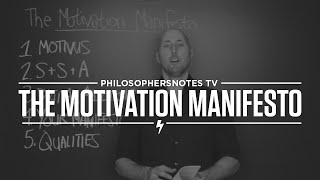
Brian Johnson summarizes Brendon Burchard’s The Motivation Manifesto and extracts five practical takeaways. He defines motivation (from Latin motivus = to move) and presents Burchard’s three-phase motivation process: spark (ambition + expectancy), sustain (attention + effort), and amplify (attitude + environment). Johnson emphasizes digital addictions as a major barrier to sustained motivation and echoes Burchard’s second declaration to reclaim one’s agenda. He also recommends writing a one-page manifesto (mission, plan, steps) and doing a eulogy/qualities exercise to clarify long-term values and translate them into daily habits. The video closes with a short membership pitch and pointers to related resources (Oprah Life class, Piers Steel’s procrastination research).
Chapters
Hi, this is Brian. Welcome back to Philosopher's Notes TV Today, another great book, the Motivation Manifesto. Motivation Manifesto by Brendon Burchard. Subtitle 9 Declarations to claim youm Personal Power Brendon Burchard is one of the world's most popular self development, slash motivational and business marketing experts in the world. He's one of the top 100 most popular public figures on Facebook. And apparently he has something like two times as many fans as Tony Robbins on Facebook. To put it in perspective, members have been recommending his books forever. I've been meaning to do a note on his books and then he and I connected last week. Decided now is the time. Philosopher's note, bunch of my favorite big ideas we're going to explore. A handful of my favorites. He's also got an Oprah life class coming up. Check it out. Sounds awesome. For now, five big ideas. The first one, motivation. What does the word motivation mean? Brendon walks us through a great description of and definition of motivation and then the process of how to spark, sustain and amplify your motivation, which is our second big idea, but starting with the root of motivation. I love the etymology of words. So motivation comes from motive, right? Motive is the reason for doing something. And motive comes from the Latin word motivus. Motivus, which means to move. So motivation is the engine for doing things.
Right.
What drives us compels us to take consistent action in pursuit of that which matters most to us, motiv us. We've got to move by cultivating our motivation. Now how do we do that? Well, Brendan walks us through three phases.
Of the motivation process.
First, we need to spark our motivation. Then we need to sustain our motivation and then we want to amplify our motivation. Spark, sustain and amplify. Each of those three phases has two components to it, right? So first you need to get going. Well, how do you do that? You do that through ambition and expectancy. Let's talk about that for a moment. Ambition and expectancy. So if you want to spark your reason for doing something, your motivation, you need to have ambition, you need to have desire, you need to be really excited about creating something. If you have a tiny little bit of ambition or tiny little bit of desire, you're not going to have strong motivation. You want strong motivation, you need to have strong desire. You have to have a strong want. I want that.
Right.
That's our ambition. Now, that's not enough though to spark motivation. You can want something, but if you don't think you can get it, if you don't have expectancy, then you have more of a hope or a wish, not deep grounded motivation. So you need to believe you can get that which you want so much. We talked about rethinking positive thinking. If you don't think that you can get what you want, then you either need to build your confidence such that you think you can get it, or you need to reduce that what you want and be able to match it with your confidence and then go to the next bigger thing after you've hit this other thing. But it's super important that you have both a strong desire or ambition and an equally strong expectancy or belief that you can have it. That's the spark phase. As we move through that, we get to sustain. So now you're fired up, you know what you want, you want it deeply and you believe you can have it. Awesome. How do you sustain it? You sustain it via attention and effort. Now again, it's easy to get fired up about something. We've all had a spark, fired up, going to do it, and then a week or two later we wonder what happened. I was so on fire about that. I actually thought I could do it. But then other things got in the way. Well, you need to sustain it, but by bringing it to your attention. Often anything you care about, you want to check in on all the time. In my interview and session on Grant Cardone's 10x rule, he talked about the fact that you need to have a healthy level of obsession if you really, really want something. And if you want to sustain your motivation toward it, you need to put your attention on it consistently. Which means write it down daily, reflect on it in the morning or in the evening, or both. But don't make it a New Year's.
Thing where you write about it on.
January 1st and forget about it until October 17th. You're not going to sustain motivation that way. You need to give it consistent attention. And of course you need to put in the effort. You need to take action consistently, day in and day out in pursuit of that which you aspire to have. If you want to sustain Motivation, attention and effort, two components to sustaining. And then in amplify we have two more components, attitude and environment. Attitude and environment. People who sustain high levels of motivation have high energy and enthusiasm and joy for life. They go for it and they work on that. Brendan goes off. He's ruthless about the fact that you need to take control of your mind. These things aren't happening to you. You're allowing positive or negative thoughts to dominate Your consciousness. You need to create an environment. Well, you need to create an attitude or an environment in your mind, right? That's positive consistently, and that takes hard work. Then you need to create an environment, both your physical environment that inspires you and the people around you who inspire you. He's also really intense about the people who kind of steal our dreams or want to steal our dreams or dissipate our energy by not believing in and supporting what we're up to. We need to take care of the our environment if we want to amplify our motivation.
So there you go. Quick look.
Spark, sustain, amplify. In the note, I talk about how that's similar to the procrastination equation by Piers Steele, who, as I've said before, won the Nobel prize equivalent in psychology for his meta analysis of all the research done on motivation. And he came up with his equation that motivation equals expectancy times value, which is exactly what we talked about here, right? Divided by impulsiveness times delay. We're going to talk about that more in our class on Procrastination 101, which is coming up this week, which could also be called Motivation 101. But for now, we're going to move on. Third big idea here is digital addictions. If we want to sustain our motivation, we need to notice how addicted we are to digital distractions. And again, Brendan, the second declaration. This book has nine declarations, right? The second one is that we need to reclaim our agenda. Reclaim our agenda. Too often we're just letting our days go. And he walks through the typical individual's day who's addicted to digital distractions. And he says, look, this is no different than an alcoholic who's addicted to the next drink or the gambler who's addicted to placing the next bet or whatever, right? So we need to realize that if we're waking up in the morning and the first thing we do is roll over and turn on our smartphones and check whatever emails or updates or whatever, just look at that and see. Are you addicted to that? Because if that's what you're doing, odds are you are. If you go through your day and you're kind of constantly being hit fed by those digital distractions, you can have a really, really hard time sustaining motivation. And in that equation, I shared on Piers Steel, we had impulsiveness. Impulsiveness is one of the best ways to destroy your motivation. Digital distractions and addictions are a cornerstone of that impulsiveness. So be honest with yourself. If you have an addiction, deal with it. We all have addictions in different ways. In the note, I joke about the fact that we all have that. And I work hard at creating bright lines so that I don't get taken over by these. And when I find myself being compulsive, I take a breath, I notice, and I choose a more constructive behavior, except when I don't. So we all do it. But let's optimize and get better. Fourth one is your manifesto. So he writes a manifesto, super intense style. And he challenges us to write our own manifesto. This. Think of a one page document, even just a few sentences. And he says, identify three things. Identify your mission. What is the mission? Spark your motivation. What's the mission that's going to guide the rest of your life? Write that down in a sentence or two. What's your plan? What's the high level plan that you're going to engage in in order to execute that mission? And then what are the steps you're going to take today? Mission plan steps. Super simple but super powerful. Challenge yourself to write that down. Mission plan steps. What is it for you? It's a good thing to look at. Bring attention to it consistently as you take consistent effort. Fifth big idea. What are the qualities by which you want to be remembered? What are the qualities by which you want to be remembered? Brendan asks us, hey, if you died tomorrow, what would you want people to say about you? And specifically what qualities and what words would you hope they use to describe you? It's an incredibly powerful exercise. And when I first started doing some coaching, one on one work like 15 years ago, this was the first exercise. I started with a eulogy exercise inspired by Stephen Covey. His whole idea was begin with the end in mind. You got to know your ultimate end. Who do you aspire to be in the most ultimate sense of how do you want to be remembered? What would people who attend your funeral say about you? Think about that now. Know what qualities, specifically the words that they would use to describe you. And then connect that back to today. We talk a lot about little tools we can use as a compass to guide our actions so we can live with arete more consistently day in and day out, week in and week out, month in and month out, month out. This is a huge one. What are the qualities by which you want to be remembered and are you living in integrity with them right now? Every moment gives us an opportunity to embody those virtues. We need to translate that wisdom into action and into true embodied virtue. That's a super quick look at this book. Five qualities Your manifesto, mission plan, steps, let go of your digital addictions, notice it, be honest about it, put it yourself in airplane mode for a little bit more, create the bright lines, turn off the Internet at whatever time in the day, do your deep work, etc. We come back to this again and again because it's so important. And then we had the spark, sustain, amplify the components to those. And we have our motivation, which comes from motive, the reason for doing something, which comes from the Latin motivus to move. We want to move in the direction of our highest selves more and more consistently. I hope you enjoyed and I look forward to sharing more. If you enjoyed this, I think you'll enjoy the book and check out Brendan's Oprah Life class. Have another awesome day. See you.
Hi, this is Brian. I hope you enjoyed that PNTV episode.
A lot of people don't know all.
The stuff I do beyond these free videos I share on YouTube, so I thought I'd do a quick video to give you an overview of our membership program that you can get access to. Get a ton of other stuff. So here's a quick look. Ten bucks a month. Join the Optimal Living Membership program. You get instant access to 250 philosopher's notes on some of the best Optimal living books out there. Old school classics, positive psychology, modern stuff, mindfulness, peak performance, purpose, neuroscience, wealth, etc.
And what you may not know is.
That in addition to the PNTV episodes, I create PDFs on all these great books. So six page PDFs. What's take a look at one of them. Joseph Campbell, you want to figure out how to live your hero's journey? Well, this is a great place to start. I basically pull out my favorite big ideas, riff on them, connect them to other books and other ideas and help you apply this wisdom to your life today. That's what the PDF looks like again. We have 250 of these on all these different great books and then I record those PDFs as an MP3 so you can listen to that MP3 while you're on a walk or working out or doing some errands or whatever that is. Philosopher's Notes. A lot going on there. And then in addition to Philosopher's Notes, you get access to optimal living classes. Optim101 idea here is that all those great teachers come back to the same big ideas again and again and again. I distill those ideas into classes. Super practical, fun, inspiring classes ranging from Habits 101, Confidence 101, Getting Stuff Done 101, Meditation 101, instant access to all those classes, and then Future classes include Relationships 101, Energy 101, Purpose 101, Business Goals, etc. Those are our full length classes. And then I create micro classes. Two to three to five minute little bursts of wisdom on my favorite great ideas from these great books across the domain that you want to optimize in your life. So we have dozens of these so far. I create 50 new micro classes every month and 10 new philosopher's notes every month for 10 bucks a month. So we're blessed to have thousands of members who are enjoying the program and sharing some incredibly kind words with us. And super simple. 10 bucks a month. Cancel anytime. Would be honored to be a bigger part of your life and I appreciate your support. And here's to optimizing and actualizing.
More from Brian

Heroic +1: What’s THE Most Creative Act in the Universe?: Turning Around Glitches (#2024)









