PNTV: The New Toughness Training for Sports by Dr. Jim Loehr (#216)
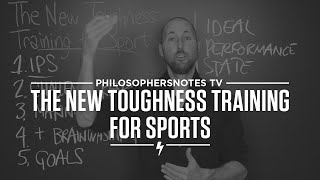
Dr. Jim Loehr's toughness training teaches athletes to use posture and breathing to trigger peak performance, reframe stress as energizing, and alternate hard work with recovery since growth happens during rest. Write affirmations to flip weaknesses and focus on performance goals you control, not just winning.
Chapters
Hi, this is Brian. Welcome Back to Philosopher's NodeTV. Today, another great book, the New Toughness Training for Sports. The New Toughness Training for Sports by Jim Lore. Jim Lohr is one of the world's leading sports psychologists who's worked with some of the world's leading sports competitors and athletes and others in peak performance for decades. We did another episode on his great book, the Power of Full Engagement. We talk about the importance of energy management vis a vis time management. We're going to talk about that a little bit more today and then I'll also put a link to our growing collection of mental training books. I love this stuff and it applies to anyone who is alive, essentially, whether you're an athlete or not or a performer or not. These ideas are incredibly powerful and applicable. So, Philosopher's note, bunch of big ideas. We've got five of them here. Let's jump straight in. The first big idea, ips. What is ips? IPS is your ideal performance state. Your ideal performance state. This is the state, IPS that great competitors know how to get into at will. Laura says great competitors are great actors. They know how to create the feelings that they want via tough thinking and tough acting. And in this particular idea, we're going to talk about how to get your body right to help you get your mind right. Rule number one of toughness training, Lore tells us, is one, you need to project and act the way that you want to feel. And corollary to that is that it goes both ways, that how you're moving your body affects how you feel and how you feel affects how your body responds. So if you're feeling depressed and sad and angry, your body is going to mirror those feelings, those emotions. But the exciting thing is you can turn it around. You, you can obviously adjust your thoughts to impact the feelings to impact your body, but you can also even more easily and quickly adjust your physical posture to adjust your feeling state. It goes both ways between your feelings and your muscles and your muscles and your feelings. So in this idea of tapping into your ideal performance state, we want to think about how we can act ourselves into that positive state and imagine how you feel when, when you're feeling most powerful. Odds are your shoulders aren't slumped and you aren't kind of sort of going around looking down and kicking the rocks and saying negative things to yourself. Your shoulders are back, you're standing tall, your head is high, you're breathing deeply. You feel great. Well, know that. And know that that has the ability to directly and powerfully impact your feelings, etc. Great competitors get that. He talks about the fact that all of us feel down at different times and don't feel like showing up, whether it's at work or with our family or in the case of these great competitors in the arena. He says, do you think that Michael Jordan and Chris Everett and Jimmy Connors and Wayne Gretzky, these great athletes, do you think they always feel psyched up and ready to go? He says, well, I'll answer the question for you. The answer is no. They often feel tired and burned out and crabby and sore, but. But they know how to flip this switch and get into that ideal performance state. We want to be able to do the same thing, cultivate it, etc. That's our first big idea. Second one is a good one, the challenge response. So the challenge response. So actually, I picked this book up because Jim Lohr wrote a Testimonial for Kelly McGonigal in her new book, the Upside of Stress. We've got an episode coming up on that soon. And I remember I loved his powerful engagement. I didn't know he had other books. So I picked this one up and a couple other ones that I'm excited to share soon. And they both talk about the challenge response. So we know the fight or flight response, right? Your heart rate increases and adrenaline's pumping through your body, et cetera. Right. But we need to know that there's a difference between. And oftentimes we think that that's just bad. That's just something we want to avoid. But the reality is, if we want to perform at our highest levels, we need to invite stress into our lives and then not feel like our life is threatened. How we perceive that stress dictates to a great degree what it does to us. That's the essence of Kelly McGonigal's work. Now, what we want to do is we want to translate the fight or flight, I'm afraid, response into a challenge response. We're eating stress like an energy bar is how John Elliot puts it. In overachievement. We get fired up, and we know that all those things that are happening to us physiologically are helping us. They're helping us meet a challenge. We have a challenge response. We want to lean into it and do our best with that energy. It's a really, really big idea. We'll be talking about that more. That's our second one. Third big idea is kind of the cornerstone of. Of Lohr's work, and it's really powerful stuff. We've Been talking about it a little bit, but he basically says we need to make waves. We need to make waves. What kind of waves? Well, imagine this sine curve that's got this nice rhythmic up wave, down wave, up wave, down wave. And Lore tells us that stress is the stimulus for growth. So when we stress ourselves out, we're stimulating the potential for growth, and. And then we need to recover. And it's in recovery, where growth actually occurs in every aspect of our lives. So if you want to build muscle, then you need to overload your body with a little bit more stress in terms of weights than you can currently handle. Not too much, you'll get injured, but not too little that you don't actually challenge yourself. When you challenge yourself, you're putting stress on your body. That's not when the growth occurs, that stimulates the growth. The growth occurs in the recovery phase. And Lore makes the huge distinction that it's not that we work too hard. It's not that we have too much of this. It's that we have inadequate recovery. So we need to actually train smart physically and emotionally and mentally and creatively, such that we're putting ourselves out there and we're adequately recovering. So you need to have a recovery plan, literally. And. And he talks about this, and he has some great charts you can use to kind of map out what you're doing. And his athletes use these, but things like, how's your sleep? It's the first thing on his checklist. What time did he go to bed? How many hours of sleep did he get? What was the quality of it? Because if you're not getting adequate recovery via your sleep, you're just kind of hanging out here, and that's not a place you want to hang out. That's not giving adequate room for recovery and the learning and all the other things that come with that. You're going to feel burned out, jaded, et cetera. So prioritize your recovery via sleep and naps and meditation and walks in nature, time with your family, whatever else gives you that deep sense of restoration. Get on that, make waves, stress yourself and recover. Super big idea. Fourth one's a fun one. Positive brainwashing. Actually didn't even have this one in the note, but it's a good one. Laura likes to focus on starting with your weakness. So when he's talking to athletes who have a weak backhand, for example, he has them work on that because that's where their game is going to fall apart, right? He says you need to identify your weakness and he has a checklist of, I don't know how many dozens of different qualities we want to have as competitors in life. The ultimate game, right? And then identify which ones you're weakest at, and then work on them. And one specific way he recommends we work on it is called positive brainwashing. So uses the example of a golfer who says to himself, I'm a terrible putter. I hate putting. That's not helpful if you have that attitude going through your mind. Guess what? Every time you step up to a putt, especially when it really matters, you're not going to be in a positive state. We need to put ourselves in that positive ideal performance state consistently and at will. He says. You need to positively brainwash yourself. The specific practice is identify what you think your weakness is. Maybe you're not patient, maybe you're not confident, Maybe you're not aggressive enough in your creativity. Whatever your weakness is that you perceive, identify that and then write down its opposite. Write it down such that you are strong at that. So the golfer would say, I love putting. And then he recommends Write it down 25 times a day. I love putting, I love putting, I love putting. Put it everywhere throughout your house. You're just impressed with this idea that you love putting. Reorient how you relate to any weakness that you might have. He says, it might sound silly, it kind of does. But it's really powerful. So think about that with your weakness. Flip it around. Positively brainwash yourself to enter your ideal performance state. The fifth big idea here is goals. He wraps up his book Part of thinking tough. There's acting tough and thinking tough. Part of thinking tough is obviously getting our minds right. Part of that is having goals we're committed to. But he makes a huge distinction. Where's some space between performance performance goals versus outcome goals? So like all great teachers, he has us realize there's a big difference between being all about the outcome, the golfer who wants to win tournaments, or the tennis player who wants to get a certain ranking and the steps you need to take in order to get there. What I like about this is performance goals. He defines them as things that you have absolute control over. Performance goals equal things you have absolute control over. So he uses the example of 200 curl ups, sit ups, or X minutes of exercise. You have absolute control over certain things in your life. That's where we want to put our focus and execute that as well as you can. I quote Tom Seaver in the note, a Hall of Fame baseball player who said, look, if you're just Focused on the stats, you're going to be too short sighted. His whole thing was focus on consistency, on the process, on performance outcomes, on the things within his control and the stats will take care of themselves over the long run. Huge idea. Think about your performance goals, the things you do when you're on your slight edge to go to yesterday's lesson, right? And focus on that. Crush those goals. Let the outcomes take care of themselves as a byproduct. Positive brainwashing is a big one. Flip your weakness into a strength. Making waves. Huge idea. Bake in a rest phase as you make waves in your life. Challenge response. Everything that happens to you when you're feeling a little bit amped up before you give a talk at work or before you perform or whatever it is, quit telling yourself that something's wrong with you because you experienced that the research is unequivocal. That if you can just orient yourself with that positively and say, well, I'm just excited doesn't mean I'm going to choke. It means I'm excited to deliver something. Here you will outperform the version of you that has a negative connotation and others who have a negative connotation. Huge idea. Challenge response. Than your ideal performance state. We want to be able to flip the switch, realizing no one feels great all the time, but we want to be able to put ourselves into that state at will. Hope you enjoyed. And what was the big idea that jumped out at you? You're like, that's good. It was a reminder of something you already knew most likely or just triggered a thought for you of wow, that'd be really cool. To test that out. Go put it into practice. Move from theory to embodiment and have fun with it. All right. Look forward to sharing more with you soon. Have another awesome day. See you.
More from Brian

Heroic +1: What’s THE Most Creative Act in the Universe?: Turning Around Glitches (#2024)









