PNTV: The Obstacle Is the Way by Ryan Holiday (#139)
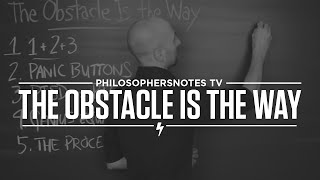
Brian Johnson summarizes and endorses Ryan Holiday's The Obstacle Is the Way, presenting it as a modern integration of ancient Stoic philosophy (Marcus Aurelius, Epictetus, Seneca) framed around three core practices: perception, action, and will. Johnson highlights practical subthemes—controlling panic, transforming trauma into growth, the "genius equation" (hard work over flashes of inspiration), and embracing a process-focused ethic of finishing—that illustrate how obstacles can catalyze personal growth.
Chapters
Hi, this is Brian. Welcome back to another episode of Philosopher's Notes tv, another great one today. The Obstacle is the Way by Ryan Holiday, who is brilliant. This book is really, really good. He's a smart guy. And this book is extraordinarily inspiring, well written and awesome. The Obstacle Is the Way. We've got five big ideas. I've got the Philosopher's Note here with a bunch more ideas. We're going to cover our favorite, my favorite ones here. The Obstacle Is the Way is basically an integration of ancient Stoic philosophy. So think Marcus Aurelius, Epictetus, Seneca. We've got Philosopher's Notes and TV episodes on each of their primary works. And I'll just read to you a quote from Aurelius. So Aurelius, old school Roman emperor, Stoic philosopher, tells us the impediment to action advances the action. What stands in the way becomes the way. So Ryan's thesis here is that we don't need to get our butts kicked by obstacles. In fact, they can become the very thing that catalyzed our growth. So how do we change our orientation to obstacles, take effective action, and have the will to move through life's challenges that inevitably come at us with. With a level of poise and grace and power? He also has a bunch of great stories of not ancient, but historical figures like John D. Rockefeller, Amelia Earhart, up to Steve Jobs, other geniuses who have made their Obstacles the Way the impetus for the catalyst for their best growth. So the book is organized around three kind of sections and three primary concepts. Number one, perception. Perception. Get into that in a moment. Action and will. Those are the three primary sections. Now, perception. How we perceive an obstacle is our starting point. Now, something happens that is bad is actually two things. There's something happening which is an objective analysis of reality. Then there's our interpretation of it, our perception of that event. If we perceive that to be bad, we're going to have a certain experience with that. If we perceive it to be an opportunity to use our greatest gifts and to show up to become a stronger human being, well, that's going to lead to a different set of experiences and emotional states, right? So perception is where it starts. We've got to perceive our obstacles, our objectively, not get overly emotional about them, and then respond from fear and from whatever we want to get control of our perception. That's one, and then two, we can take appropriate action in spite of and in the face of these obstacles, we take action. We do what needs to get done when it needs to get done whether we feel like it or not. It's effective action, right action. Not just kind of ba. Reactive action, but right action. Very grounded, bold yet humble, yet direct action. Three will. This is kind of our soul power. So we show up even when things are totally overwhelming. Maybe we can't do anything about the obstacle right now. We can learn humility. We can learn that life is unpredictable. But we have the will to see ourselves through whatever challenges we're facing. And over the long run, we see how this is going to make us stronger. Those are the three basic ideas. I'll leave it at that for now. We'll look at some of my favorite kind of ideas within those three. The next one is panic buttons. This one's fun. Panic buttons. So Ryan tells a great story about NASA. When NASA first started venturing into space, what do you think they trained their astronauts in? The number one thing they trained their astronauts in was to not panic. Panicking in outer space doesn't go well together. And then he tells a story about John Glenn. John Glenn, first American to orbit Earth. Right? Earth. John Glenn in a little contraption, going around it. The dude, his heart rate never went over 100 beats per minute. Can you imagine that? You're in outer space, first American ever orbiting the planet, and your heart rate through the entire day never goes over a hundred. What? Tom Wolfe, I think it was, wrote a book where he talked about the right stuff. John Glenn had the right stuff. And then Ryan gives us a hard time. He says, look, this guy's going out into outer space, and his heart isn't getting over 100 beats per minute. We walk up to someone on the street to have a conversation, or we have a challenging chat at work, or are we drafting an email and our heart rate's racing, we're sweating. We're getting all panicky. We need to take our finger off the panic button. And we do that by getting control of our perception. We need to get our minds right. We need to appropriately see reality and respond with grace and poise. That's the panic button. Pretty funny. Next big idea. Post traumatic stress disorder versus post traumatic growth. Psychologists call this aversive growth. We kind of take it for granted that something crazy happens. Just horrific. And then you suffer from post traumatic stress disorder. Now, there are a lot of challenging things going on, but the reality is some people, not everyone goes through that event and then experiences a stress disorder. Some people go through that event and they experience growth. How do they do that? How do they take poison and make it into medicine? We're going to talk about another book that Ryan recommended called the Undefeated Mind. We'll be doing that soon. And he has this great Buddhist idea of how do you take poison and make it medicine? Take something that could kill you and make it make you stronger and healthier. We just need to realize that it's a possibility. Oftentimes when we get into cloudy perception, we think that because something happened, therefore I responded this way. But there's always space between stimulus, something happens and response, Right? So if you got stimulus and then you have response, there's a gap there. Now, when we don't have our minds right, we think it's collapsed and it's just this, but it's not. There's always a space. What we want to do, as we talked about yesterday in the Willpower Instinct, is we want to pause and plan. We want to step into this gap and create a gap by getting our minds right consistently, such that we can choose the best possible response. That's the essence of what we want to do. And then we have the freedom to grow from the most aversive things we face in our lives. Stoics. Got this. People we admire got this. We want to get this next big idea, the genius equation. Ryan talks about this a lot. When we look at action and will. Action and will. Now, a lot of people think that genius is 99% inspiration and 1% perspiration. Right? That Michael Jordan was just born, the best basketball player ever. Mozart. Wow, Charles Darwin. These guys are geniuses. But the reality is it was 99% perspiration and 1% inspiration. As Thomas Edison, who Ryan talks about, tells us, 1% inspiration and 99% hustle and hard work. Perspiration. That's the equation for genius. And he says it's not about a flash and insight. He shares a story about USS Grant and then Thomas Edison and how many times they failed again and again and again and again. But they kept at it and they hit it again and again and again and again and again and they broke through. That's the genius equation we want to embrace. Final Big Idea. The process. He shares a story about Nick Saban. So Nick Saban is the coach of University of Alabama and one of the winningest programs in college history. Extraordinary. But they don't talk about winning SEC championships or winning national championships. They talk about the process. Capital T, Capital P. The process. Everyone in the organization is all about the process. And the word that they use that I just love. Let's find some space up here. Is Finish, finish. Nick Saban is all about finishing. Finish this rep, finish this drill, finish this play, finish this, you know, tape session. We were reviewing plays from last week. Finish, finish what you're starting. Combination of will and action. I just love that in my work, I have things I can either start and peter off on or things I can finish. We want to get in the habit of finishing. Then we have this engine, this power. We get obstacles, and those become something that fuels us. Really cool idea. The process again, we've talked about that a lot. Don't focus on the outcome. Focus on what you need to do, who you need to be to have great days. And let the outcome be a byproduct of you showing up and executing moment to moment to moment to moment. So there you go. Quick look at Ryan Holiday's great book, the obstacle is the way. One plus two plus three. Get your mind right. Perception. Take action. Keep your will strong, your soul power. Panic buttons. Do not hit the panic button. Remember our friend John Glenn cruising around earth? His heart rate stays under 100. That's awesome. He's got the right stuff. PTSD versus PTG. Post traumatic growth. Poison to medicine. Nassim Tallo in antifragile talks about the fact that wind extinguishes a candle and fuels a fire. Wind extinguishes a candle and fuels a fire. We want to be a fire where the obstacle, the wind, becomes fuel for our growth. Huge idea. Genius equation. 1% inspiration. 99% hustle, perspiration. Are you working hard or are you kind of sort of mailing in and showing up and then admiring people who you think were just born that way? These people hustle. They worked hard. The process. Finish, finish, finish, finish, finish. You start something, you finish it. Do your best. Moment to moment to moment. You diligently, patiently, persistently. And as SN Guenca says, you're bound to be successful. Bound to be successful. You can't show up diligently, patiently, persistently, day in and day out, week in and week out, month in and month out, year in and year out, decade in and decade out, and not be successful, Period. I invite you to try that. So there you go. Hope you enjoyed. What was your favorite idea? As I always ask, how can you take that idea that landed most with you, which just reminded you of what you already know, and make it an embodied part of who you are? Theory to practice. Get on that. And I look forward to sharing more with you soon. Have another awesome day. See you.
More from Brian

Heroic +1: What’s THE Most Creative Act in the Universe?: Turning Around Glitches (#2024)









