PNTV: The Paradox of Choice by Barry Schwartz (#163)
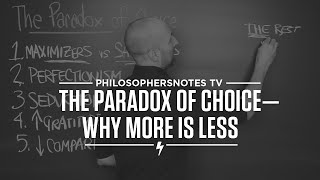
This content was created by Brian Johnson. This content was uploaded by Brian Johnson. This is a YouTube video titled "PNTV: The Paradox of Choice by Barry Schwartz (#163)" created on March 5, 2015. It features Brian Johnson discussing the book 'The Paradox of Choice' by Barry Schwartz, exploring themes such as the stress of having too many choices, the difference between maximizers and satisficers, the impact of perfectionism, the influence of branding, and the importance of gratitude and reducing social comparison to increase happiness.
Chapters
Hi, this is Brian. Welcome back to Philosopher's Notes tv. Today we've got another great book, the Paradox of Choice. Why More is Less. Barry Schwartz. Basic idea. Although we have an incredible abundance of choices today, more than we've ever had, there's a paradox inherent to that much choice, which is they're actually all those choices or are stressing us out. His subtitle is A good one. He says, how the culture of abundance Robs us of satisfaction. So we've got a philosopher's note, as always, bunch of big ideas. We're going to look at five of my favorite ones here. We're going to start with the key differentiation he makes. Maximizers versus satisficers. So he groups us in two different buckets, right? Those of us who are maximizers need to have the absolute best. I mean, the best all the time, right? Okay, that's condition one. Condition two. Satisficers. They're cool with good enough now. They have standards. Not like they're slackers. They just know what they want and what they need to see to be happy. And then when they find that they're good enough, they're satisfied, right? The maximizer needs the best all the time. The satisfies has standards. They look for excellence, but when they find it, it's good enough. Who do you think thrives versus who do you think gets stressed out and overwhelmed and anxious and depressed? Well, if you guessed the maximizers who need everything to be perfect all the time, you are correct. Those are the ones who get stressed out. What we want to do is cultivate a willingness to be satisfied. And he jokingly says, how many parents out there are saying this is good enough? No, we all want the best. But the best. In a world with this many options, an infinite number of options for trivial things is a great way to stress ourselves out. We've got to relax. Do we really need to have 2,000 options for jeans? Just buy a pair of jeans. It's not a big deal. And when every single thing in our life gives us that level of optionality, we do well to restrict ourselves and focus our choices on a smaller group and be satisfied with good enough. That's the first big idea. The second big idea is perfectionism. Guess what? Perfectionism goes hand in hand with maximizers. Although even maximizers are even worse. The perfectionist in some regard actually has a sense that their perfect standards can't be hit. Whereas the maximizer actually thinks that if they just go for it enough and look a little bit harder, they can Find the perfect solution. Now, whenever I talk about perfectionism, I like to talk about Tal Ben Shahar as a recovering perfectionist, an expert in this domain. Tal Ben Shahar, the Pursuit of Perfect if you have any perfectionistic tendencies, I highly recommend the book. We've got a video and a note on that as well you can check out. But he breaks it down and says, look, there actually are two different types of perfectionist. Unhealthy ones and then healthy ones. And he says they're so different that let's call them by different names. The unhealthy is a perfectionist. The healthy one is an optimalist. And he says the primary difference is the optimalist embraces the constraints of reality. Translated as they get the fact they're never going to be perfect, right? They go for it, but they know that they're never going to be there. They know they're only 24 hours in a day, seven days in a week, and they're willing to constrain themselves to reality and be satisfied. You could say. Now, another big difference he makes is the optimalist sees their ideal as a guiding star. The perfectionist sees their ideal as some distant shore way over there. Right now, this is a lot healthier of an orientation when you know that you're never going to be perfect, but you can see your ideals as a north star, a compass point. You're not looking at every single option and seeing how you can get to a distant shore. And like a maximizer is who's looking for the best. So you want to relax, embrace the constraints of reality, quit being such a perfectionist. That's the second big idea. Third big idea, seduction. We have been seduced by the advertising and branding agencies. No surprise there. But the good doctor shares a story with us about the fact that in the 1930s or so, cigarette manufacturers, those kind, benevolent, noble souls, were doing taste tests and they realized that people couldn't differentiate between different cigarettes. They all kind of tasted the same. And they realized that they needed to find a way to differentiate. And they had two choices. They can either differentiate via the product itself and create something that was markedly different and better, or. Or they can make you think there was a difference. Guess which one was easier, which one? They did. They figured out how to make us think there was a difference between the brands, hence branding, and we've been seduced by that. So when you look at this silly, trivial, infinite array of choices we have that lead us down the road of maximizers, which leads us down the road of depression, anxiety, etcetera, never being good enough. You have these branding agencies to think who are constantly working on all of our triggers to make us think we need more than we do. We don't need all that absurdity, period. I'll leave it at that. Alright, fourth Big idea. If you want to deal with your tendencies to get overwhelmed by the paradox of choice, then focus on gratitude. Focus on what's awesome. That's a great way to cultivate this good enough standard and and this healthy satisficer orientation where we're happy with what we have. Yesterday we did an episode on thanks Robert Emmons 25% boost in happiness by simply keeping a gratitude journal. A gratitude journal once a week, not even every day, once a week, noting five things you're grateful for. Boost your happiness by as much as 25%. That's crazy. So boost your happiness to deal with some of the regret that you might have by not always making the perfect decision, etc. Etc. Etc. You can do that via the gratitude journal. You can do that via what we talk about here is grateful flow that the Tools Guys, authors of the great book the Tools talk about and then improv wisdom. Patricia Ryan Madsen has a great idea. She calls it silent gifts. Every single day there are silent gifts that we just need to attune to and be appreciative of. Right now you're watching this on either your computer or a smartphone or something. Think about that. Like how did that object get into your life? Think about all the countless anonymous human beings you will never meet, who you owe something to for the life force that they put into making it such that you can have that in your life. That's an extraordinary thing to be grateful for. There are always opportunities to cultivate our gratitude, which is always going to boost our happiness and get us out of this tendency to think that we aren't enough, we don't have enough, etc. Etc. Etc. So there you go. Fourth big idea. The fifth big idea is a good one. When we are being seduced by all these different companies telling us what we need in order to be happy, what we tend to do is we engage in a ton of social comparison. If you want to stress yourself out and be depressed and anxious, compare yourself to other people often all the time. Watch a ton of tv, see all the hottest, wealthiest, most famous people just rocking their lives that you don't have, compare yourself negatively to them as often as you possibly can and you are guaranteed to be miserable. Sonia Lyubomirsky, another leading positive psychologist, says the happier the person, the less they focus on what other people are up to. There's an inverse correlation between your happiness happiness and your social comparison. Meaning comparison. Nice writing. So if you want to have a high level of happiness, you you need to have a low level of social comparison. You want to have a low level of happiness? Well then have a high level of social comparison. Constantly think about other people and what they're up to and think very little about yourself. Always be comparing yourself one happiness. Decrease your social comparison. This is a really, really big idea. If you find yourself constantly thinking of other people, just notice that and quit doing that. Quit talking about other people, quit gossiping about other people, quit comparing yourself to other people in any regard. Focus on what you want, get clear on that and let everybody else live their lives. It's a key to authenticity. Being the author of your own story starts by quit trying to write your story to match other people. We can talk about that for a weekend, and maybe we will someday. But for now, that's a quick look at the paradox of choice. Maximizers equal, anxious, perfectionistic, stressed out, etc. People satisficers. A little counterintuitive, but you need to be happy with good enough. Have your standards, meet them and move on. Right? Don't get swallowed in perfectionism and think that you're going to get to some ideal destination at some point and then you'll be happy. Have high ideals, but let them be a guiding star, not your obsessive need to get there before I'm feeling good. Seduction. Remember those cigarette makers? 1930s. Couldn't taste the difference. Didn't want to create something that was actually different. So let's just make people think one's better than the other. Enter branding. Enter silliness. Fourth big idea. Gratitude. Increase yours. Appreciate what you have. And then the fifth one here. Decrease your social comparison. That's a huge idea. And increase your happiness. Hope you enjoyed and I look forward to sharing more with you soon. Have another awesome day. See you.
More from Brian

Heroic +1: What’s THE Most Creative Act in the Universe?: Turning Around Glitches (#2024)









