PNTV: The Plant Paradox by Steven R. Gundry (#361)
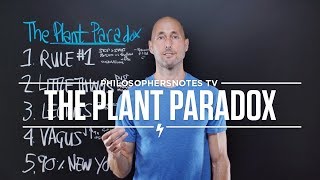
Brian Johnson breaks down Steven Gundry's argument that lectins, plant proteins found in grains and certain vegetables, trigger inflammation and gut problems. Johnson eliminated suspected lectin foods and saw his inflammation markers drop to record lows in three to four months. He emphasizes that stopping harmful foods matters more than adding healthy ones, and that the gut-brain axis drives most signaling.
Chapters
Hi, this is Brian. Welcome back to another episode of philosopher's notes. TV Today, another great book, the Plant Paradox by Dr. Steven Gundry. The Plant Paradox Subtitle the Hidden Dangers in Healthy Foods that Cause Disease and and Weight gain. Stephen Gundry, MD. Fascinating book. I picked this book up after a chat with Ben Greenfield. I meet with Ben Greenfield, genius health and fitness guy, I don't know, a few times a year to look at my blood and see what we're doing and how we can optimize. Over the last few years we've made some great progress. And in one of my recent tests, maybe like six months ago, I had a spike in inflammation which kind of came out of nowhere. We had driven it down and then it just kind of came up. We were talking about what I was doing and I had been experimenting, eating even more grains and particularly a lot of sunflower sprouts. Very interesting, right? So we talk about a little bit more in the note and we thought maybe that was contributing to the inflammation. He said, you got to read this book, the Plant Paradox. I did immediately got it and I immediately started testing this stuff. And next, fast forward three months or whatever it was three, four months, got my next test. All, all of the inflammation was gone, dropped. It was the lowest it's ever been. A ton of my other markers got optimized. Pretty exciting. I'm always doing a ton of things, so it's difficult to say what precisely is the one thing. But I attribute a ton of that to eliminating something and focusing on some other stuff which we'll talk about today. So anyway, the Plant Paradox. Anytime I do a nutrition book, note, episode, etc. I know that I'm going to get a lot of slack because so many people have so many, such an intense view of what is right and what is wrong. It's really black and white. I am agnostic, really about what any one approach might be ideal for me. It's all about experimenting, finding some things that are kind of common sense, this just doesn't make sense to do and then finding what works for each of us. So with that long prelude, I'm excited to share some of my favorite big ideas. We've got a philosopher's note here and five of my favorite big ideas here. So Stephen Gundry, leading cardiologist and heart surgeon who's written, I think hundreds of peer reviewed articles. At this point he's got two very successful clinics and to put it in perspective, he is Tony Robbins doctor. So with that five ideas, first is rule number one. So rule number one from Dr. Steven Gundry is what you stop eating has a bigger impact on your health than what you start eating. So you can start eating a lot more broccoli or a lot more of whatever you think is good for you. But if you don't stop eating that pizza, there's no amount of broccoli you're going to eat that's going to take it, take care of all the damage you're doing from eating something that just doesn't work for you. So rule number one is what you stop eating is more important than what you start eating. And that rule applies to everything. As Dave Asprey says, the fastest way to boost your performance is to quit doing the things that are draining your energy. Whether that's your health and vitality or your psychological health and vitality, or your relationship health, health and vitality. Stop doing the things that are damaging your relationships or your mind or your body with what you're eating. That is rule number one. Another corollary idea that we talk about, the note is John Durant, who wrote the Paleo Manifesto. And whether you agree in paleo or vegan or take this type of approach or whatever, this basic idea applies across all of those different philosophies. He says that in nature, you go out into nature, you will never find a fountain of youth. You won't find one thing that you could eat or do that will keep you alive forever. You won't find that it doesn't exist, but there are things in that forest that you can eat that will immediately kill you. Poisons exist. Fountains of youth do not. We want to stop doing the things that are toxic for us. If we want to optimize our well being, that's rule number one. Now, rule kind of a corollary to rule number one. And the second idea we want to talk about here is little things. So that rule doesn't apply to the big huge things, it applies to the tiny little things we're going to talk specifically about. What little things this book is about thematically, which are lectins and removing those super little things from our diet. But as a general philosophical concept, it's the little things they'd get us. It's not the huge, huge things, it's the tiny little things. And one of my favorite metaphors on this is Dave Asprey's Kryptonite dust, which we're going to talk about soon in a future episode on his book Headstrong. But he tells us that if you had Lex Luthor and he Wanted to get Superman. He can obviously bring a big chunk of kryptonite, and that will immediately drain Superman of his powers, period. But if he was really creative, what he'd do is he'd take that kryptonite chunk and he'd break it down into little, tiny little pieces. He'd actually make dust out of it. Then he'd sprinkle it in Superman and Clark Kent's house and office, right? And that little bit of dust would wear away at Superman's power gradually to a point where he wouldn't know what was happening. But all of a sudden, he wouldn't have the same level of strength he used to have. That kryptonite dust comes into our lives. Those little things that we're doing are diminishing our power. So we want to identify those little things and eliminate them and get that power back, right? So begs the question, what little things are you doing in your life, nutritionally and otherwise? That's eroding your power. What kryptonite dust do you have in your life? Another metaphor are those gnats that we talked about in the four disciplines of execution. Right? You don't get killed when you're trying to get your wildly important goal successfully achieved. It's not the dragons flying around. It's the gnats swarming around. It's the tiny little things, the little paper cuts. So take those seriously and make those little improvements incrementally to optimize your life. And of course, that's the negative side. The dust and the gnats chip away at your power. But then the marginal gains, finding those tiny little things you can do to optimize, when you aggregate and compound those over an extended period of time, what do you see? Huge gains. If you do both at once, removing the negative stuff and adding little positive things, well, you create a pretty big gap between where you would have been and where you are. That's what we want to create. Focus on the little things. We could talk about that for a whole weekend. So the third idea here is really the theme of the book. What differentiates this book from any other book out there is Gundry's emphasis on what he calls and what are called lectins. So what are lectins? Well, the basic idea to step back, the plant paradox, is that the same foods that nourish us can also damage us, can hurt us, can kill us, ultimately, right? So that's the plant paradox. Same foods that nourish us can also hurt us. We want to bear that in mind. And pay specific attention, if you're interested in the experiment, to these lectins. So lectins are basically sticky proteins that exist within these plants that serve the purpose of defending those plants from animals and insects and other predators. So everything in nature is always competing with itself or with one another. Right. And there's kind of a symbiotic relationship. Now, the lectins within plants can damage the insects and animals that consume them. This is the underlying point of the book. The most popular lectin, or sticky protein that you're probably familiar with is what. Can you guess what? Sticky protein is? Pretty ubiquitous in our consciousness these days. It is gluten. Gluten is a lectin. But Gundry makes the point that gluten is only one of many, many, many lectins that have a similar effect on our bodies. Again, little things, any one thing isn't going to do it. But when you're constantly consuming these foods that have those little bit of kryptonite dust in them over an extended period of time, your power, your vitality is diminished. If you remove them, your body can do what it naturally does, which is heal itself and perform at an optimal level and experience an optimal level of health and wellbeing. Right. So google plant Paradox food list to see what's on the approved, you can eat it list and what's on the nah, you got to remove it list. Obvious things that go are things like if you're into kind of this sort of thing, you know, things like flour and grains, etc. Some less obvious things exist on the list like squashes and cucumbers, which we used to eat a fair amount of in the Johnson household. I removed those for my test and have continued to remove them as the test continues. The results have been wonderful so far, so we'll continue the experiment. But check out the Plant Paradox food list to see what's on the approved, not approved. But remember, lectins, sticky proteins, they stick in ways that that diminish your overall well being. I'll leave it at that for now. Fourth big idea is your vagus nerve. So we've talked about your vagus nerve in different contexts. Most recently, I believe it was in Love 2.0, where Barbara Fredrickson told us about our 10th cranial nerve, which goes from our brain stem all the way. It's called vagus because it wanders. It's the wandering nerve. Right. It goes from our brain stem and she says it connects our, our mind, our brain and our heart. Right. It goes through our Heart, our respiratory system, but it also goes all the way down to our gut. So it connects our brain and our gut as well, and our heart. Pretty cool. People with a higher vagal tone are healthier human beings. They're able to recover more quickly from life stresses. They basically do everything you want to do at a higher level when you have a higher vagal tone. Now, what Gundry says, which I think is fascinating, is we tend to think that the vagal nerve connects your mind or your brain to your heart and your gut, that it goes down, right, and it's communicating from the brain down. But what he says is there are nine times more fibers going up from your gut back to your brain than there are going from your brain down to your gut. So actually, what the vagus nerve is really doing, he says, is aiding the communication up the information from your gut up. So that makes us want to pay attention to how our gut is, how healthy is our gut, right? And he talks a lot about this. All the functional medicine doctors out there tell us the root of disease starts in your gut, right? I don't know what percent, 80%, 85% or something like that of your immune systems in your gut. Your gut is responsible for your overall well being. And if you are chipping away little things, lectins, in this context, against your health, you're going to have a suboptimal experience. And there are also more neurons in your gut than your spinal cord. You literally have a second brain in your gut. Take care of it. Remember, it's communicating up to your brain, et cetera. The fifth big idea here is really inspiring. 90% new you. A 90% new version of you is created every 90 days. Gundry talks about how he works with a lot of retirees in Palm Springs and I think in LA or wherever his other offices. And it doesn't matter your age. Every 90 days, 90% of your trillions of cells are new. There's a new you. 90% of you is new every 90 days. That's incredibly inspiring. And that means that we have the opportunity, growth, mindset, optimized mindset style, to fuel ourselves as optimally as we can and create a new version of ourselves every 90 days. To me, that's exhilarating. And you can see it. I do my blood work basically every 90 days or so, and you see it. I mean, you can move the needle on whatever thing you want to optimize, just change a little bit, get the data, 90 days later, go check it again, and boom, you've moved it oh, what can we do now? Boom. Move it. And sometimes you're going to take three steps forward, and then you're going to slide back a step or two, which is what I did in my recent experimentation. Whatever. Dust yourself off. It's all data. Use that to get a little bit better the next time. But the point here is we're always reinventing ourselves at a cellular level. We can choose to step forward into the next best version of ourselves by eliminating the toxins, which is rule number one. What you stop eating and stop doing is always going to have a bigger impact than what you start doing. So what's your little thing that you're doing? If you got one thing out of this, make it. What's the one thing you're doing in your life in general that you just know isn't serving you right? Think about that. Think about if now is a good time to let it go. Check out Habits 101, our masterclass to learn how to get rid of that habit. And then what's the number one thing you're doing nutritionally that you just know? You don't need gundry to tell you that you should stop doing this. It doesn't matter what approach you take. What. What is it for you? Think about that. Think about how you can remove it. And then also think about the lectins. This has been a really fun experiment for me. I'm gonna continue running it for the foreseeable future. I appreciate Dr. Guentry and his insight. Then remember your vagus nerve. It goes down nine times. More fibers going up. Your gut matters. We want to get that optimized as we create that new version of you. 90% of you is going to be new from a cellular level in the next 90 days. Let's feed it. Well, there's the planet paradox. Hope you enjoyed, and I hope you have another awesome day. See you. Isn't it a bit odd that we went from math to science to history, but somehow missed the class on how to live? For some wacky reason, optimal living 101 never made the schedule. Of course, it's too late to go back and change that, and you're too busy to read full time to catch up. But if you're like us, you. You're all about optimizing your life so you can actualize your potential. So imagine this. Imagine having someone read the best books on how to optimize your life and pull out the big ideas that can really change your life. You know, those sections you underline and asterisks and mark all up. Then imagine that guy me connecting those awesome ideas to other great books and helping you actually apply the wisdom to to your life today. Well, that's what I do with something we call Philosopher's Notes where I've distilled hundreds of great books into 20 minute super practical summaries. Then imagine me taking the absolute best big ideas from those great books and sharing them with you in hour long Optimal Living 101 classes on everything from productivity, purpose and confidence to nutrition, goal setting and conquering procrastination. Helping you optimize every facet of your life so you can actualize your potential. You've got a personal trainer. I'm kind of like your personal philosopher. Ancient wisdom, modern science, and practical tools. That's what our Optimize membership program is all about. If you're feeling it, we'd love to have you join us.
More from Brian

Heroic +1: What’s THE Most Creative Act in the Universe?: Turning Around Glitches (#2024)









