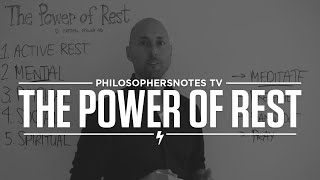
Brian Johnson (Philosopher's Notes/PNTV) summarizes Matthew Edlund, M.D.'s book The Power of Rest. The episode contrasts passive rest (sleep, naps) with active rest — short, intentional recovery practices baked into the day — and outlines four domains for active rest: mental (meditation), physical (deep breathing, mountain pose), social (meaningful time with others), and spiritual (one-minute prayer/gratitude). The host gives simple, actionable micro-practices (1–15 minutes or even 20-second breaths) and frames rest as rhythmic oscillation between engagement and recovery.
Chapters
Hi, this is Brian. Welcome back to another episode of Philosopher's Notes. Tv. Today we've got another great book. I read this one on Kindle. So we just got the Philosopher's Note, the Power of Rest by Matthew Edwin, MD. Great book. We've been taking a look at rest and sleep and naps. We had taken out Change your life. We had power sleep, and now we have the power of rest. Rest is unbelievably important. What's cool about this book is we're going to talk about active rest versus passive rest. So you can sleep, you can nap. Those are passive forms of rest. And you can actively rest throughout the day. Really cool concept. We're going to talk about that in this quick episode. But first, real quick. Matthew Edlund is a medical doctor based out of Florida. He runs the center for Circadian Rhythms down there. Sounds pretty cool. And you can find him@therealestdoctor.com One of the world's leading thinkers on rest. Good guy, Good book. Let's jump straight in. So we'll start with this idea of active rest. And he tells us that life is rhythmic. Yesterday we talked about the fact that we need to engage in absolute synchrony is what Dr. Maaz said we wanted to find with our sleep and waking patterns. We want to go to bed at the same time and wake up at the same time, day in and day out. Well, Dr. Edlund tells us we want to find those rhythms throughout our day. We want to find this oscillating, beautiful rhythm of being on and resting, performing and resting. And we can do that by embracing this idea of active rest. Again, passive rest equals napping and sleeping. Active rest equals things we could do during the day in four different domains to rejuvenate ourselves. Those four domains we're going to take a quick look at now are mental rest, physical rest, social rest, and spiritual rest. And we'll take a look at one primary way we can engage in each of those types of active rest throughout our day. So let's start with mental rest. If you haven't noticed, our minds are quite busy. You may have noticed thought to thought to thought to thought to thought to thought to thought to thought. Now, of course, we rest when we're sleeping passively or napping passively. But how do we actively rest our minds? What do you think? What's one thing we talk about again and again and again throughout these episodes? If you guessed meditation, the fact that we can meditate to actively rest our minds. You are correct. Meditation is huge. We know that it grows. Our prefrontal cortex actually enhances the connections. Neuroplasticity tells us we literally can rewire our brains by engaging in meditation. It's also the primary way to mentally rest. If you haven't picked up a meditation practice yet, what are you waiting for? Even if it's just a minute a day, give yourself that minute. We don't need to make it complicated. One of my favorite teachers on the subject, Herbert Benson, who wrote the Relaxation Revolution, we'll do one of these episodes on his great book soon. He talks about the fact that, look, you don't need to judge your meditation. When you brush your teeth, you're not sitting there while you're brushing your teeth wondering, is this a good tooth brushing or is this not a good toothbrushing? You just brush your teeth. He says we need to do the same thing with our minds. Just brush your mind. Just sit down. Whether that's for a minute or 5 minutes or 10 minutes or 12 minutes. His research shows that 12 to 15 minutes of daily meditation will literally not only rewire your brain, it will change the expression of your genetic code via something called epigenetics. We'll talk more about. So meditation is huge. If you got a practice, awesome. If you don't start one a minute a day, it's five deep breaths. Inhale to four, exhale to six. You just meditate. Do that five times. You just meditated for a minute. Don't make it a big deal, but do make it a consistent practice. And that's connected to the second way that we can actively rest, which is physically. So again, passive rest, napping, sleeping, and active rest. Physically, what can you do to actively rest? Physically, that's what you do. One way you can do it, you breathe. And again, Dr. Edlin gives us a bunch of examples. The most powerful one is breathing. Just the act of breathing deeply, which we talked about a lot in our mental training episodes. Just that act of taking in a deep breath. Let's do it right now. Breathe in to a count of four or five, four, six. And breathe out to a count of six or seven or eight. That one deep breath restores our physical selves. It also boosts our willpower. It's an amazing thing to do. And the cool thing about your breath is you can do it anywhere. You can be in your car, sitting in traffic, and rather than complaining about it, you can just take a few deep breaths. You can be in a line at the grocery store or at the airport. Take a deep breath. Or 10. Another way that you can rest physically is to stand in mountain pose, which is basically your feet a little bit more than shoulder width apart, your body relaxed, your sit bones kind of hanging down and just relaxed and grounded in this mountain pose. And then breathe. That's deeply restorative. Now you can be fidgeting while you're in line at the grocery store. You can sit in this mountain pose while you're in line or waiting for the elevator and take a few deep breaths. Those little moments of rest are huge. One of my favorite ideas on the subject of rest comes from Tal Ben Shahar, who's quoting the Power of full engagement. And Tony Schwartz says, it's not that we work too hard, it's that we don't recover enough. It's not that we work too hard, it's that we don't recover enough. So again, active rest is a really cool way to bake in mini recoveries throughout the day. So it doesn't need to be a 20 minute nap. It can be a 22nd few deep breaths in the middle of our day, throughout our day that rejuvenates us. So that's physical as an active form of rest. Another form of active rest is social. The act of hanging out with friends is one of the best ways that we can actively rest. Go on a walk with a colleague through the park during lunch or just go to lunch with a colleague rather than sitting at at your desk working hard. Or maybe you're going to take a nap that day so you're not going to hang out, but find ways to interact in meaningful ways with people around you throughout the day. Not complicated, but important. And it's a really cool form of active rest. That's social, active rest. And then our final way to actively rest is spiritual. How do you spiritually rest? Well, again, there are a lot of ways we can do that. One way that Dr. Edlin suggests is to pray one minute. He says one minute prayer. Can you take one of those deep breaths and a couple more deep breaths and think about whatever it means for you to pray, Whatever it is that you pray to or however you pray, Take a moment to do that, breathing in all the amazing things in your life and the power that's greater than us, that has given us such beauty in our lives. Find those things that we're just deeply appreciative of and imagine our even more optimal life. And as we unfold and actualize and evolve, what would our lives look like? Pray in thanksgiving and in this beautiful anticipation of this life that's unfolding prayer even in one minute is a really cool way to actively rest. So that's a super quick two or active rest. We've got passive rest activity, napping, sleeping. We've got active rest. We can do it in four different domains mental, physical, social and spiritual. One way we can do it for each of those is meditation. Great way to mentally rest. Breathing. Great way to physically rest. So is the mountain pose. Hanging out with friends. Take it for granted but if you're feeling a little bit depleted, go spend some quality time with friends and then that one minute prayer. There you go. Power of rest. Thank you Dr. Edwin. I'll give you links to learn more about him and what he's up to again. Thereestdoctor.com what was the big idea that landed? Which one did you like the most and how can you make that a bigger part of your life starting today? Get on that. I look forward to sharing more with you soon. Have another awesome day. See ya.