PNTV: The School of Greatness by Lewis Howes (#261)
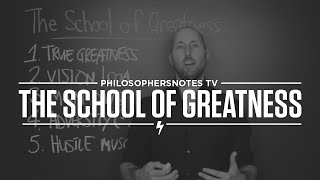
Brian Johnson summarizes and reflects on Lewis Howes' book The School of Greatness (subtitle: A Real-World Guide to Living Bigger, Loving Deeper, and Leaving a Legacy). Johnson outlines five favorite big ideas: (1) True greatness is intrinsic and within everyone (linked to Maslow's self-actualization); (2) Clear, specific vision and goals (COA—Certificate of Achievement; WOOP process); (3) Macro and micro 'Masterpiece' days (ideal day planning); (4) Adversity as fuel—be antifragile and use challenges to grow; (5) Hustle — do what others won't to achieve excellence. The clip also includes personal anecdotes (family health episode, wife Alexandra's pregnancy practices) and a short promotion for Johnson's Optimal Living membership (PDFs and audio summaries).
Chapters
Hi, this is Brian. Welcome back to Philosopher's Notes TV Today, another great book, the School of Greatness by Lewis Howes. The School Greatness Subtitle A Real World guide to Living Bigger, Loving Deeper and Leaving a Legacy. Lewis Howes is great guy who started a podcast that became uber popular called the School of Greatness.
Check it out on itunes wherever you.
Listen to your podcast. It's been downloaded millions and millions of times since he launched it in 2013. And he basically interviewed all these extraordinary, I think over 200 extraordinary teachers. And this book is essentially his notes on those kind of lectures on how to achieve greatness. Awesome stuff, written with a really fun, young, vibrant energy. If you're kind of just getting going in the process and kind of really looking to lean into your potential, I think you'll really enjoy it. And there you go, Philosopher's Note, bunch of big ideas. We've got five of my favorite ones here, so let's jump in. First, big idea is true greatness. So Lewis talks about the fact that although he talks about some of his friends and mentors who are gold medal winning athletes and uber, uber successful, publicly recognized people, he says, look, true greatness is within each of us. It's not something out there, it's within us and it's our opportunity to uncover that and to express it most fully. So in the note, I talk about the fact that this is basically Abraham Maslow, right? We've got our ultimate potential. We want to optimize, have a strong foundation and optimize and actualize our potential, as Maslow says. And if I had to summarize my entire philosophy in one sentence, this would at least be tied for first. Abraham Maslow said, what one can be, one must be. There's an impulse within us to express the highest version of ourselves. You do that and you're talking about greatness. And in the note, I talk about the fact that this isn't in extrinsic. Check me out, I'm famous, I'm uber wealthy and uber powerful. Motivation, extrinsic motivation. Those things may come as a byproduct of your commitment to doing your best and living with Arete, right, And actualizing your potential. But we're talking about an intrinsic impulse here and I use Alexandra as an example. In the know, my wife, Lewis was a former All American football player and a decathlete, which is super cool. And he talks about his stories in that journey. My wife was an All American volleyball player who's in the hall of Fame in her small town In Illinois. Awesome. One of the best athletes, if not the best athlete ever out of her town. Super cool. But she channeled that energy into being the best possible mom she could be. She sacrificed some of her near term creative mojo and how many Facebook likes she gets. She's not even online these days, how many podcast downloads she has, how much money she's making. She's made the courageous decision to worry less about that stuff and more about how she can be the most extraordinary mom and human being she can for our son Emerson, who just turned three the other day. And she's expressed greatness in that domain. Now, no one's ever going to know about it beyond our family and those people who might be hearing this. But that's not why she's doing it. She's not doing it for the pats on the back and the fame and the money and all those things. She's doing it because she wants to be great at it. So as we aspire to give ourselves to the world, let's remember that the thing that we can be most uniquely great at as mothers and fathers and grandmas and grandpas and just community leaders and citizens in our world isn't always about the things that are going to impress people or that are millions and millions of people being impacted. It's doing your best in where you are with the gifts and opportunities and responsibilities you have and doing that fully. And I share some examples of Alexander. I mean, preparing for her pregnancy. She interviewed 40 different people, like 45 people, maybe, and then shared that with her community of other people looking to become mothers or new mothers, etc. Over 40 interviews, just so she could learn what it took. She gave birth at home. I caught Emerson in our bedroom at home. Amazing. With a beautiful midwife. And she created guided meditations for every phase of the pregnancy. She created a different meditation that she meditated to every day to form a relationship with our son before he was even born. That's nuts. And then she shares those meditations with her community. I can go on and on and on, and I won't. I do a little bit more in the note. But the basic idea is we all have the potential for greatness. Who are you? What are you doing? And look at what you can do to aspire to be your best. Maslow also said, if you decide to essentially not honor that impulse, it's not a good decision. I warn you, you're going to be miserable because there's this really powerful drive to express. That's our first big idea. You have Greatness within you. Second Big Idea is the first of the eight lessons that Lewis unpacks. He says, we got to have a clear vision. Who are you? What do you want to see in your world? If you don't have that, there's no possible way you're going to achieve any level of greatness in any sense of the word. What is important to you? I didn't mention in the note, but I talked to Louis about this in the interview we did, which you can listen to as well, which was a lot of fun. Heidi Grant Halvorson, who we've profiled in these episodes and notes, wrote the most popular blog post in Harvard Business Reviews history. She wrote a book called Succeed on the science of setting goals and motivation and achievement. The first habit of what successful people have that less successful people don't have is clarity. Specificity is the word she used. They have very specific goals. They know what they want to achieve by when and how. They're specific. This is what Lewis is getting at here. He has something called the COA Certificate of Achievement. And he says, look, figure out what the most important goal is for you over the next six to 12 months. What do you want to achieve? Write it down, print it out, frame it. Literally frame it and look at it. And you're going to achieve this particular goal by whatever period of time. Boom, there it is. It's now your certificate of achievement that you stare at your vision, which is connected to a goal that is both challenging yet feasible. We want to be a little bit nervous about the fact we're going for this, yet we also want to know we can achieve it. And in the note, I talk about the whoop process and I help walk us through it. What's your wish? What's your outcome? What's your obstacle, and what is your plan to achieve it? Whoop. Scientifically proven to help us achieve our goals. But it starts with a vision that's specific. So what is yours? What's the number one thing you want to create in the next six to 12 months that's going to help you take the next step in actualizing your potential? Third Big idea is part of the first chapter as well. With specific clarity on what we want. A vision of what we want. Lewis has a great exercise to help us create what I call M and M days. Macro and micro perfect days.
He says.
He says, on a macro level, what's a perfect day look like for you? So on a big picture, if you could wave a magic wand and say, that's what my ideal Day looks like. What would it look like it should include? Process goals are going to help you achieve your outcome goal. If you want to achieve that in six to 12 months, well, what are you going to do on a daily basis such that that's the natural byproduct of your consistent hustle? That's the macro level. Your ideal day. How do you feel when you wake up? With whom are you spending time? What are you creating, how are you moving your body, how do you feel, etc. Map that out.
Right.
Macro Masterpiece.
I call it day. Right?
Then your micro perfect day is what's tomorrow going to look like? You have your general now. Your ideal day is going to move from day to day. What's tomorrow going to look like on a micro level? Laser in on what you're going to do tomorrow such that that vision comes to fruition. Really cool. Macro plus micro. Take the time to get clarity on that and have fun with it. I'll put a link to the Masterpiece.
Day video.
Near this video wherever you're. If you're watching this on YouTube, it will be there. Podcast Google Masterpiece Days micro class and you'll find it. Fourth big idea. Adversity. This is the second chapter. First chapter is vision. The second chapter is adversity. And basically, if you're going for greatness, you need to realize the fact that you're going to experience adversity, period. You're going to have challenges. It's impossible, emphasis on impossible. To do great things without challenges, adversity, obstacles, etc. Every hero's journey has a hero battling dragons, right? Not sidestepping lizards. As I like to joke. If all you're doing is trying to avoid a lizard on your path, you're not doing anything worth doing. You're going to have challenges, you're going to have adversity. That's just how it goes. And it's particularly true if you want to optimize your life and actualize your potential in a general sense. And we need to know that that's going to happen and and not be overwhelmed and dramatic about it when life doesn't turn out perfectly. And whether that's creatively or business wise or relationship wise or health wise or whatever, that's just how it works. Then when something negative happens, we can rub our hands together and say, I'm going to be antifragile about this. Not only am I not going to break down and be fragile, I'm actually going to be antifragile. I'm going to make this adversity make me better. Antifragile, kick me around, challenge me. I'm going to get stronger. That's Nassim Taleb's genius book, Antifragile, which I need to profile in depth soon. And the example that I used in the note that I've been talking about is our family had some adversity a couple months ago. Alexander had two seizures in 24 hours, sucked two ambulance rides in 18 hours. Wasn't pleasant. But even in the midst of it, I can see something good is going.
To come out of this.
My heart opened immediately to appreciate all the people serving us, to appreciate that we still have good health, albeit with this little asterisk of we got to figure this out. And we knew that we could turn poison into medicine, that we can be antifragile, that we can make the obstacle the way as Ryan Holiday describes it, and we can make this challenge make us stronger than it already has. And then we're looking at, well, how do we solve this? We got to the point we realized that her seizures were catalyzed by mold. We had mold in our kitchen for the last probably year. She spent the night in a yurt, glamping. The night that she had the first seizure, 100 degree day, no ventilation, moldy yurt, boom. She had a seizure. She's genetically predisposed to have it. Anyway, we're learning a ton. And then we wanted to reach out to a guy named Dr. Daniel Amen, who's one of the world's leading psychiatrists and an expert on the brain with mold and seizures. He's in a documentary by Dave Asprey on it. So I was planning to reach out to him. I had traded emails with him years ago, and we have many friends that are connected to him. So I was going to lean into that and reach out to him. And the day I was going to do that, he emailed me asking me if I can help him with the launch of his new book, change your Life, Change youe Brain, which has been in my queue to do a note on. And I have goosebumps. I say this, I said, well, that's amazing because I was just going to reach out to you. Long story a little shorter. We're going to see him next week for brain scans. I'm going to get one too, which I can't wait to do. And we're going to spend three hours with him. Guess what? The seizures, which sucked at the time, are making us unbelievably better. We're going to be healthier than we've ever been. Adversity is awesome when we allow it to be, rather than crawl into victim mode and say, oh, my God, my life's falling apart. I can't believe it. But we can step back, be heroes of our own story, and use our challenges to make us stronger. Getting fired up, that's our fourth big idea. Fifth big idea is my favorite. It's hustle. Lewis has a chapter dedicated to hustle in the best possible sense. If you want to be great, you've got to embrace adversity and all the other things that he talks about. And you got to be willing to hustle. And he References Michael Phelps. 18 gold medals or whatever it is, right? However many other medals he's won. Arguably the best athlete ever, he says, the greatest. If you want to be the best at what you do, you've got to be willing to do what other people are unwilling to do. To go back to Alexander, people were. Most people aren't willing to create guided meditations for their pregnancy and to do all the research she did, to have a healthy home, birth and all these other things, and to do what she's doing now. Greatness requires us to be willing to do things other people aren't willing to do. To hustle. Lewis shares the great story of his brother, Chris Howes, who was kind of a prodigy, precocious young violinist who then got into some trouble selling drugs. He spent years in jail at 19, maybe three or four years or whatever in jail. But he used that time to become a better man, a better human being. He mastered his craft while he was in there. And then he came out and he hustled, did whatever it took to make something of himself as a violinist. And fast forward, he's now one of the best jazz violinists in the world.
Check him out.
Chris Howes amazing story of turning adversity and using hustle to get the most out of it. So when you think of your vision of what you want to achieve in your life, particularly over the next six to 12 months, think about what you're going to do. Grant Cardone style, 10x 10x your vision, 10x the amount of work you're willing to do and go out and achieve your level of greatness. So there you go. Hustle, adversity, M and M days, your perfect days on a macro level and a micro level. What's your vision? Your certificate of achievement? This is what you're going to achieve. Challenging yet feasible. Don't set goals that are silly. You gotta be able to do them in the timeline. Provided that you work hard, you're not serving yourself by going way too far. Much better to set a goal you can achieve that stretches you get to that one, then set a new one. Then continue to burn yourself out by trying to set impossible and achieve impossible goals. Those are some quick ideas on true greatness. It's within all of us. And again, remember intrinsic. What do you feel called to do with your family, with your community and with the world at large? Let's get on it. Do our best. Live with Arete and Shine. Hope you enjoyed if you did. I think you'll enjoy the book and thank you Louis. Look forward to sharing more.
Have another awesome day. See you. Hi, this is Brian. I hope you enjoyed that PNTV episode. A lot of people don't know all.
The stuff I do beyond these free.
Videos I share on YouTube, so I thought I'd do a quick video to give you an overview of our membership program that you can get access to. Get a ton of other stuff. So here's a quick look. Ten bucks a month. Join the Optimal Living Membership program. You get instant access to 250 philosopher's notes on some of the best Optimal Living books out there. Old school classics, Positive Psychology, Modern stuff, Mindfulness, Peak Performance, purpose, neuroscience, wealth, etc.
And what you may not know is.
That in addition to the PNTV episodes, I create PDFs on all these great books. So six page PDFs with take a look at one of them. Joseph Campbell. You want to figure out how to live your hero's journey? Well, this is a great place to start.
I basically pull out my favorite big.
Ideas, riff on them, connect them to other books and other ideas and help you apply this wisdom to your life today. That's what the PDF looks like again. We have 250 of these on all these different great books. And then I record those PDFs as.
An MP3 so you can listen to.
That MP3 while you're on a walk or working out or doing some errands or whatever that is. Philosopher's Notes. A lot going on there and then in addition to Philosopher's Notes, you get access to Optimal Living classes. Optimal Living 101 idea here is that all those great teachers come back to the same big ideas again and again and again. I distill those ideas into classes. Super practical, fun, inspiring classes ranging from habits 101, confidence 101 getting stuff done 101 meditation 101, instant access to all those classes and then future classes include Relationships 101, Energy 101 Purpose 101 business goals, etc. Those are our full length classes. And then I create micro classes. Two to three to five minute little bursts of wisdom on my favorite great ideas from these great books across the domains that you want to optimize in your life. So we have dozens of these so far. I create 50 new micro classes every month and 10 new philosopher's notes every month for 10 bucks a month. So we're blessed to have thousands of members who are enjoying the program and sharing some incredibly kind words with us. And super simple. 10 bucks a month. Cancel anytime. Would be honored to be a bigger part of your life and I appreciate your support. And here's to optimizing and actualizing.
More from Brian

Heroic +1: What’s THE Most Creative Act in the Universe?: Turning Around Glitches (#2024)









