PNTV: The Undefeated Mind by Alex Lickerman, MD (#143)
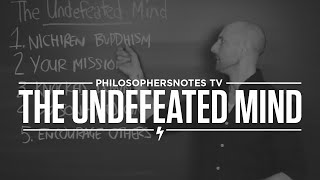
Brian Johnson discusses Alex Lickerman's book on building resilience through science and Nichiren Buddhism. Lickerman argues you can construct an indestructible self by finding your mission and learning to overcome life's hardest challenges without being defeated by them.
Chapters
Hi, this is Brian. Welcome back to Philosopher's Notes tv. Today we've got another great book, the undefeated mind by Dr. Alex Lickerman. Undefeated Mind. As always, we have a Philosopher's Note where I've unpacked some of my favorite big ideas, riffed on them, etc. And then we've got our five big ideas here. This is a great book that integrates the science of, as the subtitle says, constructing an indestructible self. The science of constructing an Indestructible self. Super cool. Dr. Lickerman mixes science, Western views of scientific analysis with ideas from Nichiren Buddhism. We'll start right there. First, big idea, Nichiren Buddhism. I'd never heard of it before. Apparently 12 million people practice it around the world. Based, enchanting, with a significant difference from other forms of Buddhism. Whereas most forms of Buddhism, roughly speaking, view suffering as a root of attachment to desires, this form of Buddhism looks at it and says, look, that's actually not what's going on. That's not what the Buddha said. What he said was, it's a belief that we don't essentially have what it takes to deal with life's challenges. We're all going to be born and not be able to fulfill all of our needs. We're going to get sick, we're going to get old, and we're going to die. The four fundamental aspects of human suffering that the Buddha discovered. But the issue isn't attachment to our desire to have things being different. It's that we don't believe we can meet those obstacles. That's the root of suffering. And he talks about chronic clinical depression is essentially chronic clinical levels of powerlessness. So if we want to create an undefeated mind, he says, the Buddha says we need to believe that we can deal with life's obstacles. We can hit them head on and achieve what he calls victory, ultimate victory. Powerful stuff. So a lot more to talk about there, obviously, but that's a nice distinction that I like. We need to believe in our ability to deal with life's challenges. That's the root of how we're going to experience happiness. Then he talks about your mission. Second big idea here. We need to find our mission. He has nine principles for creating undefeated mind. This is a very important one, your mission. So he differentiates your mission and your higher purpose in a way that is similar to the way that I've been framing it. So if you got your purpose, he says, look, everyone's purpose is the same. That's to be happy. Happy that's good. But we have unique manifestations of what we're here to do as individuals. Right? We have missions. And he walks us through a really cool exercise on how to discover our mission. So if you don't feel like you have the clarity you'd like on your mission, or you just like to deepen your clarity, try this out. He says, first of all, you can't just look at what you want to do. You got to think about just for your own benefit, you've got to think about how you can ask yourself the question, how can I create value for people? How can I serve profoundly? How can I create value in other people's lives? It's a key part of our mission if we want to achieve this happiness right now. He says, do this, sit down, find some quiet time and identify the 50 or so experiences in your life up to this point that have given you the most joy. What 50 things have you done in your life that have given you the most joy? Think about that and then look at that list and think about the things that you did that gave you joy, that involved other people, that involved creating value for other people. It wasn't just about you. You were serving in a profound way. Identify those events in your life and then imagine you're 90 years old and the president of whatever country you live in is honoring you with an award. What is he honoring you for? What is he honoring you for? What have you spent your life committed to that you're so proud, you're so joyous that you're being recognized by someone you admire and respect at this advanced stage in your life? That's a really cool way to get more clarity on what your mission is. What gives you joy that involves creating value that you dedicate your life to. That's a cool way to look at our mission. Next big idea. Knock down. Alright, great. Get back up. It's the essence of a undefeated mind. We get knocked down. That's just what happens in life. As we talked about yesterday with Tony Horton's big picture, failure is the new awesome. Failure happens, period. We're going to get knocked down. The question is, what do we do when we get knocked down? In the note, I share a story about my own experience, which I'll share briefly here. So I was raising money for my last business, this is almost 10 years ago now, nine years ago maybe, and wound up meeting a gentleman who had been very, very successful in his family. He's a billionaire, right? And we're in Aspen and he's invested over A million dollars in me and in our business. And he's introducing me to some of his friends. We're, you know, kind of giving a pitch on, you know, seeing if they're interested in investing. So we're in his house, and he introduces me and he says, this is Brian. I invested in him because he knows how to get knocked down and get bloodied and get back up off the mat. Brian, tell him about your business. And I remember at the time thinking that was a little weird. That's a kind of funny way to be introduced, but okay, I'll run with that. And as I reflected on that in the years since, been an amazing thing for me to see that this is a billionaire who's created an extraordinary amount of success in his life. And the thing that he thought he should share with his friends about me was that I know how to get knocked down, which we're all going to do, inevitably. He knows that. He's created all these businesses. No plan that any entrepreneur starts with is going to be the plan that works. He knows that. So what do you do when you get knocked down? Do you know how to get back up? That was what he saw in me, that I used to be ashamed of the fact that we failed, and I failed at different times. And in fact, months before I met him. This is Sam Wiley. Met his daughter Christiana at an Integral Institute event. Super hippie who wound up being unbelievably sophisticated in all this stuff. And her family was a huge supporter for me and my last business, Zozo. The fact that he would see that as the character trait that he found most admirable moved me. And I went from being ashamed to being proud of what we've done. Paulo Coelho talks about the fact that you want to wear your scars like metals. Wear your scars like metals. That shows that you've lived, you've put yourself out there. But anyway, three months before I met him, we had completely rebooted our business. We had spent about a half a million dollars. Two years of time. Didn't work. Threw it completely away. All the code, the software code we've built. I like to joke that when you throw that much code away, it's like this huge ball of tinfoil you need to stuff into a garbage dumpster. It sucked. Complete hard reboot. Completely started the business in a different angle, which was much better in hindsight. Anyway, he knew that we had done that. He admired it, and he admired what I had done in my prior business and saw that as something so powerful, so we want to embrace this. Failure is new. Awesome, knock down, get back up. And part of that process is we turn poison into medicine. Buddhist idea. Challenges happen, you get knocked down. How do you take that poison and make it medicine? Make it make you better. That's what we want to do. That's the hallmark of an undefeated and undefeatable mind. You get poisoned, you turn it into medicine. Doesn't kill you, it makes you stronger. That's crazy powerful. Final big idea. Encourage others. He makes a great distinction that when people come to us, they're not looking for advice as much as they're looking for encouragement. I don't know about you, but my tendency is to try to fix things and to give advice. And he says that's actually not what's really going to move people the most. What they want from us is a sense that we believe in them, that they want to feel encouraged. So let's take the opportunity today, tomorrow and next week to find ways to encourage people around us. Let's pause on the advice a bit. Just check in and let them know that we believe in them. We believe in their power to surmount their obstacles, that they too can cultivate an undefeated mind. That the human potential, the human spirit has so much potential and we believe in their ability to actualize it. We want to encourage people more deliberately and consistently so. There you go. Quick look. Undefeated mind creating. Constructing an indestructible self. I like it. Made a distinction here in Buddhism that it's not so much attachment to desires as it is a belief that we can't deal with life's challenges that leads to suffering. Very cool. Clinical depression is essentially absolute helplessness. We've got to reclaim our power and know that we can deal with life's obstacles. We got to identify our mission. We all have the same purpose, which is to create happiness in our lives. How do we create value? Remember those 50 things we're going to identify that gave us joy over our lives? Well, how do we find the ones that created value? Imagine that 90 year old version of ourselves receiving an award honoring us for a lifetime of what? That's your mission? Get knocked down? Get back up. I went off on that. Failure is new. Awesome. Poison into medicine. How cool would that be to live from that place? We get knocked down, we get stronger. Antifragile style. Encourage others. It's a great way to encourage ourselves and it's just the beautiful, right, generous, kind thing to do. So let's see how we can do that more. Let's make it a practice. Let's make it a commitment to find ways to encourage people more today and going forward. There you go. Hope you enjoyed what landed the most. What was the idea that most resonated? It's just a reminder of what you already know. Integrate it more into your life. How are you going to do that? Think about that, reflect on it, Go out and rock it. And I look forward to sharing more with you soon. Have another awesome day. See you.
More from Brian

Heroic +1: What’s THE Most Creative Act in the Universe?: Turning Around Glitches (#2024)









