PNTV: The Way of the Fight by Georges St-Pierre (#250)
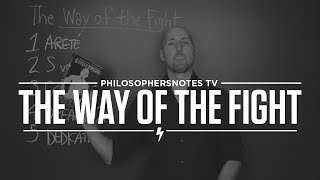
YouTube episode (Philosopher's Notes TV) by Brian Johnson summarizing five key ideas from Georges St-Pierre's book The Way of the Fight: 1) Arete — striving to express your highest potential (linked to Greek eudaimonia); 2) Sacrifices vs. decisions — framing life changes as deliberate cuts toward a mission rather than suffering; 3) Courage — healthy relationship to fear, built through practice and aiming for Aristotle's mean; 4) Dreams + 2 million steps — big goals require repeated small actions (illustrated by ~2.1 million steps for a 1,000-mile metaphor); 5) Dedication — sustained routines and consistency are the distinguishing factor behind excellence. The episode also contains brief promotional content describing the membership (250 Philosopher's Notes PDFs, MP3s, and classes).
Chapters
Hi, this is Brian. Welcome back to Philosopher's Notes TV Today, another great book, the Way of the Fight by Georges St. Pierre. Gsp. The Way of the Fight. Gsp. No subtitle necessary.
Awesome book.
Now, I'm not that into MMA, but somehow I got connected with Firaz Zahabi, GSP's head coach. He and I hit it off, became instant virtual friends. And then I was reading the Procrastination Equation by Piers Steele, who's a huge. He's a psychologist, a researcher who's the leading authority on procrastination, and he's a huge MMA fan and a big GSP fan. Told Faraz about that. He said, hey, GSP has a book. So I checked it out. I'm glad I did. It's awesome. Philosopher's Note, bunch of big ideas. If you do not know who GSP is, he is arguably, if not the, certainly one of the best fighters ever. Pound for pound, an amazing human being, and the book reveals his path to greatness. I love biographies in general, sports biographies in particular, to kind of get a peek into the routines and the mindset of what makes great people great. That's always been one of my passions, and it was a really, really fun book with a ton of big ideas. So let's jump in. Five of my favorites. Now, this is the first video I'm doing after launching our podcast, and I'm listening to that, and we share those as audio only. So I'm going to share the five big ideas real quick by themselves, and then we're going to jump in. So five big ideas we're going to cover. For those of you listening who can't see it on the whiteboard or chalkboard, arete is the first big idea. The second big idea is sacrifices versus decisions, big distinction. Third big idea is courage and how we need to practice building it. Fourth big idea is dreams. They're important, but then we need to take steps. Over 2 million of them. I'll tell you about that. And then the fifth big idea is dedication. So first big idea. Arete. Arete.
If you've listened to more than one.
Of these, you've probably heard me talk about arete, which is. Well, GSP talks about it early on in his book. He says a good friend of his turned him onto the idea. The word arete, Socrates, Plato, Aristotle talked about it. It has no direct translation into English or any other language, but it means something. The literal translation is excellence or virtue, but it means something closer to striving to express your highest potential, to live at your highest potential, moment to moment to moment. Arete. The Greeks said that arete is the engine of eudaimonia, which is their word for happiness, which really means flourishing. If you want to achieve great things in your life, live with arete. That's what GSP does, has done to achieve the level of success he's achieved and continues to do. How do you show up and connect to that engine within you that's propelling you to express the highest version of yourself? That's rta. That's the first big idea. In our interview with Jonathan Haidt that we just shared about the big ideas from his great book, the Happiness Hypothesis. Jonathan is one of the leading positive psychologists. He's literally the editor of the positive psychology journal called Flourish. He talks about arete. This is it. If we want to flourish, if we want to express our highest potential, we need to connect to that idea of expressing our highest version of ourselves consistently, which is what my work and these.
Sessions are all about.
Second big idea is a really good one. So you're committed to living a great life, right? Well, what's your dream? What's your goal? GSP tells us, jokingly, if you don't have time to read the whole book, you're not interested in it. Know this.
You.
You need to set a goal that inspires you. You need to set a realistic plan to go for it. Then you need to execute that plan. Then you need to repeat it. That's the roadmap in a nutshell. Now, when you do that, when you create your target, I keep on coming back to the Greek word telos. We're teleological beings, right? You have your target, then you want to hit that target. You're committed. As Stephen Cope describes it in the great work of your life, you have a sacred calling that dharma, the purpose, your mission in life. GSP's mission. And people thought he was crazy. We'll talk about it in a few minutes here. They thought he was crazy. When he said he wanted to be world champion, his dad said he thought he was nuts. But that was just a vision he had in his head. He could see it. He had this target. And then he decided to shape his entire life around achieving that goal, to become the best in the world at what he does. And then when he made that decision, he tells us he was no longer making sacrifices. It wasn't a sacrifice to go for this target. It was a decision. He decided to cut off a ton of things from his life. He didn't party anymore. He trained. He didn't waste time. He did what needed to get done. And he opens his book and I'll talk about this in the last Big Idea about dedication. He opens the book with his routines and what he does on a day in and day out basis and how it's absolutely consistent. He does this, then he does that, then he does this. He gets home at the end of the day, he does this and this and this and this and this. And he goes to bed and he starts again. But those weren't sacrifices for him. He was committed to something bigger than himself. And he simply decided. Remember the Latin root of the word decide? Decir literally means to cut. He cut off things that were not part of his mission. Wasn't making sacrifices, he was making decisions. It's a really cool distinction, sacrifices versus distinctions. The third big idea is courage. So I often mention the fact that when I read a book, I'm looking for one word that the author comes back to again and again and again. I mentioned with mastery Robert Greene's great book. His word was intensity. I don't know how many times he said intensity when describing Da Vinci and Darwin and the Wright brothers and all these amazing, great human beings. They were intensely committed. And then Idan Ravine in the last episode, the Hoops Whisperer. He works with LeBron James, Kevin Durant, all these superstars. And his word was greatness. That he came back to again and again and again. He wants greatness out of his athletes and out of himself. GSP's word, somewhat surprisingly, was fear. Fear was the word that he came back to again and again and again. It's amazing, right? This is the world's best fighter who's talking about his relationship to fear. And he shares some amazingly powerful wisdom. And for me, as a guy who used to be afraid of everything, I was so nervous in high school, I'd literally bring two shirts with me to school because I knew I was going to sweat through the first one before the first period was over. That's just how I was. Super nervous and afraid of everything. And I thought something was wrong with me. I thought everybody else was fearless and particularly the people that I admired. And before I studied this stuff, I absolutely would have thought GSP was fearless. How else can you get into the Octagon and do what he does for a living? But the reality is, as I studied this more and more and more, and it has GSP shares in his book, only idiots are Fearless. Crazy people are fearless. As David Reynolds says, super conservative, awesome, Zen plus Western therapy guy. He says Anyone who says they're not afraid of anything is both stupid and lying. One of my favorite quotes, anyone who says they're not afraid of anything is both stupid and lying. GSP is a huge fan of Aristotle, who tells us that there's a virtuous meaning, right? So there's a vice of deficiency, and then there's a vice of excess. And Aristotle told us, you want the virtuous mean, you want what's right in the middle. So when you look at fear, if you have, or courage for that matter, courage is the virtue in the middle. Right now, courage is a healthy relationship to fear. If you have too little fear in your life, you're going to be rash, you're going to be careless. If you discount it too much, you're not going to be virtuous. But if you have too much fear and you let it just kind of overwhelm you and you drown in it, then you're going to be a coward. That's a vice of excess or a vice of deficiency. In this matter of too little courage, you want to find your virtuous mean, but that requires us to have a healthy relationship with it. And again, the stories that GSP shares are amazing, of how he constantly, in the past tense and in the present tense, finds himself and puts himself in situations that he's afraid. When you talk about mastery and deliberately practicing where you're putting yourself outside your comfort zone again and again and again, you have to have a healthy relationship to fear. You have to have a growth mindset and a confidence that's earned by continually doing that, where you trust yourself and you know that you might get knocked down, but you can get back up and you can handle whatever it is that you're currently afraid of. It's a really cool idea. The other thing we talk about in the note, the fact that how do you build courage? Well, you build courage the way you build anything else through practice. And Aristotle says that excellence, AKA arete, is not an act, but a habit. It's what we repeatedly do. So when you find yourself afraid of something, quit telling yourself a story that something's wrong with you. Nothing's wrong with you. It's a condition of the game, and it's a condition of trying to live a great life. If you want to completely curl into a ball and go crawl into bed and not get out, okay, maybe you'll be able to avoid some fear. At least pretend you're avoiding fear. But if you're committed to living a great life, you're going to Experience it and then just practice facing it and getting a little bit stronger day in and day out. I'll share a link to a video that I have on how to conquer your fear. We're not going to go into that right now, but the lesson I want to share right now is gsp, one of the greatest fighters in the world, has an intimate relationship with fear. And he said, when you truly embrace it, it becomes a weapon. You can use it to your advantage in powerful ways because it's constantly challenging you to grow and you know you can handle whatever life gives you. Fourth big idea, dreams and 2 million steps. So dreams. I mentioned before that GSP had this vision, this dream of being the best in the world at what he does, and people around him thought he was crazy, but he could see it. And then he just got to work and he took. He has this great line in the book where he says, look, I knew that if I wanted to hit my goal and live my dream, I'd have to take the first step, and then I'd have to take another, and then I'd have to take another. I just loved it. I read it and I had this hit of. We all know that the journey of a thousand miles begins with the first step. But then what at the end, after you take the first step, then what happens? Well, then you take the next step and then you take the next step. And I just thought, you know, what's the math on that? If a journey of a thousand miles begins with the first step and we're not driving, we're not flying, we got to go a thousand miles and we're walking. Back in the day when Lao Tzu came up with that, right? How many steps is that? How many steps is a thousand mile journey? The quick math, if you are, I'm six one, right? It's about a two and a half foot stride length or so. Do the math on that. And if I did my math right, it's about 2.1 million steps. So when you have this big dream, super excited about it, you got to take the first step. That's the most important one. And then the next step is the most important one, the next one. And get prepared to take over 2 million of those steps if you want to actualize your potential. That's our fourth big idea. Dreams with hustle and hard work, which is the fifth big idea. Dedication. GSP tells us that he said if he's proud of himself, for one thing, the quality that he likes the most about himself, I think, is how he Framed it is his dedication. He says if I've achieved greatness in anything, it's my dedication. He said, I've never been the fastest, I've never been the quickest, I've never been the strongest. But I'm dedicated. And that's what I'm all about, is just making the execution of my routines and the decisions that I've made to structure my life in such a way that I could achieve what I wanted to achieve and to be so dedicated to that that the success was inevitable. That's what he was most proud of. That's what he thinks is the quality that most embodies who he aspires to be. Dedication. Absolutely love that. And what's exciting about that is you don't need to be the fastest or the smartest or the quickest or fill in the blank for whatever you think other people have more of. He said, look, you do this enough and you realize there are a lot of people who are better at any one thing than you. But you can be the best at dedication. That's not an inborn thing. That's a practice. Something that we can cultivate via practice, which is what Robert Greene talks about in mastery. Intense commitment to optimizing and actualizing. So there you go. Quick look. Dedication, dreams. Be willing to be a little crazy, and then back it up with 2 million steps worth of effort. Courage. It's not about not having fear. It's about feeling the fear, doing what needs to get done and practicing getting a little bit better at cultivating that virtue. Day in and day out. Sacrifices versus decisions. Victims say that they're making a sacrifice, so I can't watch TV or I'm not going to spend my time time online, whatever. When we're truly creating our ideal lives, we make decisions. We cut off things that don't support our mission and we celebrate that. And then the first big idea, Arete. Let's express the highest version of ourselves, moment to moment to moment, as we optimize and actualize. Hope you enjoyed. What was the big idea that jumped.
Out at you the most.
How do you make that a bigger part of your practical life day in and day out? Get on that and I look forward to sharing more. Have another awesome day. See you.
Hi, this is Brian. I hope you enjoyed that PNTV episode.
A lot of people don't know all.
The stuff I do beyond these free videos I share on YouTube, so I thought I'd do a quick video to give you an overview of our membership program that you can get access to and get a ton of other stuff. So here's a quick look. 10 bucks a month join the optimal Living Membership program. You get Instant Access to 250 Philosopher's Notes on some of the best optimal living books out there. Old school classics, positive psychology, modern stuff, mindfulness, Peak Performance, purpose, neuroscience, wealth, etc.
And what you may not know is.
That in addition to the PNTV episodes, I create PDFs on all these great books. So six page PDFs. Let's take a look at one of them. Joseph Campbell, you want to figure out how to live your hero's journey? Well, this is a great place to start.
I basically pull out my favorite big.
Ideas, riff on them, connect them to other books and other ideas and help you apply this wisdom to your life today. That's what the PDF looks like again, we have 250 of these on all these different great books. And then I record those PDFs as an MP3 so you can listen to that MP3 while you're on a walk or working out or doing some errands or whatever that is. Philosopher's Notes. A lot going on there. And then in addition to Philosopher's Notes, you get access to optimal living classes. Optimal Living 101 idea here is that all those great teachers come back to.
The same big ideas again and again and again.
I distill those ideas into classes. Super practical, fun, inspiring classes ranging from Habits101, Confidence101, Getting Stuff Done101 Meditation101, instant access to all those classes and then Future classes include Relationships 101 Energy 101 Purpose 101 business goals, etc. Those are our full length classes. And then I create micro classes. Two to three to five minute little bursts of wisdom on my favorite great ideas from these great books across the domain that you want to optimize in your life. So we have dozens of these so far. I create 50 new micro classes every month. 10 new philosopher's notes every month for 10 bucks a month. So we're blessed to have thousands of members who are enjoying the program and sharing some incredibly kind words with us. And super simple. 10 bucks a month. Cancel anytime. Would be honored to be a bigger part of your life and I appreciate your support. And here's to optimizing and actualizing.
More from Brian

Heroic +1: What’s THE Most Creative Act in the Universe?: Turning Around Glitches (#2024)









