PNTV: The Way Of The Seal by Mark Divine (#353)
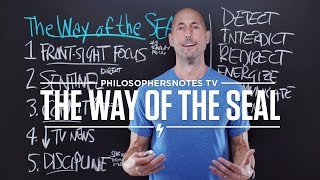
Brian Johnson (Philosopher's Notes TV) summarizes and reflects on Mark Divine’s book The Way of the SEAL, extracting five practical principles for elite performance and personal development. Key takeaways: establish a clear set point/purpose and a single front‑sight focus, use a trained “sentinel” to detect→interdict→redirect→energize→communicate→train your thoughts, commit fully to chosen goals, reduce attention‑draining TV/news, and cultivate disciplined habits that make extraordinary effort habitual.
Chapters
Hi, this is Brian. Welcome back to another episode of Philosopher's Notes TV Today, another great book, the Way of the SEAL by retired commander Mark Devine. The Way of the SEAL Subtitle Think like an Elite Warrior to Lead and Succeed. This is the second book of Mark Devine's that we have featured. The first was Unbeatable Mind. Both of these books are amazing. I'm a big fan of Mark and over the course of the last year or two, we have gotten to know one another and consider him a good friend. Now when we are texting, as it turns out, when I text, I'm taking a break right now, but when we text, apparently the last four digits in my cell phone number are 5320. That apparently is basically a junior seal. So I say, hey, Commander, and then I sign it off with 5320, which for me is a sign of humility and respect to the good commander. In any case, we've got a philosopher's note, bunch of my favorite big ideas. We've got five of them here. Let's take a quick look. So the Way of the seal, how to Become an Elite Performer in our Lives. Mark talks about the fact that he uses the word warrior as both a real, you know, individual that he is and has been trained to be with 20 years of service as a officer in the SEALs, he's got 25 years as a martial artist and then he's also built six multi million dollar businesses. But that idea of a warrior who's out there striving to be the best version of themselves, we're going to bring that to our lives and, and look at the eight principles of performing at an elite level like a Navy seal. The first one is to establish your set point to get clear on your values and your purpose in life to know who you are and what you're here to do. The second principle is to have what he calls front sight focus. So as a warrior, we need to have front sight focus. We know what our target is. Mark makes the point that we need to get really clear on what that is. And you got to also know that one of the reasons why seals can perform at such a high level and do what appears to be so much is that they take one target at a time. You can only have one target in your front sight focus. This is similar to what we talked about in the four disciplines of execution. You need to know what your wildly important goal is. They say you can have one or two. You're only going to go one into that front side focus, right? But you certainly can't have 3, even 3 or 5 or certainly not 5 or 10 or 20. You can't defuse your efforts. You need to get clear on what's worthy of you and then be willing to go all in on that as you do that. You're going to face challenges obviously. And one of the principles down the road is to when you inevitably face the challenges, the fog of war, the chaos of war, as Mark describes it, you need to simplify your battlefield and create micro goals. So you have your big wildly important goal and then we need to break it down so we have our next micro goal. We're hitting after or going after. Front side focus. Front sight focus. Front side focus. So the question for you is what is in your front sight focus? What is the most important goal you are working on in your life right now? If you want to operate at a higher level, get clarity on that, then have the combined clarity and courage to, to actually go out and execute that mission. That's our first big idea. The second one is the sentinel. So Mark talks about the fact that we need to gain control of our mind. He wrote an entire book on this called Unbeatable Mind. But in this book he walks us through what he calls the direct process. So first imagine you have a sentinel who is observing the traffic going in and out of your mind, right? So you've got a sentinel that is always on duty. We want that sentinel to always be on duty. This is why we meditate, this is why we train our mind. And we can do this to optimize Mark Devine style. So he says we need to use our sentinel to direct our mind. Acronym for what? First thing we need to do is we need to detect, we need to know when our mind is off, alright? So you need to be able to detect the negative thoughts. And you got to know that detecting the negative is actually a really positive thing. Simply having the awareness of what's working and what's not is always the first step. Now when you notice that that's not enough. You can't just notice it, then let it run all over you. You've got to do what he calls interdict it. You need to stop it. You need to literally say to yourself, stop. Nope, not letting that train of thought go. So you direct it, you detect it. Rather you interdict it and then you redirect it, right? So you notice it was going in the wrong direction. You stop that. Then you redirect it into the positive direction that you're committed to flowing in. And then he says, you need to energize it. You need to get powerful, energize it with a sense of presence and emotional energy. So you're excited about what you're going to do. And then you communicate to yourself in a positive way one of Mark's mantras, which, again, mantra literally means a tool of the mind. One of his mantras that got him through hell week, and then he uses, at least when he was writing this book, all the time. He is looking good, feeling good, I should be in Hollywood. When you're having a tough time and you're chanting that to yourself focuses your mind in a powerful way. As I said in the note, when I first read this, I just loved that phrase. So I started saying it, and Emerson would start saying it. He loved it. He had no idea where Hollywood was, but he thought it was pretty funny. And then Mark came out and visited us not too long ago. Emerson got to meet him. And Mark is kind of my hero that I talk about. What do you think Commander Divine would do? Right. When we're celebrating Veterans Day, we're thinking about Mark and his service and his contribution. But we want to have that fun dialogue with ourselves, right? So we've detected the negative, we've interdicted, we've stopped it, we're redirecting it to the positive, we're energizing it, we're communicating to ourself. And then what? Then the final step is you need to train that. That can't be a I do it when I feel like it thing. I do it once in a while. It's got to be in every time we notice that our mind is going in the wrong direction. We train it. We train it, we train it. So that becomes the default position, which we're going to talk about more in our final big idea. But that's your sentinel directing your mind in the most powerful, positive way. Another thing that Mark says, I think it was an unbeatable mind. First, you. You need to win in your mind. You're never going to win in life if you can't get yourself to win in your mind. And if you're allowing these negative thoughts to just go off whenever they want to, we won't have that mental discipline which is the source of mental toughness. So direct your mind. The third big idea here is you got your front side focus. Then you need to commit. You need to be willing to go all in. Mark quotes the most wonderful, wise Jedi ever, Yoda do or do not. There is no, try decide what you're going to do, get clear on it, do your whoop, process through it. Is it attainable? Can you really do it? A stretch goal, that's not a snap goal, it's a stretch goal that you can do, get clear and then be willing to go all in. This psychology of utter commitment is what my coach Phil Stutz describes it as. And when he read one of our plus ones on Mark Devine, simplify the battlefield, he absolutely loved it. That idea of simplifying your battlefield, maintaining frontside focus and then being willing to go all in. So psychology of utter commitment, you're all in. Mark says that commitment is a one way street and too often we say, yeah, I'm going to do this and it gets a little tough when we back out, right? So we've got to know it's going to be challenging and then commit, go all in, etc. So think about that. And then again, as you start doubting yourself, simplify your battlefield. Make your goals smaller and smaller and smaller as you do that. One of Mark's big themes as well is you 20x your potential. So in one of his trainings he has his students assume the plank position, for example. So how long do you think these guys hold the plank position for? If I went down and did that, I haven't done that for time in quite a while. Right, but you're thinking in like minutes, right? Like, okay, I don't know, like minute and a half, two minutes, three minutes, maybe four minutes, five minutes if you're really feeling it. Right. We were chatting literally last week about this and 63 minutes. Something absurd like that is how long these guys and women hold plank. How do they do that? Well, they simplify the battlefield. They're focused on what they're going to do. And he has some other techniques that he teaches, including the breath and mantra, et cetera. But we need and they're committed is the point with this. They're committed to doing their best. You can do some amazing things when you're willing to step up with that level of intense commitment. The fourth big idea here is reducing TV news. So in the note I quote Mark and he's got some great thoughts on this, about how pernicious the TV news is. And his advice is very simple. Eliminate it. It's obviously deliberately negative. That's how they're going to capture your attention. We've just got to continue to be aware of how many different things out there are trying to capture our attention in different ways. And obviously there's a lot of great information out there, but we need to know that all that information is consuming our most valuable asset, which is our attention. Then be very, very, very selective in what gets in through that sentinel's gate. We've talked about it in prior episodes, but the quantity of TV talk shows you watch is really highly correlated to your levels of anxiety, depression, etc. All the stuff you don't want. We talked about Kelly McGonagall's upside of stress. People who watched over six hours of the Boston bombing news reporting, watched it on TV had more post Traumatic stress disorder symptoms than people who actually experienced it. Alberto Violdo has the great line, and he says that our minds evolved to deal with one lion at a time, right? We deal with that fight or flight, we'd either dead or we escaped. And then we shake it off. Right now it's as if the entire jungle is roaring at us all day, every day. And our limbic system didn't evolve to handle that level of stress. We need to have the discipline to disconnect and then put our energy into what we've said is the most important. The amount of energy that we reclaim when we do that is huge. So think about that and think about if you can eliminate some of the unessential news you might be consuming or echo chamber perspectives, et cetera, and get to work on what really matters and how you're going to deal with the challenges that exist in the world today rather than simply react and get stressed from it. Our fifth and final idea is discipline. Mark tells us that it's discipline that is the spark that leads to habits. And he says the ancient etymology of the word discipline is literally to be a disciple to something. He says we need to be a disciple to our highest selves and be willing to commit to mastery such that we can serve that highest version of ourselves and give our gifts, as I would say, in greatest service to the world. So discipline is the spark that allows those habits to come through, that allows us to shine as powerfully as we can. And he has a great line. He says when extraordinary effort becomes commonplace, when it's just normal for you to show up and do extraordinary things, effort wise, extraordinary results are going to follow. So think about that. When you have extraordinary efforts to an extent that's just habitual, it's just who you are, it's commonplace, extraordinary results going to follow. That's the essence of performing at an elite level, Navy SEAL style. In the process, you're reducing or eliminating TV news. If you're feeling it, you're committing. You're going all in. Do or do not. There is no try one way street. Make the choice. Decide. Do it. The Sentinel helps us detect, interdict, redirect, energize, communicate and train our minds moment to moment to moment as we maintain front side focus on that wildly important goal that that we decided is most important to us. The way the seal Mark Devine Check out the book, the Note, his site, etc. If you're feeling it and think about what idea most landed and how you can go out and make it a more integrated part of your life. Starting today. Get on that. Make today another awesome day. See you. Isn't it a bit odd that we went from math to science to history but somehow missed the class on how to live? For some wacky reason, optimal living 101 never made the schedule. Of course it's too late to go back and change that and you're too busy to read full time to catch up. But if you're like us, you're all about optimizing your life so you can actualize your potential. So imagine this. Imagine having someone read the best books on how to optimize your life and pull out the big ideas that can really change your life. You know those sections. You underline an asterisk and mark all up. Then imagine that guy me connecting those awesome ideas to other great books and helping you actually apply the wisdom to your life today. Well, that's what I do with something we call Philosopher's Notes where I've distilled hundreds of great books into 20 minute super practical summaries. Then imagine me taking the absolute best big ideas from those great books and sharing them with you in hour long Optimal Living 101 classes on everything from productivity, purpose and confidence to nutrition, goal setting and conquering procrastination. Helping you optimize every facet of your life so you can actualize your potential. You've got a personal trainer. I'm kind of like your personal philosopher. Ancient wisdom, modern science, and practical tools. That's what our Optimized membership program is all about. If you're feeling it, we'd love to have you join us. Sa.
More from Brian

Heroic +1: What’s THE Most Creative Act in the Universe?: Turning Around Glitches (#2024)









