PNTV: Toughness Training for Life by James E. Loehr (#218)
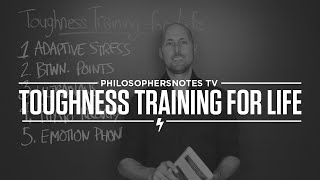
Brian Johnson (Philosopher's Notes) summarizes Jim Loehr's Toughness Training for Life, focusing on five practical ideas for building mental, emotional, and physical toughness. Key points: find and train within an adaptive stress zone (between undertraining and overtraining) across physical, mental, and emotional domains; train recovery practices by imitating elite performers' between-point routines; honor circadian and ultradian rhythms (90–120 minute work cycles with 15–20 minute recovery); prioritize physiological fundamentals (exercise, nutrition, sleep) as the base for higher-level performance; and treat negative emotions as signals (an "emotion phone") indicating unmet needs to address. The episode emphasizes creating stress-and-recovery "waves" rather than chronic linear stress or flatlining recovery.
Chapters
Hi, this is Brian. Welcome back to Philosopher's Notes. Tv. Today, another great book, Toughness Training for Life by Jim Lore. Toughness Training for Life. We did another one of his books called Toughness Training the New Toughness Training for Sports last week. As I mentioned in that episode, I'm kind of feasting on Jim Lohr's wisdom right now. He also wrote the Power of Full Engagement. That book and another older book on mental toughness and that good stuff. We have a philosopher's note with a bunch of big ideas and five of my favorite big ideas. Very exciting new piece of chalk. So five big ideas. But before we jump into that, let's do a quick recap of what we talked about last week. The cornerstone of Laura's ideas on training toughness is to make waves, right? So we talked about the fact that we got to create stress in our lives, which stimulates the opportunity for growth. But then we grow in the recovery and then we challenge ourselves again and then we recover. We challenge ourselves, we recover, we make waves. We do not want to be flatline. Your heart when it's on an EKG is making waves. The only time it's a flatline is when you're dead. Same with our lives. We don't want to be in a chronic state of stress. We also don't want to be in a chronic state of recovery. We want to make waves by challenging ourselves with stress and recovery. That's the basic idea. Now, these five ideas are distinct from what we talked about last week. Good stuff. Adaptive stress. I think I'm going to do an entire episode just on this. The journal will lend itself well to talking about this in some more depth. But here's the basic idea. We have different types of stress that we can put ourselves under, right? So here's stress. We have low stress and high stress. And then there's time here. Right now, we can have a low level of stress and that's under training. We can have a high level of stress, and that's overtraining under training, overtraining, high levels of stress, you can't handle it. And then under training, too little stress, it's not stimulating you. What's interesting is they both have similar effects. If you're over training, you're going to feel fatigued, you're going to feel burned out, you're going to lack motivation and you're not really going to want to show up. But if you're under trained, you're actually going to have some similar fatigue, lack of energy, lack of motivation, etcetera and he says the key is you want to play right here. That's your adaptive stress level. This is called your maintenance stress level. It's more than under training. It's enough to keep you in your current state of fitness and well being in any aspect of your life. What we want to do is move into our adaptive stress zone. Your adaptive stress zone works in the three domains that he talks about. Your physical life, your mental life and your emotional life. You want to push yourself outside of your comfort zone so you're overloading yourself with more stress than you can currently handle. It's how your muscle builds strength, right? You push your muscle past the point that it can easily bear whatever weight you're putting on it. Not too far. You don't want to go all the way up here where you injure yourself and you overtrain, but enough that you force an adaptive response. That adaptive stress is the cornerstone of growth. That's what we want to find in our physical, mental and emotional domains of our lives. And he makes a really interesting point that athletes are typically over trained. They're over trained both physically and emotionally. They're pushing themselves hard. But he says with non sport life, most people are emotionally over trained, but physically under trained. Isn't that interesting? And what's really cool. And he talks about this and I talk about it in the note a little bit more. I'm not going to go off on it right now, but if you want to deal with your emotional over training, one of the best ways to do that is to get your physical training up to an adaptive level. Simply doing that builds more emotional toughness. Huge idea. Save that for another time. Second big idea. Here is the time between points. This is fascinating. This. Jim Lore is one of the world's leading sports psychologists and he worked with primarily in the early part of his career, tennis players. And he spent two and a half years studying elite tennis competitors. And he wanted to understand what made them tough. And he watched them month after month after month live and video. And he was trying to understand what differentiated them. And he couldn't figure it out because their playing time, when they're actually playing the point, they look so similar, right? Their technique was similar, blah, blah, blah, blah, blah. And what he found was it was the time between the points that the tough competitors differentiated themselves from the non tough competitors. And what's fascinating is that in tennis each point is followed by or preceded by a 25 second little break. You 25 seconds between points in tennis. And he makes the point that in a two hour tennis match, they might only be playing for 20 minutes. Something like 80% or more of the time is between points. And he realized, wow, what you do between points is really important. And the toughest best competitors were more consistent with in recovering during the point after the point, during the point, after the point. The toughest competitors were really good at creating waves. The non tough competitors were more linear. Their heart rate didn't come down. They were talking to themselves negatively between points. If they made a shot they didn't like, you can tell they were physically frustrated. But the tough competitors always did basically the exact same thing. They look at their racket in a certain way. You'd see them mouthing certain words to themselves. They mastered the art of recovering. That's what he discovered between the points. And he says, we need to do the same thing. If that's so powerful, being able to make these waves go up, go down. We all know how to go up. Life is stressful. We're constantly being bombarded with challenges. We need to train recovery as much as we train the stress, the work. Super big idea. So you need to think about how you are recovering. We're going to talk about that in these next couple ideas. Third big idea, ultradian rhythms. So circadian rhythms are our 24 hour rhythms. You want to pay attention to that, that's your strongest link. Those rhythms are some of your strongest links to the world. If you haven't noticed, certain things repeat every 24 hours. We, having evolved over millions of years, evolved to be aligned with, in rhythm with those rhythms. So, so you ignore your circadian rhythms at your own risk. And then there are little microrhythms throughout the day that are called ultradian rhythms. Ultradian rhythms are 90 to 120 minute cycles of energy that then needs to be adequately supported with recovery. Old Tradiens, 90 to 120 minutes you can have for a work cycle and then you want to take 15 to 20 minutes of recovery and you want to bake that into your schedule. Just like those tennis players who were elite. They didn't sit here and flatline at the top. They recovered between points. They only had 25 seconds, but they recovered better than those who didn't compete as well. You need to. And we need to cultivate the skills to recover better. So when you schedule your day, look at it and say, okay, well I'm going to get up at this time, hopefully in sync with a circadian rhythm, going to bed at the same hour or very similar hour, plus or minus 30 minutes. And getting up at the same time, plus or minus 30 minutes, and then bake in a really cool schedule for your ultradians. Don't work longer than 120 minutes consistently. Violating your circadian and ultradian rhythms is a great way to create chronic fatigue, depression, hope, hopelessness, and just a sense of burnout that's over training. We need to make those waves shatter the linearity by baking in recovery. And you can do whatever you want. Go for a walk, take a nap, do a little workout, read whatever is restorative for you. Build that into your day. Have fun creating optimal ultradian rhythms. The fourth idea here is another big one. He says again and again and again and again and again and again and again throughout this book and the other book and again, that if you want to optimize your potential, here's your potential. And he compares his model of toughness training to Maslow. Who's got this hierarchy? Well, guess what? What's at the base of Maslow's hierarchy? Your basic physiological needs. Just as you're not going to spend a whole lot of time thinking about how you can actualize your potential, if you're worried about where your next meal is going to come from, you're not going to develop your peak potential in terms of toughness. If your physiological base is all jacked, you need to take care of this simple stuff. It's what we talk about all the time. Physiological fundees or fundamentals. Your exercise, your nutrition, your rest, your relaxation. Again, he comes back to this again and again and again. Vince Lombardi said, fatigue makes cowards of us all. If you're tired in a tennis match or in life or you're hungry, you're not going to perform at your highest level. So always attend to your physiological fundies first. He says he doesn't use fundies, but you get the idea. So think about you. Where are you weakest in your physiological fundamentals? Is it your nutrition, your rest, your exercise, your ability to unplug and just relax? Think about that and then identify what's one little thing you can start doing and you can do today and, and tomorrow and the day after that to optimize that just a little bit? Get this base dialed in. If you want to actualize your potential, you're not going to get here if you don't have a strong base here. That's our fourth big idea. The fifth big idea. Emotion Phone. He has some great ideas related to your emotions, and he basically says that your emotional toughness, you don't have as much Control over your emotions directly as you do your thoughts and your physical toughness. So your physical toughness and your mental toughness, you have more direct control over than your emotional toughness. But by focusing on your physical toughness, your mental toughness, you create emotional toughness. Very cool idea. And he says you need to realize that if you feel negative emotions, it's very much like an athlete who, who feels pain physically. So if an athlete has a sore knee or a sore ankle, they pay attention to that and they get the proper training and recovery so that they can get in a place where that's no longer painful. Now, if you have emotional pain, Lor tells us, it's as if a phone is ringing. The phone's ringing, and you can choose to ignore that at your detriment, or you can answer it and say, hey, what's up? Oh, yeah, I'm feeling 10 tired or hungry or irritated or angry or afraid or lonely or whatever. Negative emotion. And then we can say, well, what need is that pain telling me I need to address? What unmet need do I need to fill in order to make that phone stop ringing? He says, look, there's soft rings, then there's really loud rings. Soft rings are mild upset and frustration. The things I just listed. Strong, loud phone ringing that hurts your ears. It's so loud is stuff like depression and really, really strong fear, hopelessness, etc. So we want to. Those are very strong needs that we need to look at and say, hey, what need in my life am I not paying attention to? And start here. Start with your physiological fundies. You don't need to make it something big and dramatic and esoteric. If you sleep four or five hours a night or six hours a night even, and you don't feel great, well, guess what? That's not particularly complicated. You need more sleep. If you're not eating well, if you're not exercising, those are basic physiological needs that your emotions might be ringing very loudly about that you can address quite simply by altering your behavior, et cetera, et cetera. Anyway, think about that. A phone ringing. Don't ignore it. Answer the phone and say, oh, thanks for letting me know. Yeah, you're right. I'm feeling this. This is what I can do to address that need. Okay, great, thank you. And then go address it whenever you can. If it's a better night's sleep tonight, go get it. And then put yourself in a positive state and get back to what you need to do right now. We talk about it a little bit more in the note. But that's the basic idea. Emotion, phone, physiological recovery and your fundamentals. Ultradian rhythms. 90 to 120 minute cycles. Go with the circadian rhythms between points. Fascinating stuff. What can you do to create recovery between your points, between your playing and performance time during the day? Know that's a key to performing at a high level. And then adaptive stress, we've got under training, we've got maintenance training, we've got overtraining way up here. Then we've got adaptive training, adaptive stress, which is how we train our toughness. Challenging ourselves a little bit more and then letting ourselves recovery through, trained recovery and, and becoming a little stronger, a little more optimized day in and day out. Hope you enjoyed and I look forward to sharing more with you soon. Have another awesome day. See you.
More from Brian

Heroic +1: What’s THE Most Creative Act in the Universe?: Turning Around Glitches (#2024)









