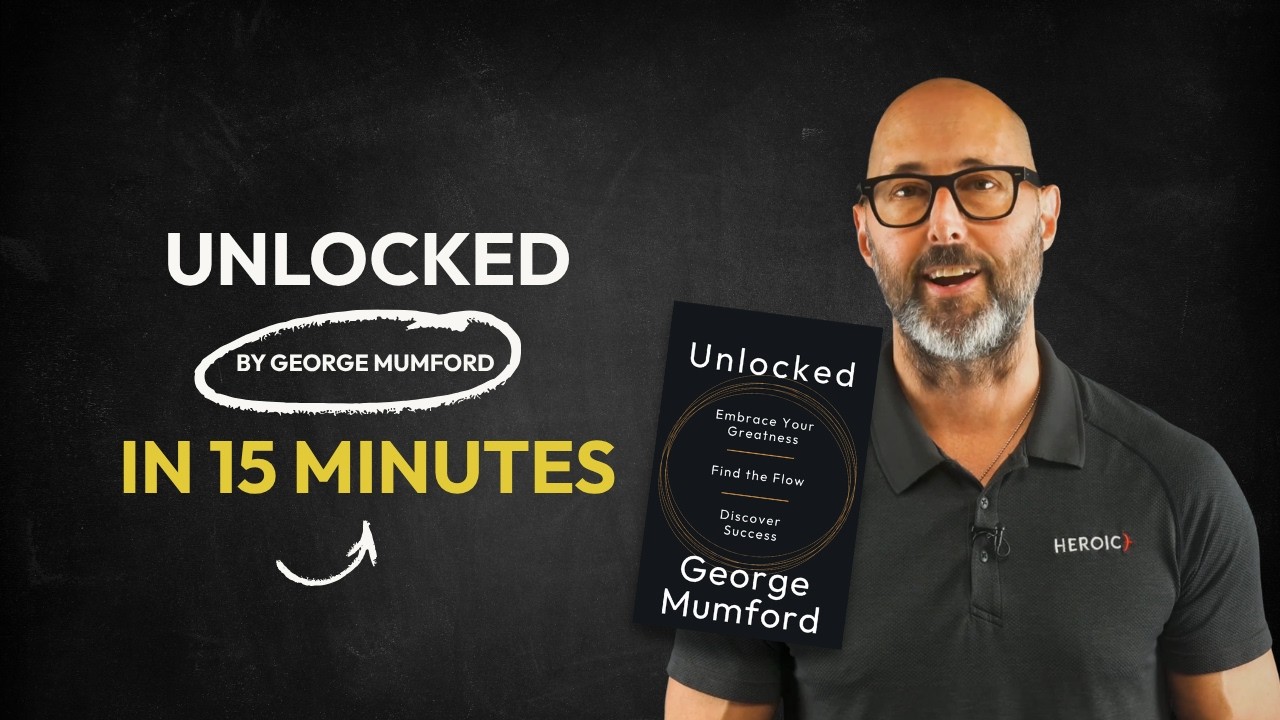
In this solo‑host episode of Philosopher’s Notes TV, Brian Johnson reviews George Mumford’s book Unlocked and weaves together Mumford’s personal transformation—from heroin and alcohol addiction to coaching the Chicago Bulls, Los Angeles Lakers, and other elite athletes—with timeless mythic structures and performance principles. Johnson frames the content around five core ideas: (1) the Hero’s Journey as a continuous, day‑to‑day process of answering calls to adventure, facing trials, and returning transformed; (2) the “masterpiece within” metaphor, illustrated by Michelangelo’s David and the Golden Buddha story, which emphasizes chiseling away obstacles to reveal innate greatness; (3) the necessity of an “all‑in” attitude—turning up the heat, embracing intense training, and refusing days off—to unlock peak performance; (4) the ancient Greek concept of the daimon and eudaimonia, positioning personal fulfillment as aligning with one’s guiding spirit; and (5) practical steps for moving from theory to daily practice, encouraging listeners to close the gap between their current self and their potential. Throughout, Johnson references Joseph Campbell’s monomyth, the documentary Finding Joe, Steven Pressfield’s War of Art series, and his recent conversations with Olympic swimming coach Bob Bowman, reinforcing the universality of these principles across sports, art, and life. The episode ends with a call to action for listeners to identify their own heroic call, chip away at limiting patterns, and live an unlocked, heroic life.
Chapters
From addicted to alcohol and heroin to sitting behind the bench for the Bulls, the Lakers, etc. Now, to exit your comfort zone to become the next best version of you. Now, you get big calls, but you also get micro calls all day, every day. It's not one and done. You don't live one hero's journey, then call it a day. A good life is one hero's journey after another. That deep sense of aliveness when you connect to your daimon. And then your job is to remove everything that's getting in the way of you forming that connection. Hi, this is Brian. Welcome back to another Philosopher's Notes TV. Today we've got another great book, Unlocked by George Mumford. I'd hold up the book, but it is currently lost somewhere in my library. Too many books, folks. We do have a Philosopher's Notes on it that you can get for free. Check out the show notes. George Mumford is one of my absolute favorite human beings on the planet. He wrote a book called The Mindful Athlete. And then this is his second book, Unlock, that we're going to talk about today. But as we've discussed in different contexts, he was the coach, the mental toughness mindfulness coach that Phil Jackson brought into the Chicago Bulls and the LA Lakers to work with Michael Jordan, Scottie Pippen, Kobe Bryant, Shaquille O'Neal, guys like that. He has worked with the most elite athletes in the world. And his story, which we're going to talk about, is in itself unbelievably inspiring, from addicted to alcohol and heroin to sitting behind the bench for the Bulls, the Lakers, etc. Now, George and I connected a couple weekends ago with Bob Bowman, who we featured in the last TV episode. Bob is Michael Phelps's coach. George, coach of Jordan and Kobe, etc. And I got together, um, with the Inner Game folks to talk about peak performance, mental toughness, etc. Check out our last episode on Bob's book, The Golden Rule. Kind of excited. Next week, working with Bob and his UT swim team to see if I can help them three-peat. Let's go! All right, let's get to work. So we've got 5 ideas here. We're going to talk about the hero, the hero's journey, the masterpiece within, which is what George talks about when he talks about getting unlocked, connecting to that best version of you, the fact that these great elite performers didn't take days off, Neither should we when we are on the ultimate quest to become unlocked. We'll start at the top. We'll talk about the hero. So the hero of the book is you, but George's story is unbelievable, and he talks about Joseph Campbell and the hero's journey. As we've discussed, as a guy with heroic tattooed into his arm, I'm kind of into the whole hero's journey. Check out Finding Joe, the documentary. We'll link to that in the show notes if you haven't watched that yet. Basically a modern look at Joseph Campbell and the hero's myth. So there are 3, essentially, if you're going to boil it down, right? There's 3 components to the hero's journey. Number 1, you receive a call to adventure, to exit your comfort zone, to become the next best version of you. Now you get big calls, but you also get micro calls all day, every day. First step in the hero's journey. Now, first rule, Of the hero's journey. And this is what you see when you watch Star Wars or The Odyssey or whatever. The hero almost always refuses the call. So my hunch is you are either on a hero's journey right now, or— and/or, because you're always evolving on a hero's journey even if you're on it— you're hearing a call that you may or may not be paying attention to. But nothing happens until you answer the call. Nothing happens until you're willing to take those first courageous steps Off the beaten path. Then what happens? Well, then basically you face dragons, right? You get trials. The hero faces trials. They face metaphorical and real dragons and all that good stuff. We don't go watch the hero's journey— The Odyssey, just watched it for the second time with my almost 14-year-old son, right? I didn't want to see Odysseus just sitting on the beach eating lotus leaves with Calypso all 3 hours or whatever it was of the show. I want to see him battling dragons and Cyclops and facing all the challenges that a hero faces on their heroic quest. Now, important point here. George, when he talks about his own story dealing with his addiction to alcohol and heroin, and he's now like basically 40 years in recovery, but that hell, he says, quoting a great Zen teacher, that hell was training. The dragons we face, the challenges that we are challenged to overcome, are what forge Our strength. I should also mention, the hero, when they answer the call, they get buddies, other people on the quest with them, and they get guides. Dumbledore, Gandalf, fill in the blank, right? Then the third part is we return. We return transformed. We become more unlocked, to use George's term, right? We transform our consciousness, we come back, and we serve. We bring our gifts back. And our principal gift that we bring back is our transformed consciousness, having answered the call, face dragons, and becoming a better version of ourselves. So again, super inspiring. George's story is unbelievable, and he talks about how, you know, he's worked with not only the elite performers but people who are serving life sentences who have transformed their lives and become unlocked. So each of us is called in our own unique, idiosyncratic way to answer the call, face our challenges, become the better version of ourselves, and live The ultimate heroic quest. And remember, Joseph Campbell tells us a good life is not one and done. You don't live one hero's journey then call it a day. A good life is one hero's journey after another. We're constantly spiraling up and evolving, answering the call, facing new challenges, and becoming a better version of ourselves. And the real master in this process has 1,000 hero's journeys in any given day. Steven Pressfield wrote a whole book on it in his War of Art series— War of Art, Do the Work, Turn Pro. Well, one of them is called The Artist's Journey, and he says, look, Jay-Z goes on a 1,000 Heroes Journey every day. He needs to challenge himself to leave his comfort zone and to become that next best version of himself. So again, we're constantly going through this evolutionary spiral. Why? So that we can release the masterpiece that exists within us. Again, that's what it means to be unlocked. We'll talk a little bit more about how I frame it up in a moment. But George likes to say we each have a masterpiece within, and he uses the Michelangelo story you might have heard of where when he's carving David, the huge statue, 14th century, right, in Florence, and he saw it in the marble. The statue was there. What he needed to do was to remove what was in the way. George says the same thing with us. All the great spiritual and peak performance teachers say the same thing: quit getting in your own way. Remove the things that are blocking you from becoming connected to that best version of yourself. Chip away at what is in the way. One of the stories I share in the note is on the Golden Buddha. The Golden Buddha is actually the story Alan Cohen shares at the beginning of the documentary I mentioned called Finding Joe. The story briefly is there's a huge golden statue of Buddha. I think it's in Thailand back in the day, right? And when I first heard this, I thought it was just a story. Oh, that's a cool metaphor. But it's actually real. Once upon a time, there was this huge golden statue and an invading army was coming into town, and the monks at the monastery were afraid that their statue would be melted down for gold and destroyed. Rightfully concerned. So what they did was they basically put clay and plaster and other stuff on top of the golden Buddha so it looked like a clay golden Buddha with no apparent worth. Well, the invading army comes in, they conquer the land, but they don't think anything about that big clay mud statue, right? Well, fast forward X years and decades, and the monks who did that are no longer there. And the monks who are now there don't know that underneath the mud is this golden Buddha until they move it from one location to another and a piece of it breaks off. A piece of the mud, the clay, breaks off, and lo and behold, underneath is pure gold. They chip away, chip away, chip away, and the thing's worth hundreds of millions of dollars. Crazy true story. Excuse me. I don't have any water. And I'm not going to take a cut on this. We'll see if I can get through. Let's go. I don't edit these. I'm not going to do the punchy, punchy, punchy edits. You're in a classroom with me. Let's go. Sip of water. I'll have it with me next time. So that's the Golden Buddha. That is the masterpiece within. That is what you and I need to do— chip away at the things that are in the way so we can express the best within ourselves. Now, in order to do that, you got to know it's not easy. Now, it's harder than you would like it to be, but it's not as hard as you think it will be, right? Harder than you may want it to be, but not as hard as you think it will be. But George tells us, look, we got to turn up the heat. We got to have what Bob Bowman calls an all-in attitude, right? That was the second rule in his golden rules. First, you got to dream big. Second, you got to go all in. You got to activate. You got to hit that 212 degrees where water boils. You got to hit the 451 degrees where paper is ignited with fire, right? And you got to enter the forge at 2,000 degrees, which we've talked about in different contexts many, many times. You got to activate. You got to go all in. And you got to remember The great ones don't take days off. Now, of course, part of your training is recovery, but you are constantly on the ultimate quest to become unlocked. And this leads us to the final idea, obviously, but the way that I frame it up, ultimately, if we want to be unlocked, we've got to connect to that best version of ourselves. The ancient Greeks called that your daimon. And the ultimate purpose of life, the ultimate quest, was to be a eudaimon, a good soul, to connect to that guiding spirit within you, to experience eudaimonia, a sense of deep joy and flourishing as you create a meaningful life. Not easy. You're going to go through challenges, but you know you're doing your best, and you feel that deep sense of aliveness when you connect to your daimon. And then your job is to remove everything that's getting in the way of you forming that connection. Right? And we can talk about this for hours and hours and hours and weeks and months because this is what I've spent my life trying to help us take off the bumper sticker and make a reality in our lives. But that's what it means to be unlocked, to connect to and express that best version of ourselves. And that's what the ones we admire the most, whether it's athletes or spiritual teachers like Gandhi or leaders like Nelson Mandela, whoever it is you admire, that's what they've done. That is our primary job, to connect to and to express The best within ourselves. Remembering it's an all-day, every-day— close the gap. Live with arete was how the ancient Greeks and Roman Stoics said we can achieve that state of eudaimonia. Close the gap between who you're capable of being and who you're actually being. Moment to moment to moment. Boom. We're expressing ourselves. We are unlocked. Remember that masterpiece within? Get on the journey. Be the hero of your own story. You are the hero we've been waiting for. It is a privilege to spend time with you. That is a quick look at this great book. Check out the notes, check out the book, check out George Mumford, who is just the— he's the embodiment of these ideals. To sit next to him and to feel his joy, his passion, his love was, um, just a treat. We had connected and traded a lot of texts over the years and connected with videos and whatnot, but I hadn't met him in person until a couple weeks ago. And just to feel his joyful, loving presence, um, was, was just an absolute treat. So hope you enjoyed. As always, most important part of our time together What's an idea or a distinction that kind of jumped out and landed for you? I hope there was at least one. What was it for you? And how can you move from theory to practice to mastery on that? Let's do it together. Let's do it today. Hope you have another great day. See ya.