PNTV: Unsubscribe by Jocelyn K. Glei (#356)
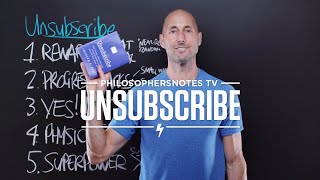
Jocelyn K. Glei argues email and smartphones work like slot machines, rewarding you randomly so you keep checking. The fix: do your meaningful work first, before touching email. Track progress visibly and send fewer emails, since every message you send creates incoming work that pulls you away from deep focus.
Chapters
Hi, this is Brian. Welcome back to another episode of Philosopher's Notes. TV Today, another great book Unsubscribe by Jocelyn Glei Unsubscribe Subtitle how to Kill Email Anxiety, Avoid Distractions and Get Real Work Done Jocelyn Gleich Great book. This is the fourth episode and note we've done on Jocelyn's work. She did the 99U series which included Maximize youe Potential, Manage youe Day to Day and Make youe Mark. All of her books are great succinct, quick reading encapsulations of those given themes. The other ones she was the editor of and contributed along with a number of other world class thinkers. This is all her and and it is all awesome. As you know, I'm a huge fan of unsubscribing unplugging from technology. This is a great little manifesto and manual on how to go about doing that while still engaging meaningfully with the world and doing the work you're here to do with that. Philosopher's Note as always, PDF MP3 favorite ideas here. Let's jump in. First one, Jocelyn has a number of different sections in it. The first part is looking at the psychology. What's going on? Why do we have such a tough time unsubscribing? The short story is we're addicted to email and to other distractions. In Irresistible. Our episode on that great book, we talked about the fact that there's a rise in addictive technologies and for every screen you're interacting with, there are a thousand people on the other side trying to get you to stay there. The attention economy is based on mining your mind. Essentially. If you look at the stats, it's stunning how much we are addicted to these technologies. Whether it's push notifications, the amount of time we spend on our smartphones, or how quickly we respond to emails. The Average response time 70% of the people in the workforce respond to an email within six seconds and they check some crazy number of times per day. They used to be me as well. I'm now on the other extreme. I don't use email at all, which is obviously radically extreme and deliberately so. But anyway, we need to look at the fact that there are rewards set into email and other systems that make us act like rats. And the research is fascinating on this. You can look at how to get a rat to do something and and you can do what's called a fixed interval reward where a rat hits a lever and you reward them every 10 pushes, or every 20 or every 30 or whatever, right they won't get as excited about and maintain their motivation, if you will, if it's fixed as much as they will if it's random. If you give them a pellet when they do it five times and then 12 times, and then seven times and then 19 times, and it's random, your rewards are random, that rat will push the heck out of the lever. And guess what? Behavioral economists like Dan Ariely say that email is a near perfect random reward system. Email is a near perfect random reward system. And he advocates basically having your IT department cut off access to email between 8 and 11, but only if you want to get meaningful work done. Why? Because otherwise you're going to have emails flying around and you're going to have that little ticker saying you've got new mail. Part of your mind is going to be thinking about that atrophying your performance, or you're going to jump in and respond and you're going to be in a constant state of rat rewards and not doing real work that leads to real rewards. So we want to pay attention to that and start noticing how addicted we are. Peter Drucker would tell us, start tracking. Maybe you want to track how much time you spend in your email or how many times you check it, or how many times you turn on your phone. The number of times people interact with their phone is also a crazy, crazy stat. But know that all those technologies are built in a near perfect random reward system. But also remember that you're kind of acting like a rat unless you step back and consciously choose how you want to go about operating. And again, this is the theme of unsubscribe. Jocelyn gives us a ton of different ideas. She says we need to come up with progress hacks. And she talks about something called the paradox of progress. So all the addictive technologies like email, you know how you're doing, right? You get your inbox to zero, which she says is an addictive game that's just useless and gets you doing meaningless stuff. Right. But you have progress. You can tell. Yeah, I just chipped away at 5, 10, 15, 20, 25 emails. There's progress there. And we know that progress, as per Theresa Amabile's progress principle, is really important. So she says you need to hack your progress. You need to make progress on meaningful goals. Well, how do you do that? You go back up to our real rewards and you get clear on what's important to you. Because the times when you tend to be aimless, you don't have clear goals, or when you tend to do things like check your email every six seconds or respond within six seconds. Right. So we need to. We're going to talk about getting a clear yes on what you want to do in your life. We'll actually go there now. What do you want to do in your life? What's your wildly important goal? You've got to start there. It's not effective, as Cal Newport says, to tell people to quit being distracted. Just unsubscribe from stuff that doesn't work. That's not a strong enough motivation. You need to have something that really fires you up, that creates a terrifying longing. As David Brooks says, as the four disciplines of execution guys say, what's your wildly important goal? When you know that you can prioritize your day such that you create progress on stuff that matters. Jocelyn echoes what I think is the number one thing we can do, which is be creative before you're reactive. Be creative before you're reactive. Before you go into email. Know the night before what you're going to do to move your big, yes, meaningful goal forward. What is it? This is exactly, by the way, what Theresa Amabile says. Know the night before how you're going to create progress on a meaningful goal. That's how you create small wins or micro wins, which creates the inner state that keeps that motivation going up in a positive cycle. To go back to the progress hacks, Jocelyn says you want to create micro wins, but you also want to have a scorecard. You want to keep track, you want to know how you're doing. Again, the paradox is email makes it easy to see how you're doing. You need to make it easy to see that you're making progress. So for me, I've got my wall calendar and I'm constantly crossing things off and big old smiley face. She also says if you're writing, for example, keep a stack of your drafts right, that you can see you're making progress. I do this with our master classes. I do it with whatever I'm working on, right? So I'm working on PNTVs every Monday right now for a month. I'm showing up and doing these well, I want to see the progress. I've got a stack that's growing of the PNTVs. I'm catching up on of the books I've done in the past. When, when I teach an optimal living class, I've got a stack this thick. Of the 25 plus approaching 30 classes we've done, I can see the progress I've made on that as I make Progress on a new meaningful target. So we want to get clear on what that big yes is and then create a scorecard and visible signs of the progress we're making. Progress hacks. The fourth idea is physics. Newton's law. We've talked about the first law quite a bit. An object in motion tends to stay in motion unless acted upon by another force or it will stay at rest unless acted upon by another force. Right. Well, the third law is that every action has an equal and opposite reaction. How do we apply that to unsubscribe? Well, when you send out an email, what happens? You get an email back. Send one out, you get one back. There's an opposite and equal reaction. What does that mean? How do we apply it? Well, quit sending out so many emails is one way to do it. Quit creating so much little busy work. Be really mindful in how you're responding. Right? And you can only be mindful if you know what's important. If you don't know what's important, you don't know how to prioritize your work and then you don't know how to prioritize doing that before you get into email. Then when you get into email, you just jump in, right? You just start responding. Well, when you do that, all of that work creates more work coming back to you. So step back, notice that and be much more selective in how you choose to interact with that technology. Jocelyn1 says that email should be viewed as a tool, not as a task, not as something you have to do, but as a tool you can use to get something important done. It's a very important distinction. Remember Newton? All of which leads us to our fifth big idea, which is superpower. What does a 21st century superpower look like? Well, Jocelyn tells us that success, if you look at what success is, what is that? She says it's focusing your talents single mindedly over the long run on something that matters. Focusing your talents single mindedly on something that matters over the long run, that's a superpower. To be able to put your attention where you want, when you want, for how long you want, and do the deep work that you want to do is literally a superpower. Cal Newport cites Eric Barker, who we're going to feature soon in Barking up the Wrong Tree, who describes being able to do deep work as the 21st century superpower. Well, guess what? Our kryptonite is all of those little things that are coming in and paper cutting us in our consciousness and our attention and our ability to, to single mindedly focus our talents on something that matters over the long run. Solution Unsubscribe and or at least significantly reduce your consumption of distracting stuff. Remember Newton's first and third laws. Get yourself in motion and you're going to stay in motion. You can use that positively. If you get yourself in motion on creative work that matters, you tend to stay in that motion. But if you get yourself in motion on distraction and reactivity, you tend to keep on doing that. The reason why I now rigorously hold myself to my I'm creative before I'm reactive standard. I never turn on my email, or I don't turn on email at all, but I never turn on any reactive technology until I've created is because I could see that when I start reacting to the world, I tend to stay there and I can blow up a whole day that way. And I refuse to do that. The third law again was opposite equal reaction to every action. Therefore, quit blowing up other people with emails who are going to respond back to you. Say yes to something that really, really matters to you and it becomes a lot easier to say no to other things. Create a scorecard of your small wins. Have a stack of all the work that you've done and are doing. Have little ways to create those wins the night before. Know what you're going to do the next day so you can give yourself a real reward of doing meaningful work and get out of the little rat maze of doing things that make you feel good. Give you the dopamine rush in the moment, but aren't bringing you closer to your ultimate goal that really matters to you. There you go. Quick look. I hope you enjoyed. I hope you have another distraction free awesome day. Think about the idea that most jumped out and landed and how you can make it a more integrated part of your day and make today awesome. See you. Isn't it a bit odd that we went from math to science to history but somehow missed the class on how to live? For some wacky reason, optimal living 101 never made the schedule. Of course, it's too late to go back and change that and you're too busy to read full time to catch up. But if you're like us, you're all about optimizing your life so you can actualize your potential. So imagine this. Imagine having someone read the best books on how to optimize your life and pull out the big ideas that can really change your life. You know those sections you underline and asterisks and mark all up. Then imagine that guy me connecting those awesome ideas to other great books and helping you actually apply the wisdom to your life today. Well, that's what I do with something we call Philosopher's Notes, where I've distilled hundreds of great books into 20 minute super practical summaries. Then imagine me taking the absolute best big ideas from those great books and sharing them with you in hour long Optimal Living 101 classes on everything from productivity, purpose and confidence to nutrition, goal setting and conquering procrastination. Helping you optimize every facet of your life so you can actualize your potential. You've got a personal trainer. I'm kind of like your personal philosopher. Ancient wisdom, modern science, and practical tools. That's what our optimized membership program is all about. If you're feeling it, we'd love to have you join us.
More from Brian

Heroic +1: What’s THE Most Creative Act in the Universe?: Turning Around Glitches (#2024)









