PNTV: Wherever You Go There You Are by Jon Kabat-Zinn (#158)
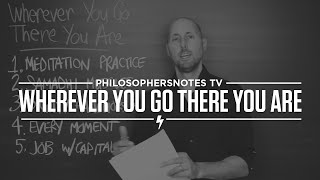
Brian Johnson breaks down Jon Kabat-Zinn's meditation book, explaining how to build attention through practice: sit with dignity, anchor to your breath, watch thoughts like a waterfall. Meditation thickens gray matter. Finding your "Job" means serving the universe by doing what you love.
Chapters
Hi, this is Brian. Welcome back to Philosopher's Notes tv. Today, another great book. Wherever you go, there you are. Two lines. First one with two lines. Wherever you go, there you are. Jon Kabat Zinn, one of the world's leading researchers, scientists, practitioners of meditation and mindfulness. His mindfulness based stress reduction has literally changed the world. We have him and his colleagues to thank for the influence of meditation and mindfulness in the Western world. So thank you, Jon Kabat Zinn. Lots of big ideas in this great book. I've got a bunch of them in the Philosopher's Note here we have five that we're going to look at in this short time together. Now, we'll start with number one, Meditation practice. Meditation practice. We're going to talk about a couple of practical ideas or a few practical ideas with meditation. And I'll link you to a video where I talked about why and how to meditate. But meditation practice, two words there. First, meditation. So what's interesting is apparently in Sanskrit there isn't even really a word for meditation per se. It's bhavana, which is cultivation. So what we're really doing when we meditate is cultivating what we're cultivating ourselves as human beings, and specifically cultivating our attention, our ability to train. We'll talk about the next big idea, our samadhi muscles, our ability to focus our attention, put it where we want, when we want to concentrate our mental energy. Meditation, then practice is the key word here, practice, which is what we talk about all the time, which implies showing up day in and day out. It's not about seeing if you're kind of sort of into it and then doing it when you feel like it. It's about saying, I am committed to this as a practice, as a way of being. I'm going to show up and see if I can get a little bit better day in and day out. That's the heart of meditation practice. Obviously there's a ton we can talk about there and we'll talk about a little bit more throughout. Next big idea, Samadhi muscles. Samadhi muscles. So I love this word, samadhi. So samadhi essentially means one pointedness, one pointedness. So being able to put our mind where we want to put it, when we want to put it, is essential. It's the hallmark of happy, healthy, flourishing human beings. The reality is, if you haven't noticed, you've got that little monkey swinging in your mind from thought to thought to thought to thought to thought to thought to thought. The happiest among us, either consciously or just by their own natural or kind of default abilities. Although most of us have practiced this, have the ability to be able to notice when their mind's going nuts and bring it back to a focal point. They can bring their mind to a one pointed attention and do what needs to get done and quit ruminating about all the negative stuff or getting anxious about the future stuff that they're stressed out about. And that's what we're doing when we meditate, is we're cultivating our ability to concentrate our one pointedness, our samadhi muscles. So think of it like this. Imagine Arnold Schwarzenegger to use an iconic bodybuilder. He worked on his body so much, and it was just so amazingly sculpted, because that's what he did. That's what he dedicated his life to in that phase of his life, right? And you can see it. You can see the physical results of the training that he put his body through. Well, someone like the Dalai Lama has done the exact same thing on their minds. We can't quite see it in his physical body, other than his smile and his countenance and his presence and his wisdom that is so deeply respected. Think of it like that. The Dalai Lama is jacked with his samadhi muscles. He has just sculpted his mind beautifully, perfectly to its highest potential. He's cultivated his samadhi muscles. That's what we want to do. And as we know, we talk about in all these notes on neuroscience, etc. Human, you can literally change your brain in a very similar way that you change your muscular structure. Got to show up and you have to hit the gym. You need to sit down and honor your meditation practice. You do that within a very short period of time, a matter of weeks. Scientists can bring your brain into a lab before you start meditating. And afterwards, and actually see your gray matter shifting, becoming denser, which allows you to step in between stimulus and response, maintain a better presence, less impulsivity, etc. Etc. Etc. Building our samadhi muscles is a big idea. So then let's talk about a few things that we can apply to our meditation practice now and again. We've got a video I'll link you to that goes into more detail. But let's just talk about a couple of things here. First question that people often ask is in general, and I get often asked this because meditation is a big part of my life, how do I sit? How do I sit? Jon Kabat Zinn has the best way I've ever heard to Help us get the right posture. You can sit in a chair. You can sit in a meditative position. You don't really want to lay down, you don't want to fall asleep. If you're committed to this type of meditation practice. I do a napitation during the day most days, but that's really a commitment to relax and to nap more than it is to meditate. So if you're going to meditate, you want to be in an upright posture, your spine nice and straight, et cetera. He uses one word. He says, sit with dignity. Sit with dignity. Right now, as you're watching this, if you're sitting, how would you sit if you were sitting with dignity, you wouldn't slouch over and be kind of lazy about it. And you also wouldn't be ramrod straight. You'd be dignified. You, you'd be present, you'd be powerful, you'd be regal, you'd have a certain level of dignity to you, which is a combination of being present yet relaxed. That's dignity. We want to sit with dignity. Really cool idea. Another little nuts and bolts stuff. Meditation wise. When you're practicing concentration meditation, which again is samadhi, and this one pointedness, you want to create an anchor. You want to bring an anchor into your mind and your consciousness that you can come back to. So if you're a ship out at sea and you want to quit drifting, what do you do? You throw an anchor overboard. The anchor lodges to the bottom of the sea and it keeps you fixed in one place. That's what you need to create in your meditation. You want to create an anchor. Throw an anchor over. Your anchor can be any number of different things that you come back to during your meditation when your mind inevitably wanders, right? So you can use your breath. That's the easiest, perhaps best way to anchor your attention. You're just watching your breath going in and going out. Your mind flitters away. Cool. Bring it back to your breath. No big deal. Bring it back to your breath. Going in, going out. That's your anchor. You can count one breath in, one breath out, two breaths in, two breaths out. There's another anchor. You can find a number of different ways to anchor your attention. Prayer, mind mantras, again, your breath, whatever. But you want to have an anchor. And when your mind wanders, you bring it back. Your mind wanders, you bring it back. It's just like going to the gym and doing another repetition, after another repetition, after another repetition, your mind will wander. And if you're doing your Practice. You will bring it back. That's how you cultivate your samadhi muscles. Again, we can talk about this a lot more. One other idea here is waterfalls. So think about waterfalls. And you have a choice. If you imagine a waterfall, right, the water's all cascading down. Now, usually you're here, ah, you're getting bombarded, or you're just getting crushed by this water. Your thoughts are just cascading in and you're not even able to stop them, right? The whole point of meditation is that you're able to kind of either sneak back here into a little cove in the waterfall, or maybe you swim. Here's the lagoon. You swim over to the bank and you're able to watch the waterfall from over here. You want to gain a perspective where you can see the water cascading down, the thoughts cascading down, but not be hammered by them. That's a big part of what meditation does for us, is we can observe our thoughts. We aren't being thrown around by them, or we're not caught in a stream, to use another water metaphor. And like a leaf that's just going down, we can be on the bank and watch the stream go. We can watch our thoughts go. So there's three quick little ideas. Dignity. It's a way to sit, anchor your attention and then remember the waterfall. You want to get out of it. When your mind gets cascaded down, which it will come back, observe it, bring yourself back to the anchor. Good stuff. That's for your actual meditation practice that you do for 5, 10, 15, 20, 30 minutes, whatever it is for you. Then we've got to remember that that's really just warm up for our lives. It's not about how we feel while we're meditating. It's about who we are throughout the rest of the day. Every single moment gives us an opportunity to meditate, to cultivate our sense of self and our being and our attention. All life is yoga. Aurobindo said, every single moment. God's kindergarten is how Orison Sweatt Marden put it, right? Show up every single moment and use each challenge, each opportunity. Reach challenge as an opportunity to grow. Big idea. And then the final big idea here we'll wrap this up is we want to discover our job with a capital J. Job. Capital J. What's your job? Jon Kabat Zinn shares a great story of Buckminster Fuller, who had experienced a bunch of challenges. Life wasn't going the way he wanted and he was actually thinking about killing himself. Not a good Place got to a place where he was literally, you know, serious about it. And then he just had this awakening in a moment of, this isn't what I'm going to do. And he decided that he was going to be an employee for the universe. Spaceship Earth was going to hire him. He was just going to do what he thought he could do to serve humanity. He created, looked for, and created his job with a capital J. Not a job where he's punching the clock, but how could he serve profoundly? And Jon Kabat Zinn challenges us. The whole point of this cultivation of ourselves via meditation and other practices is so that we can discover how to use our greatest gifts in greatest service to the world. So what's your job with a capital J? One way to arrive at that is to ask yourself, what do you love so much? What do you love to do so much that you would actually pay to do it? That's a good sign that you're onto something. And how do you figure out how to get paid to do that which you love so much that you would pay to do it? This is what I'm doing now. This is my whole thing of turning pro, moving away from kind of the entrepreneurial side, too. This is it. I love this so much. I love the opportunity to be in dialogue with people about ways to optimize their lives, actualize our potential. I literally would pay to be able to read all day long and to implement these ideas and to teach these ideas. Now, of course, the challenge, well, how do you integrate that into your life so you can get paid to do what you love so much you'd pay to do, but that's your job with a capital J. Everything that we're talking about in this is all about that. Now, that might mean something creatively for me. It not only means teaching, but also means being a great dad and a great husband and starting with my family. What is it for you? Think about that. Get excited about it. Be willing to put in the effort as a practice to discover this. Everything is a practice. And get on it. Meditation will be a huge guide for you to do that. Develop your samadhi muscles. Remember Arnold Schwarzenegger? The Dalai Lama's consciousness looks like that. Dignity anchors and waterfalls. Every moment is an opportunity to practice, and it all leads to us serving the universe, an employee at large. How can we give our greatest gifts and greatest service to the world? There you go. And remember, wherever you go, there you are. So let's be the best version of ourselves in each of those moments. Hope you enjoyed. Look forward to sharing more with you soon. Have another awesome day. See you.
More from Brian

Heroic +1: What’s THE Most Creative Act in the Universe?: Turning Around Glitches (#2024)









