PNTV: Why We Sleep by Matthew Walker (#392)
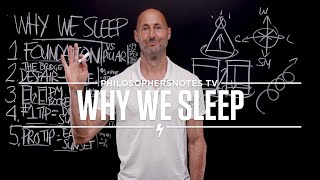
Brian Johnson breaks down Matthew Walker's research on sleep as a foundational health element. Walker's book reveals how sleep affects everything from memory to immune function, and Johnson explores why the Optimize Coach program prioritizes it above almost everything else.
Chapters
Hi, this is Brian. Welcome back to another Philosopher's Notes tv. Second one since we've been back. In our last session we covered Abraham Maslow's unpublished papers, a book called Future Visions. Hope you enjoyed that. We're going to have a streak of a hundred of these philosopher's notes TVs in a row, starting with my absolute favorite books over the last couple of years. So this book, I don't have it to hold up because it's still in boxes. We moved from Southern California, outside in the country, outside of Austin. I haven't unpacked all of our books yet, been busy. But imagine me holding up a book, why We Sleep. Matthew Walker, Philosopher's Notes. 6 page PDF, 20 minute MP3, check it out on the app, etc. Optimize Me apps or just go to optimize me to see all 600 philosopher's notes, etc. Etc. This book, why We Sleep. Matthew Walker, UC Berkeley, leading neuroscientist, one of the world's leading authorities on sleep. It's an amazing book. In fact, it's so good that with our coaches, we have the Optimize Coach program, right? Nearly 2,000 people from over 70 countries, 300 day program. Check it out. Optimize Me Coach, the one book that I say, hey, look, we obviously encourage them to read a lot of books and they need to read.
I think we have them read 101.
Of our philosopher's notes. We curate 100 of the best notes, right? But this is the one book. I say read this book if you're only going to read one book. As a master who wants to improve.
Your life, or as a master who.
Wants to become a coach and help others improve their lives, read this book, why We Sleep, why We Sleep. It is such a transformative book. And Matthew Walker makes the point, which is our first idea here, that sleep isn't a pillar of health. It's not eating, moving, sleeping. He says, no, no, no. You read the research on sleep and you realize, he says again, that 17,000 studies or something like that, that sleep is the foundation on which the pillars of eating and moving rest. So I always draw this, right? This is our hierarchy of needs, our adaptation of it for Optimize Maslow's idea, boom, you're going up, you're actualizing. I draw this circle to represent the foundation. You want to see how tall a building is going to be. Look at how deeply they're digging the foundation. Which is why we spend in our program for the coaches, three months on eating, moving, Sleeping, breathing, focusing, celebrating and prospering. Our seven fundamentals. But again, this is the very foundation. Sleep is the thing that kind of sits under all of it. Now, if you talk to a nutrition specialist, right, or a movement specialist, or even a breathing specialist, they're all going to say that their thing is the number one thing. But this is huge. Foundation versus pillar. Some stats. Matthew throws out a ton of stats. He tells us all animals sleep. Worms, chickens, fish, every animal sleeps. Evolution doesn't waste time. If it wasn't important, we wouldn't need to do it. Yet we have changed the way that we live in modern times. Obviously, we're going to talk about some of the ramifications. Millions of years, the only light at night was a faint moon or your firelight, and the only source of blue light was the sun. Millions of years. Let's go to the last hundred years. And even the last punctuated 10 years, smartphones, boom, emitting this blue light that's confusing our brains. We're staying up late. We're not getting the recommended seven to nine hours of sleep. And you've got to know that two thirds of us don't get the recommended seven to nine hours of sleep a night. And if you don't chronically get at least seven hours of sleep a night, you double your risk of cancer. Now, we talk about this a lot in our coach program, but the number of minutes or hours you spend in bed is not the number you need to pay attention to because you're not sleeping 100% of that time. You, if you wear something like an OURA ring, you know that you have an efficiency. 85% is actually considered very good. 90% is really good. Higher than that is just excellent. But you are definitely, if you're only spending six hours in bed, you're obviously not getting the recommended seven. But even if you're spending seven hours in bed, you got to do the math. Times it by 85% or 90%, how much sleep are you actually getting? And if you are less than that seven to nine hours of recommended, you need to know you're doubling your risk of getting cancer and all the other things that you don't want to have, from mood disorders to whatever you want to fill in the blank on, on that. Now, if you think you are one of the people on the planet who's got a genetic mutation that allows you to get by on the less than recommended seven to nine hours of sleep, Matthew makes the playful point that your odds of being struck by lightning, which is 1 in 12,000 in your lifetime is actually much greater than your odds of being the rare genetic person that can get by on the less than the seven, nine hours of sleep. I think that's pretty funny. So he says if you round down the percentage chance that you are the one lucky one that can get by on less sleep to the nearest whole integer, the likelihood is 0%. Sleep matters now, unfortunately, he says that we have a baseline resetting such that when we don't get enough sleep, we don't realize that we're not getting enough sleep. Seneca says the worse a person is, the less he or she feels it. The worse you are, the less you feel it. Matthew echoes that in modern terms with sleep. The more sleep deprived you are, the less aware of just how sleep deprived you are. You've reset your baseline. You're used to being tired all day, every day. But. But what would happen if you got a good night of sleep consistently? You'd actualize your potential a heck of a lot more. Which is why, again, in our program, we'll talk about some of the tips that we share. We emphasize sleep again and again, and it changes people's lives. One other stat, he says that sometimes if he gives a presentation, he can make people not want to get out of bed in the morning because they're so stressed out about the sleep or lack of sleep. But he says one stat often does the trick. He shares this one. A billion people participate in a study twice a year. Don't even know you're doing it. A billion people. When time changes, daylight savings time, right? We spring forward and then we fall back. When we spring forward, we effectively lose an hour of sleep. So he says you have a billion people going through a study losing an hour of sleep, basically. And researchers have actually looked at hospital logs, entries, right, and have seen a rise in heart attacks that day. With one hour less of sleep, boom. Heart attacks will go up significantly, he says. It's just astonishing. And traffic accidents will also go up on that day. The time changes and we all got an hour less sleep for most of us anyway. And then the opposite happens when we get an extra hour of bonus sleep when the time falls back. Astonishing stuff. Sleep matters. It is the foundation, not even the pillar of our well being. That's our first idea. That was fun. The second one is an idea that we come back to again and again and again in our work at Optimize as well. He quotes an American entrepreneur who says that a good night of sleep is like a bridge from despair to hope. Imagine that you get a good night of sleep. Dis despair to hope. You don't get a good night of sleep. Hope to despair. The bridge goes both ways. And I often share that. My number one self care habit, the thing that I just got to take care of if I want to feel great in any given day is get a good night of sleep, right? And if I don't get at least seven hours of sleep, I just feel just different. Seven and a half last night, I'm feeling great. I like eight hours of sleep. That's even. Oof, let's go. But seven and a half does the trick, even over seven. But if I'm teetering down toward, you know, six and a half, which I very rarely do, I literally can't see the world in the same way. I can't quite feel the same hope and the same power. And I'm a pretty hopeful guy. I'm a very hopeful guy. But if your physiology is not right, your psychology will not be right. And again, sleep is the bridge. A good night of sleep is the bridge between despair and hope. And in our last session with Maslow, we talked about the Jonah complex, right, of actually living your heroic journey. And he said that the difference between those who do it and those who don't is the difference between courage and fear. You need to have the willingness to act in the presence of fear. I walked through our little wisdom compass, right? And I talked about the cardinal virtues we had. Wisdom, self mastery, courage and love. Now, I mentioned that we had some sub virtues here as well. So the sub virtues in our little compass are, are the virtues that science says are the most highly correlated to your flourishing. And again, the whole positive psychology movement. When they started that, they looked at every ancient wisdom tradition from Judaism and Christianity and Islam to Taoism and Confucianism and the classic Greek philosophers and Hinduism, all across the spectrum. And what they found was they all came back to the same constellation of virtues.
They found six of them.
We talk about four in their essence, right? Then as they've studied what virtues and they've broken their 6 into like 24 longer chat that we have in our mastery series. But for now, I ask you, what do you think is the number one virtue most highly correlated with your flourishing, with your well being? When I asked this, I'll give you a moment. When I asked this, at our coach graduation, first class had 1,000 people. Over 500 of them, I think 600 came out to LA to graduate. We all did a Spartan race together. It was awesome. Now I think it was on the morning I gave a little pep talk lecture before we all did the Spartan race. Second largest team in history. Epic. I said, hey, do you guys know what the top two strengths are? One woman knew who had gone through the Masters of Applied Positive Psychology program at the University of Pennsylvania. Awesome optimized, coach. We'll leave it at that for now. She knew that the top two virtues are zest and hope. The number one virtue most highly correlated with your flourishing is zest. Kind of a goofy word for your energy. Which is why we spend so much time getting your energy right, so you can show up powerfully in your work and love. And guess what? Sleep is the number one way to boost your energy. Which is why a good night of sleep moves you from despair to hope, which, oh, by the way, hope is the second most powerful virtue most highly correlated with your well being. Psychologists arm wrestle between hope and gratitude. Those are the top three. Zest, hope, gratitude, then curiosity and love round out the top five most robust scientifically proven to boost your well being. Right? But zest and hope both are connected to our sleep, which is why we want to pay attention to that. We can talk about that for a while longer. We'll leave it at that for now. Practically speaking, what do we do about that? Right. Well, the number one tip that Matthew offers and all sleep scientists offer is have a consistent PM routine, a ritual. We call that a PM bookend, right? This is literally the number one tip. Go to bed basically at the same time every night and have a ritual that you do to allow yourself to prepare for a good night of sleep. We call that our PM bookend. So imagine you were drawing a day, right? Let me draw that a little bigger. Here's your day, right? Now. You think your day starts in the.
Morning.
One way it does, but we say, no, no, no. Here's your day in the morning. And you want to really make the connection to the fact that your day started the night before. Because if you don't have a good PM bookend a good nighttime routine. Shutdown complete, you're done with work. Turn off the electronics. We'll talk about that in a moment. Then guess what? You're going to get a bad night of sleep. Less than the seven to nine. And how do you feel when you get a bad night of sleep? You're tossing and turning. You can't turn your brain off as you hit the pillow because you've been blowing it up all day long. We're going to talk about this in digital minimalism. Cal Newport's book Getting energized Tranquility rather than enervated anxiety. Of course you can't fall asleep. You were blowing yourself up with stimulation all day and then all night. And you wake up in the middle of the night and your brain's buzzing again. Of course it is. We got to discipline ourselves to turn our brains off. But anyway, if you don't get a good night of sleep, how are you going to feel the next morning? And then how's that going to dictate the rest of your day? PM bookend. Your PM creates the next day's AM and then you want to see that your PM actually counts twice. Any given day actually has two PMs. If you look at it this way, the night before and then tonight. So you want to get your PM bookend dialed in. So I ask you, how's your PM bookend? When do you end your workday? When do you turn off your electronics? When do you go to sleep?
Are you giving yourself adequate time to.
Wake up, ideally without an alarm, feeling refreshed? I think the last PNTV I did before I took a break was on Arianna Huffington's Sleep Revolution, which is perfect. She says the word alarm literally means, like, emergency. So you're waking up to an emergency every morning. Really? That's a great way to set the tone on your fight or flight. Sympathetic nervous system. Why don't you go to bed early enough, turn off all the electronics, all the unnecessary stimulation and entertainment and news and last check of email, decide you want to wake up feeling great and feeling hopeful without an alarm, naturally energized. That's what we want to do. And the way we do that, the number one tip that we encourage our coaches to follow in all of our optimizers and we actually hold them to this standard. To be an optimized certified coach, you've actually got to practice certain things because we want to help them move from theory to practice to mastery. So one of the things that they need to do if they want to be a certified optimized coach is turn off their electronics one hour before their bedtime. 90% of people in the US don't do that. And again, it's no measure of health to be well adjusted to a profoundly sick society. We want to know that when we're looking at screens and that blue light is coming into our brains, our brains do not know what to do with that because the only source of that type of light until very recently was, as I said, the sun. Ah, must be daytime. Let's go. Cortisol levels stay up. Melatonin levels don't drop. Even reading on an iPad, which we talk about in the note versus a book, will make a difference in how much your melatonin is released and how easily you fall asleep. Those bright screens are not helping the cause. Put them away. If you want to go all in, get the blue light blocking glasses. We have orange lights all around our house. We never turn on bright lights at night. Going to bed early so we can wake up feeling refreshed. It's like a sport at the Johnson House. You ask our, you know, three and seven year old kids why we don't have bright lights on, they'll tell you it messes up your melatonin. This isn't complicated, but we got to make the connection and see that this PM is driving our am. And we can make some very simple changes here that can literally change our lives. Literally that one hour of sleep, less heart attacks, less traffic accidents, more hope, et cetera, et cetera. Now that's the number one basic tip. The number one pro tip if you want to go all in is don't just have a digital sunset, which is when you turn off all your electronics, have an eating sunset. We talk about this in a range of contexts. The longevity paradox by Dr. Gundry will be a note that we feature soon. In one of these episodes they tell us researchers in this domain looking at the connection between when you eat and how you sleep tell us that your body has a lymphatic system, your brain has a glymphatic system. It's kind of like your lymph, but only in your brain. It's like the cleanup crew, right? They take out the garbage, they recycle stuff, et cetera, glymph system. Now, your glymphatic system can't work if your body's spending all of its energy digesting food, which is a very energy intensive process, which is why researchers say eat at least two hours before you go to bed. I kind of knew that rule before and frankly, this is one of the last things I mastered. I used to eat a little bit too late because I didn't take it that seriously. Then I read the Longevity Paradox and this book, and he doesn't go into this much detail on it in this note, but sold me on the importance of sleep. And the two together made me test eating my last meal at least four hours before I went to sleep. At least four hours. Now when I heard that, I thought that was absurd. Seriously, like really four Hours, that's crazy. If I go to bed at like 9, I got to eat by 5. If I go to bed at 8:30, I gotta eat it by 4:30. That's kind of crazy, really. Yeah, I tested it. OURA ring data came back. And I talk about how I ritualize my habits a lot in the new video series called the Number Ones. Every morning I look at my aura data and hopefully whether you have an OURA ring or anything else, you can get something out of it. But I'm always trying to improve. I'm always spiraling up, seeing what's working, what needs work, what am I going to do differently today. I'm always going through that process. So I look at my data on my OURA ring, which tells me things like my resting heart rate overnight, my heart rate variability, which is a measure of your parasympathetic nervous system, the opposite of fight or flight. How basically it's a very key measure to your well being, your recovery. And then they give great data on that. And then they give, you know, kind of. We're still working on a data on the amount of REM sleep you got, deep work sleep you got, et cetera, but I love to use it for all of that. And when I started eating, having an eating sunset, four hours before I went to bed, my resting heart rate dropped significantly, like 10, 15%. My heart rate variability exploded up like 30%. And it's just been astonishing. So there's one of those things that just makes the hugest difference. I went from like 50, 48 resting heart rate, which was surprising because I could bring it down lower than that during the day to a 40. My resting heart rate last night the lowest point was 40, the average was 42. And this is one of the key levers. It's incredible. And then my heart rate variability did the same thing. It went up 30%. It's now gone up even more as I've stacked different things. Now it's over 70 as measured by the aura, blah blah blah. Anyway, eating sunsets, this is a surprisingly big idea. So when do you eat your last meal if you're going to go to bed? Well, just tell me, think about it. When do you eat your last meal and then when do you go to bed? And how long of a window is there there? One hour, two hours? Can you get it to three hours or four hours? And know this too. You want to have at least a 14 hour window, at least a 14 hour window between your last meal and your first meal the next day or you're going to increase your risk of cancer and other stuff. The data on this is, is nascent but powerful. And if you can't go that long without eating, that means you have some metabolic inflexibility and we got to deal with that. We're going to talk about some optimized food rules, getting rid of sugar, factory processed food, et cetera. And then this is one of our main food rules is in eating sunset, giving yourself the night off. We playfully say so eating sunsets, digital sunsets. Same question. How long before you intend to go to bed do you turn off your electronics? It's a very, very powerful idea. Life changing for getting a good night of sleep via a good bookend so you can move from despair to hope. Not be in the group of people that ignore this fundamental foundation of our well being. Two thirds don't get the recommended seven, nine hours of sleep and they double the risk of cancer. Where do you fall on that and what can you do today to get a little better? Get on that. Make today and tonight awesome. See you soon.
Hey guys, this is Bry. Hope you enjoyed that video. We have a lot of people ask us what Optimize is all about. So I just wanted to give you a super quick tour of our site, tell you what we do. We do two primary things. We have an optimized core membership and and we have an optimized coach certification program for people that want to go from theory to practice to mastery. So the core membership is basically 10 bucks a month depending on whether you do monthly or annual. And you get instant access to over 500 philosopher's notes, the six page PDF, you know, 25 minute or so MP3 recordings of these great books. And then you get over a thousand optimized plus ones, 50 optimal living 101 masterclasses, et cetera. And we have a free trial the team set up, get it free for 14 days and then go from there.
If you like it.
So we're blessed to have a lot of people who subscribe to this, including some of my friends who happen to be some world class peak performance gurus like Tal Ben Shahar, who taught the two of the largest classes in Harvard's history. Starts every day with Optimize. Ben Greenfield friend and coach optimizes bar none. My go to source for taking a deep efficient dive into some of the world's best books via the Philosopher's Notes. It's an indispensable resource. Thank you Ben. Marcy Shimoff loves Philosopher's Notes. Mark Devine Retired US Navy SEAL commander, dear friend who starts his days with Optimized plus one winning win in the mind routine to charge him up for the day's battle. If you're serious about leading heroically, I recommend you use them too.
Huya. Thank you.
And 10,000 plus other awesome humans around the world. That's the core membership.
Then we have, and I should say we have apps. Excuse me, you can get apps.
IOS and Android. You know, we're feel pretty proud and blessed to have basically a 4.9 ranking and people saying some great things. You can check that at Optimize Me Apps. And then our coach program is all about helping you master yourself so you can serve heroically, so you can empower others to do the same. We have trained over a thousand optimized coaches from over 50 countries and yeah, really excited about this. This is one of the core levers for us to fulfill our mission to change the world one person at a time together starting with you and us today. We've been told that here's one little thought and we have hundreds of testimonials you can check out about how it's transformed people's lives. And if you want to be a coach, you're coaching practice now. Half the people who do this want to be coaches. The other half just want to master their lives. But Barb, a coach of ours, says I already had two coaching certifications but Optimize Coach was indisputably the most valuable I have taken. Thank you, Barb. Honored to be part of your life. You can learn more about what we're doing with Optimize Coach at Optimize Me Coach. There you go. Hope you're doing great. Look forward to sharing more with you soon. Have an awesome day. See ya.
More from Brian

Heroic +1: What’s THE Most Creative Act in the Universe?: Turning Around Glitches (#2024)









